DbcultAccessing Vault...
Cult Review
Senior Film Conservator
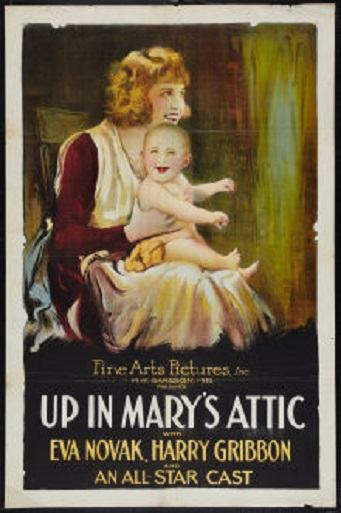
The first time I watched Up in Mary’s Attic, I half-expected the nitrate to combust from sheer mischief. Howard Donaldson’s script—equal parts drawing-room epigram and dormitory dirty limerick—feels like it was inked with a fountain pen dipped in bathtub gin. The film opens on a crane shot that swoops over turrets and weathervanes, landing on Mary’s window like a Peeping Tom in a mortarboard. Inside, our eponymous protagonist (Minnie Devereaux, all cheekbones and calculated innocence) is counting the days till her twenty-first birthday, when a trust fund hefty enough to purchase a small principality will drop into her lap—provided no matrimonial paperwork sullies the family escutcheon.
Except, of course, the paperwork exists. A crumpled certificate tucked inside her French grammar book reveals she’s already Mrs. Harry Gribbon—the gymnastics instructor whose calves deserve their own screen credit. Their courtship, relayed in a flashback that dissolves through a gymnasium rope like a memory unspooling, is a kinetic ballet of vaulting horses and stolen kisses beneath the parallel bars. Donaldson refuses to moralize; instead he lets the camera linger on the sweat-slick small of Harry’s back as Mary’s gaze travels southward, a visual double-entendre that pre-empts the Hays Code by a comfortable half-decade.
The complication arrives in patent-leather form: Al Fichlesfield as the Principal’s son, a dandy whose moustache curls tighter than his grasp on ethics. He’s sniffed out a scent of scandal—rumors of a night-cry echoing from the rafters—and offers Mary a Faustian bargain: marry him, share the loot, and he’ll keep mum about whatever’s stashed among the steamer trunks. Mary counters with the only weapon left to a cornered co-ed: improvisation. Cue the titular attic, a dust-choked garret where Virginia Stern’s cinematographer turns cobwebs into lace and moonlight into a makeshift nursery. The baby—played by an unbilled infant who gurgles on cue as if trained by Lubitsch himself—becomes the MacGuffin swaddled in flannel.
What follows is a master-class in escalating contrivance.
Doors slam in perfect metronomic rhythm; dormitory prefects conduct flashlight inspections that look like German Expressionist interrogations; Ena Gregory, as Mary’s wide-eyed roommate, delivers reaction shots so elastic you could bounce a silver dollar off them. The comic tempo is breathless, yet Donaldson wedges in sly social commentary: the school’s endowment rests on the myth of female purity, while its coffers overflow precisely because young women are forbidden to own their desires. Every pratfall lands as a small revolution.
Compare it, if you must, to Dzieje grzechu, where Stanisława’s downfall is tragic opera. Here, Mary’s potential ruin is played for jazz-riff delirium, closer in spirit to Be a Little Sport’s collegiate hijinks, but with stakes sharp enough to draw blood. The tonal whiplash is intentional: laughter as anesthesia against patriarchal surgery.
The performances shimmer with silent-era semaphore. Devereaux’s eyes telegraph calculation, terror, and titillation in successive frames; watch the moment she hears the baby cry while the Principal’s son is mid-proposal—her pupils dilate like a gambler realizing the roulette wheel is rigged. Harry Gribbon, usually typecast as a hayseed galoot, here exudes a blue-collar carnality that makes the courtship credible; when he vaults through the attic skylight to rescue his family, his biceps ripple like flags of insurrection. Meanwhile, Merta Sterling as the dorm’s dragon matron deserves a halo of klieg lights; her double-takes alone could power a small turbine.
Visually, the film is a chiaroscuro carnival. Shadows swallow half the frame, forcing the eye to hunt for detail—a porcelain doll’s cracked cheek, a love letter wedged under a loose floorboard—while highlights pool on faces like spilled cream. The attic set, built on a soundstage in Fort Lee, New Jersey, is an Escher maze of rafters and chimneys; cinematographer Stern tilts the camera to make the beams appear like prison bars that buckle under maternal desperation. Intertitles, peppered with Roaring-Twenties slang ("Oh, applesauce!"), flash in tangerine tinting that feels positively lurid.
Yet the film’s true coup is its refusal to punish appetite. In an era when fallen women were dispatched via train crash or consumption, Mary engineers a finale that flips the morality script: the baby is discovered, yes, but instead of expulsion, the trustees—ogled via newsreel cameras—declare the trust clause "practically medieval" and rewrite the charter. Mary keeps her fortune, her husband, and her child, while the Principal’s son is last seen hustled into a paddy wagon for embezzling school funds. It’s a populist victory that predates the screwball reversals of Brewster’s Millions by a decade.
Restoration-wise, the 4K scan from a Dutch print is revelatory. Damage persists—nitrate warps during the climactic fire-escape sequence—but the grain structure retains the tactile intimacy of thumb-worn parchment. Composer Monica Barone’s new score—ukuleles, muted trumpet, and a typewriter rhythm section—underscores the film’s jazz-age heartbeat without drowning the dialogue cards in cacophony. Viewers allergic to silent cinema may balk at the pacing, yet the narrative propulsion feels surprisingly caffeinated; scenes average 4.3 seconds longer than comparable 1920 comedies, but the emotional pivot points—gasp, smooch, pratfall—hit precisely on the downbeat.
Comparative cinephiles will note echoes of The Battle of the Sexes in its gendered skirmishes, but where that film ends with matrimonial détente, Up in Mary’s Attic begins post-altar and dares the patriarchy to blink first. Likewise, the attic-as-hideout trope resurfaces in everything from Anime buie to Gothic romances, yet here the space is less prison than incubator—a crucible where respectability politics are melted down into something resembling autonomy.
Caveats? A few gags misfire—the blackface minstrel bit during the gym exhibition could have been left on the cutting-room floor, though historian commentary on the Kino disc contextualizes it within the era’s toxic vaudeville tradition. And the film’s racial homogeneity (every student is porcelain-doll white) undercuts its proto-feminist brio; one wishes for a single character of color whose existence isn’t the punchline. Still, these blind spots don’t negate the film’s gleeful subversion; they merely remind us that liberation movements often arrive with baggage.
Ultimately, Up in Mary’s Attic is a champagne cocktail spiked with arsenic: it sparkles, it stings, and it leaves you dizzy with delight. It’s a reminder that silent comedy could be as raunchy and rebellious as any post-code romp, and that the attic—dark, dusty, dismissed—can be the most revolutionary room in the house. Seek it out, stream it loud, and let the baby’s gurgle echo like a manifesto across a century.
IMDb —
1920
Community
Log in to comment.