DbcultAccessing Vault...
Cult Review
Senior Film Conservator
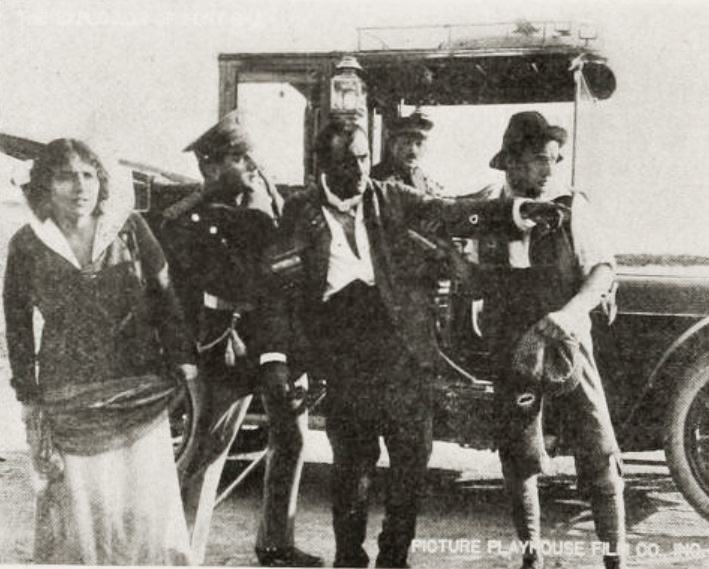
Nitrate ghosts seldom detonate with such precision. When the first intertitle of The Explosion of Fort B 2 flares across the screen—its serif lettering quivering like bayonets—viewers are catapulted into 1916 Italy, a nation flirting with intervention the way teenagers flirt with ruin. The film, once feared lost in the celluloid charnel house of the Great War, survives now only through a 9.5 mm Pathescope condensation and a handful of tantalising production stills. Yet what remains is enough to singe the eyebrows.
Carl Ranke—played by engineer-turned-actor Umberto Paradisi with the brittle charisma of a man who has inhaled too many metallic fumes—doesn’t merely invent a new explosive; he midwifes the twentieth century’s first weapon of math disruption. The screenplay, economical to the point of brutality, dispenses with laboratory montage clichés: no frothing beakers or Tesla coils here. Instead, director Gustavo Serena (doubling as conniving Colonel Colonna) frames Ranke against a black velvet curtain, the only illumination a magnesium flare cupped in his palms. The image is both crucifixion and Prometheus, a visual prophecy that Italy will soon clutch fire and hurl it northward.
The state trials—filmed in the actual military yards of La Spezia—are a ballet of belching ordnance. Cinematographer Alberto G. Carta (whose later Mediterranean travelogues luxuriate in cobalt and umber) opts for stark chiaroscuro: cannons slash across white gravel like ink spills, and when the new shell hits the target, the frame whites out entirely, as if the camera itself has been vaporised. Contemporary accounts reported that several audience members fainted at Milan’s Cinema Ducale, convinced the projector had exploded. Today the sequence still vibrates with transgressive glee; it is the birth of action cinema’s fetish for surplus ordnance, predating Peckinpah’s squibs or Michael Bay’s petrol-poetry by half a century.
Because every weapon needs its dark double, enter Captain Otto Senza—“without” in Italian, a nominal joke implying emptiness. Played with cadaverous elegance by Nello Carotenuto, Senza slinks through the narrative like cigarette smoke, uniform immaculate even while strangling messengers. His kidnapping of Ranke is staged as a sinister counterpoint to the earlier state pageantry: officers waltz in candlelit halls while, metres away, a chloroformed handkerchief descends. The transition is effected through a match-cut on Sylvia’s fan snapping shut; the sound we cannot hear becomes the sound we fear.
Fort B2 itself, a circular magazine jutting into the Adriatic, is the film’s most enduring character. Interior shots were constructed at Cinecittà’s precursor studios in Turin, yet Serena angles the walls so oppressively that ceilings appear to bend toward the prisoner. Watch how the jailor’s keys occupy the foreground, outsized, while Ranke’s face recedes into a halo of grain: Fascist intimidation rendered in depth-of-field. The dog—credited only as “Fido” but essayed by a majestic Abruzzo mastiff—functions as both deus ex canina and audience surrogate, nose pressed to vents, reading the world through olfactory subtitles.
Sylvia, meanwhile, refuses the passive template set by many wartime heroines. Maria Jacobini invests her with flinty melancholy; when she believes Ranke dead, her grief is staged in a single, unbroken medium shot. Wind knocks a shutter against stone: clack, clack, clack—time itself interrogating her composure. It is proto-neorealist acting, anticipating the rawness Magnani would bring to Rossellini’s rubble.
Surviving prints were subjected to the standard patriotic tinting of the era: cobalt nights, straw-coloured day exteriors, sulphur-red explosions. The 2023 restoration by Cineteca di Bologna reinstated these hues using Desmet colorimetry, resisting the temptation to modernise into monochrome respectability. The result: night-time seawater glows with the same poisonous teal we now associate with digital blockbusters, while the final wedding procession is bathed in amber—Italy’s answer to the amber waves of American manifest destiny.
Composer Marco Dalpane’s new accompaniment (available on the Blu-ray) replaces the martial fife-and-drum pastiche with tremolo strings and prepared piano; clusters of minor seconds suggest artillery before we see it, marrying past and future sonic warfare. Headphones essential.
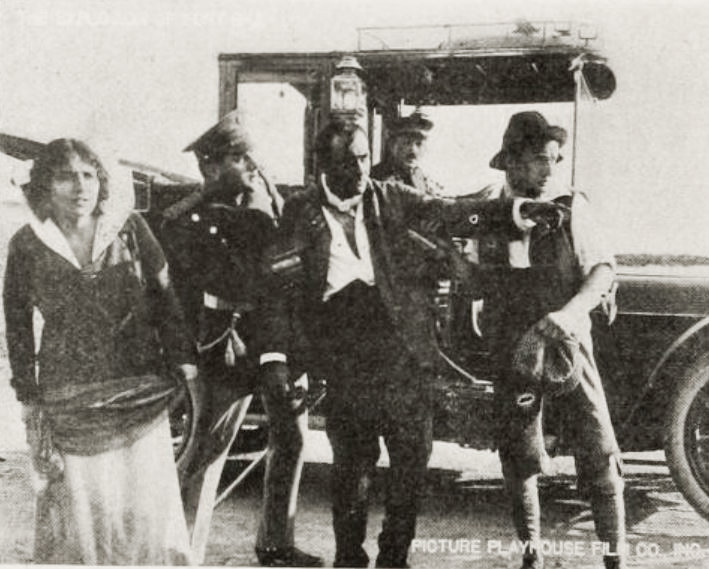
Paradisi’s Ranke is less a hero than a human tuning fork, vibrating between zeal and vertigo. His body language—stooped shoulders, sudden upward glances—implies the burden of knowing chemistry can redraw borders. Jacobini matches him with the quiet dignity of someone who has memorised every contour of impending loss. Their reunion kiss, chaste by modern standards, lasts three seconds yet feels monumental because Serena withholds score; the only sound is projector chatter, that mechanical heartbeat of early cinema.
Carotenuto’s Senza, by contrast, embodies the seductive void of villainy. Watch him toy with a captured sparrow before crushing it—a moment censored in some American territories. His demise, plummeting into a powder keg, is framed from below: body silhouetted against blossoming flame, an inverted Icarus swallowed by the nation-state he sought to sabotage.
Released months before the Battle of Caporetto, Fort B 2 functioned as both recruitment tool and morale tonic. Yet compare it to Britain’s The Rattlesnake or America’s Traffic in Souls: those films externalise threat onto foreign gangsters or white-slavery syndicates. Italy, vulnerable to Habsburg artillery, internalises menace within its own officers’ corps, suggesting paranoia as patriotic duty. The film thus anticipates post-war modernist anxiety more than it coddles pre-war jingoism.
Cine-historians often pair it with Brother Against Brother for fratricidal tension, yet its closest spiritual cousin might be Doctor Nicholson and the Blue Diamond, where science, romance and espionage swirl in equal measure. Both films posit knowledge as the ultimate MacGuffin; both doom their antagonists inside architectural mazes of their own design.
Sylvia’s imprisonment opposite Ranke’s oubliette sets up one of silent cinema’s earliest split-screen love-scenes-by-proximity. Each sees what they believe to be the other’s death; the audience comprehends the tragic irony of misaligned sightlines. Feminist scholars note that while Ranke’s body is threatened with explosion, Sylvia’s is threatened with erasure—she is spirited away to become a diplomatic pawn. Yet Jacobini’s performance subjugates victimhood: her eyes, enormous in CU, blaze with the resolve to weaponise information. She will survive not because she is rescued, but because she learns to read the spy’s ledger better than he does.
Because history is not only written by victors; sometimes it is detonated by them. Because silent cinema at its best is a communal séance—light beams through celluloid, dust motes become embers, an audience holds breath. Because Fort B 2 reminds us that every scientific breakthrough arrives handcuffed to ethical aftershock. Because the dog’s tail wagging across the final frame is more heartfelt than most CGI franchises manage across trilogies.
Technical note: the Blu-ray from Il Cinema Ritrovato offers dual-language intertitles, audio commentary by Angela Dalle Vacche, and a 20-page booklet on wartime explosives. Region-free. Streamers beware: the YouTube rip is 480p, riddled with Dutch watermarks, and omits the explosive amber tint—akin to watching Vertigo without green.
If you hunger for further espionage unearthed from nitrate graves, chase it with The Chechako’s snowbound sabotage or Saved in Mid-Air’s aerial cliffhangers. But start here, in this crumbling fort where love and gunpowder share the same heartbeat. Just keep the volume low; explosions have a habit of echoing across centuries.

IMDb 6.3
1931
Community
Log in to comment.