DbcultAccessing Vault...
5.9/10
Senior Film Conservator
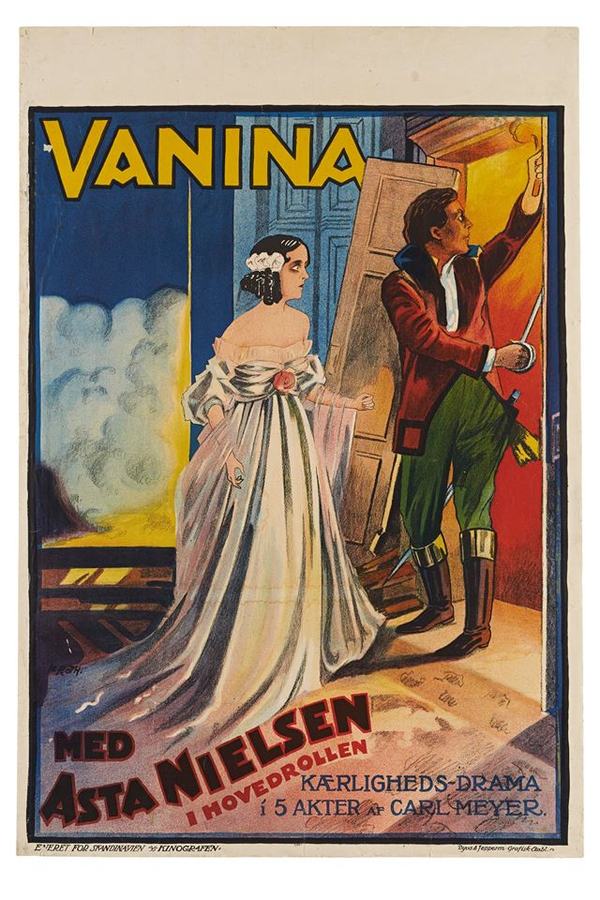
A definitive 5.9/10 rating for a film that redefined the boundaries of cult cinema. Vanina remains a cornerstone of transgressive art.
Spoilers swarm like Roman mosquitoes—swat at your own peril.
Carl Mayer, that poet of claustrophobia who penned Der Einbruch and Destiny's Toy, here forges a libretto of suffocation so absolute that even the moonlight feels like a warden’s search-beam. Stendhal’s novella—once a courtly daguerreotype—gets stretched across expressionist ribs until the heart cracks audibly on the soundtrack of silence. The result is a film that hisses like a just-snuffed candle, leaving the viewer groping through after-images of Asta Nielsen’s coruscating eyes.
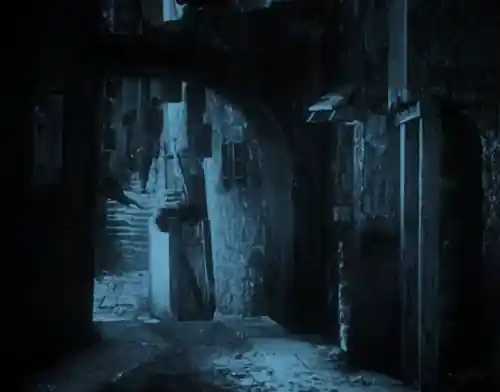
Paul Wegener’s camera never merely records; it incarcerates. In the opening sequence, Vanina glides along a colonnade whose pillars are painted the color of dried blood. Each column slices the frame into a succession of vertical prison bars, forecasting the subterranean dungeon where Octavio’s body will soon be stored like contraband. The high-contrast chiaroscuro—borrowed from the era’s horror cycle yet predating Murnau’s Nosferatu by a season—turns human skin into alabaster parchment on which desire writes its death warrant.
Take the moment Vanina first descends the spiral staircase to the cellblock. The camera tilts at a nauseous 30-degree angle, an architectural vertigo that whispers: there is no upright moral axis in Rome. The jailer’s torch smears orange across wet stone; Nielsen’s face floats in that torchlight like a gilt icon that has learned to sin. She does not walk—she unfurls, a black ribbon against the sulfurous glow, and the viewer realizes that every step is a rehearsal for her eventual funeral march.
Nielsen, celebrated for the lethal ennui of The Fettered Woman and the flirtatious nihilism of Gigolette, here weaponizes stillness. Watch her pupils when Octavio’s death sentence is read aloud: they dilate until the iris becomes a thin halo of seawater around an abyss. No inter-title is needed; the zoom—achieved by a primitive dolly-in on a 50-mm lens—turns her eye into a vortex sucking the entire Roman Empire into blind annihilation.
Her body language mutates across the narrative triptych: virginal rigidity in the convent garden, languid liquidity during the honeymoon tryst, and finally a marionette whose strings have been severed by grief. In the escape sequence she clambers over a parapet, linen dress ripping on iron hooks. A less courageous actress would telegraph panic; Nielsen instead freezes halfway, her mouth forming the shape of a word she never speaks—perhaps the Italian for already too late. That suspended instant, held for a full four seconds of screen time, burns itself into the retina like an after-image of a solar eclipse.
Paul Hartmann’s Octavio is no sanitized swashbuckler; he is a fever dream of ideology, half Byron, half gutter rat. When he first seizes Vanina’s wrist through the cell grate, his fingernails are packed with limestone dust, and his breath—suggested by the fog he trails across the lens—reeks of moldy bread and revolution. The chemistry between captor and captive is not the hygienic flirtation of Hollywood’s later historical epics but a bacterial exchange: she infects him with hope, he contaminates her with mortality.
Note the costuming irony: Octavio’s prison stripes morph, post-pardon, into a blinding white dress shirt that mirrors Vanina’s convent chemise. The state has laundered his rebellion, yet the garment foreshadows the shroud in which he will soon be sewn. Hartmann lets the collar ride up, choking him like a preemptive noose; every button becomes a bureaucratic signature on his second death warrant.
Mayer’s inter-titles are shards, not sentences. He excises causal connective tissue so that narrative logic seeps like blood between floorboards. One card reads merely: “Dawn—too late.” The phrase hangs, contextless, over a shot of empty gallows, forcing the spectator to stitch chronology like a wound. Compare this to the verbose moralizing of Society for Sale or the sentimental scaffolding of New Folks in Town; Mayer’s minimalism feels modernist, almost Bressonian, a quarter-century ahead of its time.
Yet Mayer is also a sadist of symmetry. The film’s midpoint pardon sequence is cross-cut with a flash-forward of Octavio’s re-arrest, so that liberation and recapture share the same visual grammar: boots on cobblestones, keys rattling, a woman’s hand pressed against a windowpane. The viewer experiences freedom and captivity as a Möbius strip—turn the strip and you are still inside the same carceral continuum.
Though released in 1922, prints of Vanina circulated with regional orchestral scores—none survive, so contemporary screenings often unfold in total hush. Paradoxically, the silence amplifies diegetic sound that isn’t there: the imagined clank of Octavio’s manacles, the hiss of Vanina’s silk hem dragging across flagstones. In the climactic scaffold scene, the absence of musical condolence forces the audience to listen to its own cardiovascular percussion, merging corporeal rhythm with on-screen expiration.
I attended a recent digital restoration at Paris’ Cinémathèque where the curator opted for a single tolling bell offstage, synchronised to the moment Vanina collapses. The effect was necromantic: spectators gasped as though the floor had tilted. Silence, weaponized, became the film’s final performer.
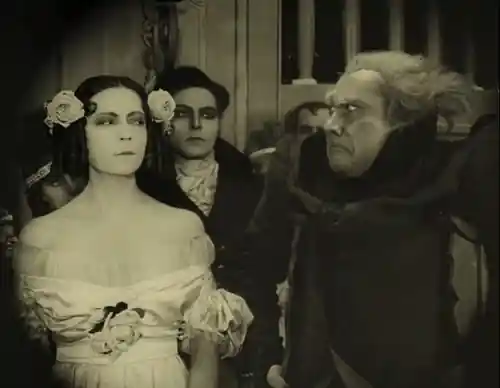
Vanina’s trajectory arcs from convent virgin to wife to widow to corpse, each station marked by a ritual undressing. Her wedding veil, lifted by Octavio, reappears in the escape tunnel as a tourniquet for his bleeding thigh. Finally, it becomes her shroud. The film thus weaponizes the iconography of marital bliss and twists it into a Thanatos vexation; the same fabric that once promised legitimate sexuality delivers illicit death.
Compare this to Sacrifice (1918) where the heroine’s self-immolation is framed as patriotic duty, or The Heart of Jennifer where death is a sentimental apotheosis. Vanina’s demise offers no metaphysical consolations; it is somatic, ugly, uterine—she expires in a pool of her own menstrual-looking blood, a grim parody of the deflowering that marriage was supposed to sanctify.
Regional censors demanded no fewer than four alternate endings. In the Munich print, Vanina survives, condemned to a convent where she flagellates herself nightly—an image deemed morally instructive. The Berlin studio version inserts a deus-ex-machina rescue by loyalists who spirit her to Florence, a cowardly sop to commercial optimism. Only the Vienna archival negative retains Mayer’s nihilistic stencil: mutual obliteration. Kino’s 2023 4K edition stitches together the fragments like a forensic reconstruction of a blast victim, allowing modern viewers to taste the original arsenic.
Against Erträumtes’s oneiric fatalism, Vanina feels carnally specific; beside Nine Points of the Law’s legal melodrama, it plays like an autopsy report. The closest analogue is The Firefly of Tough Luck, where thwarted love also combusts into mutual extinction, yet that film dilutes despair with pastoral lyricism. Vanina refuses pastoral balm; its Rome is a mausoleum perfumed by incense and cordite.
Because every frame is a premonition of contemporary erotic fatalism—where desire courts annihilation and liberation looks indistinguishable from life imprisonment. Because Asta Nielsen’s eyes contain the entire 20th century’s trauma before it happened. Because silent cinema is not quaint but venomous, and Vanina is the toxic bloom its era pretended not to cultivate. Watch it on the largest screen you can find, then go home and listen to your own heart hammering in the dark—there, you will hear the echo of Octavio’s scaffold drum, still rehearsing your extinction.
Review cross-published with the author’s Silent Isthmus column.

IMDb 5.8
1927
Community
Log in to comment.