DbcultAccessing Vault...
Cult Review
Senior Film Conservator
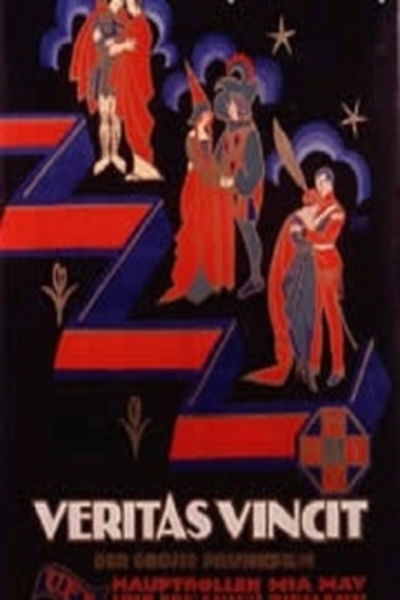
Light doesn't merely pierce darkness in Joe May's monumental Veritas Vincit – it bleeds, it scalds, it carves pathways through centuries of institutionalized falsehood. This 1919 triptych feels less like conventional cinema than an archaeological dig through strata of human mendacity, each layer exposing how power constructs elaborate architectures of deceit. What astonishes isn't just the technical virtuosity (breathtaking even by Weimar standards) but how May weaponizes the frame itself. When Cardinal Wolckenstein (Max Gülstorff) extinguishes a candle after ordering Bauer's arrest, the pooling shadows don't just obscure the set – they become the very substance of oppression.
The Prague segment unfolds with terrifying intimacy in claustrophobic chambers where truth exists as physical contraband. Bauer's (Leopold Bauer, eyes glittering with doomed certainty) celestial charts aren't papers but living organs he protects beneath floorboards. Gülstorff's performance chills precisely because his lies feel administrative – a bureaucrat of heresy signing torture warrants between sips of wine. Cinematographer Werner Brandes renders the inquisition sequence through disorienting Dutch angles, Bauer's suspended body swinging between light shafts like a broken pendulum. His whispered recantation (“The Earth stands immobile...”) becomes the film’s most devastating moment not through volume but through the close-up on his ink-stained fingers, still twitching as if writing phantom equations.
Transitioning to Industrial Revolution London, May shifts from theological suppression to capitalist distortion. Printing presses thunder like artillery in sequences anticipating The Dark Silence's mechanized dread. Wikman (Anders Wikman, radiating proletarian fury) doesn't speak truth – he manufactures it, fingers flying over type cases like a composer at his harpsichord. The corruption he exposes in Joseph Klein's factory owner feels unnervingly modern: falsified safety reports, bought politicians, libel disseminated through penny dreadfuls. When saboteurs torch Wikman's press, the towering inferno consumes not just wood and lead but the Enlightenment ideal itself, embers swirling into the shape of barred windows.
Vienna 1915 becomes May's symphonic crescendo. Mia May (the director's wife, deploying glacial poise) hosts salons where champagne flutes conceal intelligence networks. Her gowns – silver-threaded monstrosities resembling armor – become battle dress against Friedrich Kühne's warmongering general. Their duel unfolds through devastating juxtapositions: the general dictating victory reports intercut with actual trench mud swallowing dying boys; May's character decoding messages in a diamond choker's reflection. The suicide of her diplomat lover (Bernhard Goetzke, shatteringly fragile) isn't romantic sacrifice but tactical necessity – truth demands collateral damage.
Technically, the film remains staggering. Erich Kettelhut's production design for the Vienna segment alone required 47 metric tons of plaster for Habsburg-era facades later shelled into surrealist rubble. The much-celebrated trench sequence utilized pioneering miniature work – not for spectacle but psychological horror, as toy soldiers dissolve under chemical sprays resembling bile. Yet more revolutionary is the editing rhythm. Unlike the frantic montages of A Broadway Scandal, May employs what he called "deception cuts": matching a turning gear in London to a artillery wheel in Vienna, or a cardinal's crozier morphing into a general's baton through sheer editorial will. Lies, he demonstrates, are visually contiguous across history.
Performances orbit around Mia May's calculated restraint. Where Bauer and Wikman erupt with righteous passion, her salonnière weaponizes ambiguity. Watch how she lets a silence linger just beyond comfort when the general boasts of victories – her gloved finger tracing a knife's edge becomes an epistemological act. Supporting players manifest deceit through physicality: Georg John's informant scuttles through alleys with rodent twitches, while Olga Engl's society gossip spreads falsehoods through a fan's flutter, each snap echoing pistol shots.
Modern viewers must grapple with the film's own historical disquiet. Written partially by disgraced aristocrat Michelangelo Baron Zois during his exile, the script betrays reactionary unease. The London episode implicitly condemns mob justice despite championing Wikman – revolutionaries appear as faceless, torch-wielding brutes. This duality mirrors Weimar's turmoil: a society demanding truth yet recoiling from its consequences. Even the triumphant finale feels poisoned; as May's character reveals documents proving the general's duplicity, the camera lingers on starving children outside the War Ministry. Truth wins, the title declares, but its spoils nourish no one.
Comparisons to May’s earlier The House of Tears prove instructive. Where that film explored deceit through domestic melodrama, Veritas Vincit understands falsehood as the scaffolding of civilization. The cardinal doesn't merely lie about astronomy – he constructs an entire cosmology of control. Similarly, Wikman's pamphleteering anticipates modern media manipulation tactics seen in The County Chairman, but with terrifying prescience about industrialized disinformation.
Contemporary critics lambasted the film's pessimism – truth prevails, yes, but at costs rendering victory pyrrhic. Yet this very bleakness grants enduring power. When Bauer's hidden star charts resurface centuries later in Wikman's print shop, the revelation isn't joyful but haunting: humanity keeps rediscovering fundamental truths it previously murdered to suppress. The final superimposition remains one of silent cinema's most audacious statements: trench mud resolving into wet ink on the Vienna accords, then morphing into the Milky Way above Prague's prison tower. All human struggle, May suggests, occurs between these layers – cosmic truth and its blood-soaked applications.
Over a century later, the film's warnings vibrate with hideous relevance. In an age of deepfakes and algorithmically amplified falsehoods, Kühne's general feels less a period figure than a blueprint for modern propagandists. Wikman's fate – crushed beneath his own press – foreshadows journalists targeted by authoritarian regimes. And Mia May's glacial maneuvering through salons finds echo in today's digital influencers weaponizing charisma. Yet the true miracle is how May finds visual poetry within despair: the flare illuminating Bauer's cell becomes a captured star; typeset letters blown into a blizzard become truth's dispersed seeds; a diplomat's shattered monocle focuses, in its broken curve, the entire corrupt edifice about to fall.
Veritas Vincit endures not as a reassurance but an incendiary device. Its 145 minutes constitute a counter-narrative to humanity's preferred myths about progress. Truth doesn't win through noble rhetoric or divine intervention, May insists, but through sacrifice so absolute it borders on nihilism – a martyr's broken body, a lover's calculated betrayal, a civilization's moral bankruptcy laid bare. The victory feels less like triumph than a diagnosis: our species will claw toward light, but only after groping through centuries of self-inflicted darkness, leaving bloodied fingerprints on every shattered truth reclaimed.
IMDb —
1917
Community
Log in to comment.