DbcultAccessing Vault...
Cult Review
Senior Film Conservator
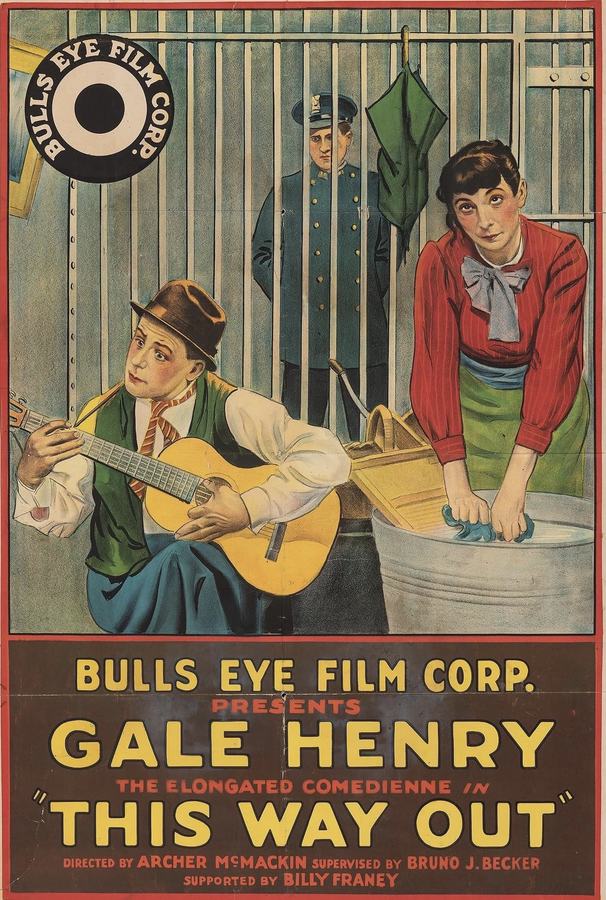
In the grand, often overlooked annals of the silent era, few figures possess the idiosyncratic magnetism of Gale Henry. Often referred to as the 'Elongated Comedienne,' Henry’s physical presence in This Way Out (1920) provides a masterclass in skeletal slapstick. This film, a frantic short that tackles the surprisingly modern anxiety of the housing crisis, serves as a poignant, if hilariously exaggerated, reflection of societal exclusion. While contemporary audiences might look toward the high-stakes drama of The Cheat for social commentary, Henry and her co-star Billy Franey find a more visceral, relatable truth in the mundane struggle of finding a roof that doesn't mind a little noise.
The chemistry between Billy Franey and Gale Henry is predicated on a delightful visual dissonance. Franey, with his compact frame and nervous energy, acts as the frantic engine of the family unit, while Henry provides the sweeping, often erratic navigational steering. Their predicament in This Way Out is ostensibly simple: they have children, they have a dog, and they have nowhere to put them. In a world of rigid Victorian remnants, these two are agents of entropy. Unlike the more structured heroism found in Boy Scouts to the Rescue, their survival depends entirely on their ability to absorb physical punishment and social rejection with a rubbery resilience.
The film’s brilliance lies in its pacing. Every time the couple finds a potential sanctuary, the inevitable 'No Dogs, No Children' sign appears like a recurring villain in a melodrama. It is a structural motif that mirrors the repetitive frustrations of the working class. We see echoes of this domestic struggle in other 1920 releases, such as the more somber The Heart of a Child, yet This Way Out refuses to descend into pathos. Instead, it weaponizes the inconvenience of family life, turning a crying baby or a barking dog into a comedic projectile aimed at the stuffy heart of the landlord class.
The cinematography of the 1920s was often limited by the heavy machinery of the era, yet This Way Out utilizes its interior spaces with a claustrophobic wit. The hallways are too narrow for the couple’s ambitions; the doorways are thresholds of disappointment. There is a specific scene involving a staircase that rivals the mechanical comedy of Tillie Wakes Up, where the sheer physics of moving a family through a hostile environment becomes a dance of near-misses and spectacular falls. The film understands that humor is often found in the friction between human desire and the unyielding nature of physical objects.
While a film like Parsifal might deal in the ethereal and the legendary, This Way Out is rooted firmly in the asphalt and brick of the city. The 'Out' in the title is not just a direction, but a status. To be 'out' is to be excluded from the burgeoning American dream of stability. Gale Henry’s face, a canvas of elastic despair, captures this perfectly. Her expressions transition from hopeful anticipation to a weary, knowing cynicism in the blink of an eye, a skill that elevates the film from a mere series of gags to a character study of the perennially displaced.
To truly appreciate the nuance of this short, one must place it alongside the broader cinematic output of the year. It lacks the propagandistic fervor of How Uncle Sam Prepares, and it eschews the historical gravitas of Europäisches Sklavenleben. Instead, it occupies a middle ground of domestic anarchy. In many ways, the film is more honest about the daily grind than the romanticized struggles in The Unbroken Road or the moralizing tone of The Dawn of Understanding. It suggests that understanding is impossible when you’re being kicked out of your fourth apartment in a week.
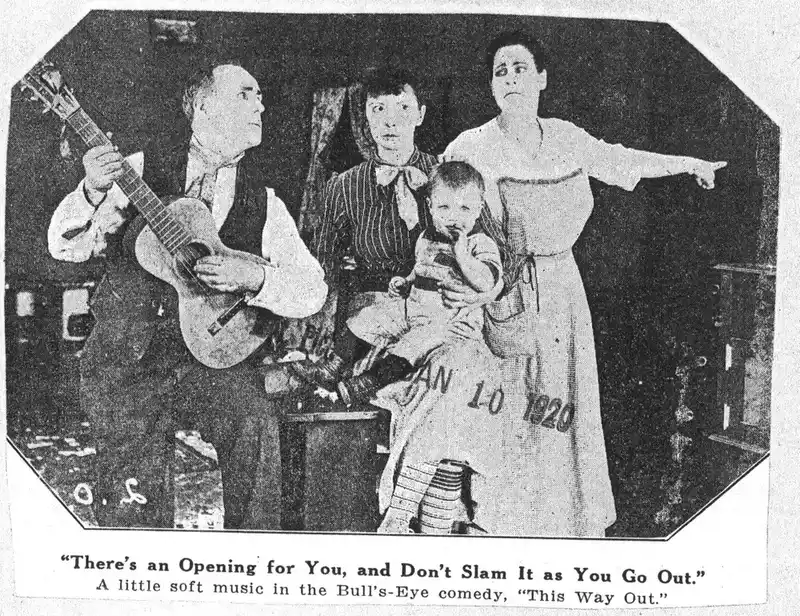
Phyllis Allen and Hap Ward provide excellent support, rounding out a cast that understands the rhythm of the 'knockabout' style. Allen, in particular, embodies the formidable gatekeepers of the era—women who held the keys to the kingdom and were not afraid to use them. The interactions between Henry and Allen are highlights of the film, representing a clash between the gangly chaos of the new generation and the rigid, unyielding standards of the old guard. It is a conflict that resonates far beyond the 1920s, touching on the universal friction between the 'haves' and the 'have-nots' who just happen to have a dog.
Visually, the film benefits from the stark contrasts of the silent era’s lighting. Shadows in the boarding house hallways feel like judgmental eyes, and the bright, over-exposed exteriors emphasize the exposure of the couple. There is no place to hide their 'shameful' appendages—the kids and the pet. This visual vulnerability adds a layer of depth to the comedy. When they are on the street, they are at the mercy of the elements; when they are inside, they are at the mercy of the lease. It is a binary of discomfort that Franey navigates with a frantic, Chaplin-esque pathos, though his style is much more aggressive and less sentimental than the Little Tramp.
Interestingly, the film avoids the surrealism of The Sleep of Cyma Roget or the operatic melodrama of Sposa nella morte!. It stays grounded in the gritty, dusty reality of the sidewalk. Even the dog, often a source of easy sentimentality in films like Poludevy, is treated here as a comedic catalyst—a four-legged wrecking ball that ensures the couple’s stay in any one location is as brief as possible. The canine is not a hero; it is a liability, and in the world of This Way Out, liabilities are the funniest things on earth.
One cannot discuss this film without a deep dive into Gale Henry’s technique. Her movements are not merely funny; they are mathematically precise. She uses her height to create awkward angles that defy the expected flow of a scene. In a sequence where she attempts to hide the dog under her coat, her silhouette becomes a grotesque, shifting shape that mocks the 'proper' female form of the time. This is subversive comedy. It challenges the viewer to find beauty in the distorted and the desperate. It is far more daring than the conventional slapstick of The Dutiful Dub, as it links physical deformity (temporary and comedic) with social ostracization.
The film’s conclusion—if one can call the final explosion of chaos a conclusion—doesn't offer a neat resolution. There is no sudden inheritance or a change of heart from a landlord. Instead, there is the implication that the cycle will continue. This lack of closure is what makes This Way Out feel surprisingly modern. It acknowledges that for some, the 'way out' is just a door to another 'way in' that will eventually lead back to the street. It is a cynical, yet hilariously vibrant, take on the American experience of 1920.
Ultimately, This Way Out stands as a testament to the power of the short-form comedy to capture the zeitgeist. While it may not have the martial pride of Legion of Honor or the dark allure of La gola, it possesses a grit and a frantic honesty that remains infectious. The casting of Billy Franey and Gale Henry was a stroke of genius, pairing two performers who understood that the funniest thing about life is often its refusal to give you a place to sit down.
As we look back through the lens of a hundred years, the frustrations of the Franey-Henry household feel remarkably contemporary. The 'No Children, No Dogs' sign has been replaced by credit checks and security deposits, but the fundamental comedy of the unwanted tenant remains. This Way Out is a reminder that even when the world is telling you to leave, there is a profound, hilarious dignity in the act of trying to stay. It is a minor masterpiece of the silent era, a loud shout of laughter in an era of hushed tones and flickering lights.
IMDb 7.2
1930
Community
Log in to comment.