DbcultAccessing Vault...
6.4/10
Senior Film Conservator
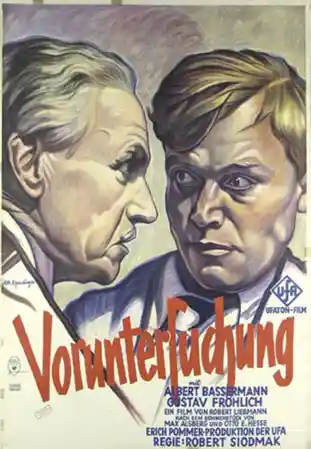
A definitive 6.4/10 rating for a film that redefined the boundaries of cult cinema. Voruntersuchung remains a cornerstone of transgressive art.
If you are lookin' for a fast-paced thriller to watch tonight with some popcorn, just skip this. But if you have a soft spot for dusty, black-and-white German court dramas where people look incredibly guilty just by standing in a doorway, Voruntersuchung is actually a hidden gem.
Anyone who hates reading subtitles or gets annoyed by hiss in old audio tracks will absolutely loathe this. But for the rest of us, it is a fascinating trip back to 1931.
Directed by Robert Siodmak, the movie is basically about a judge who realizes his own son might have killed a young woman. Talk about a terrible day at the office. 😅
The plot gets messy fast because there is too many connections between the dead woman, her lover, the son, and the judge's daughter. At times, it feels like everyone in Berlin was dating the same three people.
What really grabbed me was how Siodmak uses sound. This was right at the dawn of talkies, when most directors were just pointing a camera at people talking and hoping for the best.
Unlike other 1931 films like Millie, which sometimes get bogged down in theatrical screeching, Siodmak knows when to keep things quiet. Here, the silence is heavy, and you can hear the footsteps echoing down those cold, institutional hallways.

There is this one scene where Albert Bassermann (playing the judge) is just staring at a piece of paper. The clock in his office ticks so loudly it starts to feel like a headache.
Bassermann is incredible here. His face is like a crumbling stone wall, trying to stay professional while his whole world is falling apart.
There is a moment where he almost drops his glasses, and it feels so real, like it was a genuine accident they just kept in the film because it worked.
The son, played by Gustav Fröhlich (you might know him from Metropolis), is... fine. He does that typical silent-actor thing where he stares with wide eyes when he is scared, which gets a bit exhausting after the third time he panics.
The pacing drops off a bit in the middle. There is a long sequence in a crowded apartment where people just argue about who was where at 10 PM.
I actually lost track of who the lover was for a second because two of the actors looked almost identical under those harsh studio lights. But still, the atmosphere is so thick you can almost smell the wet wool coats and the stale cigarette smoke.
It has that Weimar-era gloom that nobody has ever quite recreated since. If you are a fan of old-school crime procedurals, this is definitely worth your time on a rainy evening.
IMDb 6.9
1932
Community
Log in to comment.