DbcultAccessing Vault...
Cult Review
Senior Film Conservator
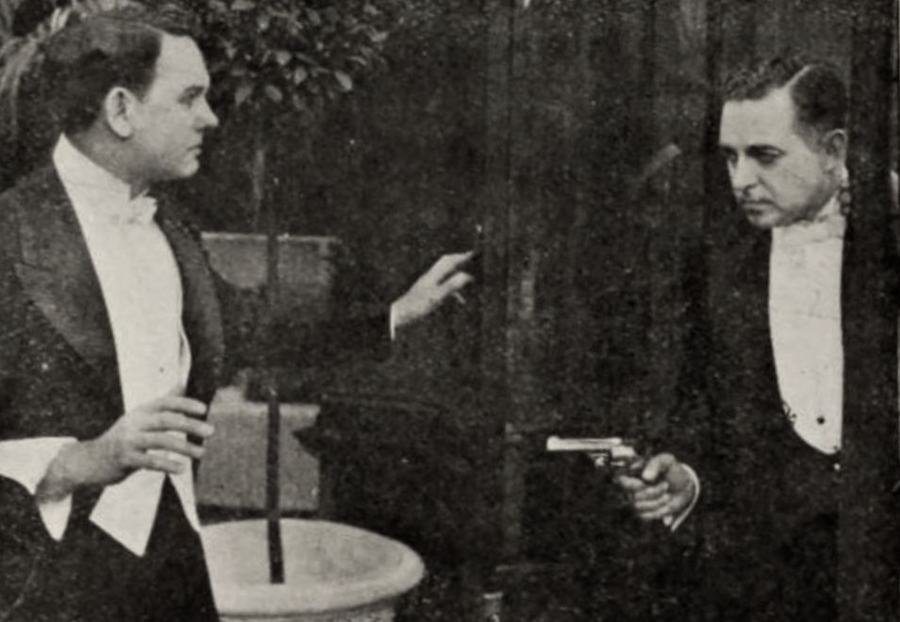
Harold McGrath’s pulp pages hiss like wet magnesium when flung onto celluloid; The Voice in the Fog arrives as both séance and pickpocket, slipping its fingers into the coat of 1915 spectatorship and lifting whatever certainty they once owned about voices, bodies, and who gets to speak in the dark. Forget the genteel drawing-room thrillers that usually bookend the era—this is an acoustic mugging. From its first close-up of a brass phonograph horn, the film insists that every recorded tremor is a potential hostage note.
McGrath’s serial originally ran in The Saturday Evening Post while Europe’s cannons tuned up for their own thunderous soundtrack. Producer William A. Brady optioned the property for the same reason sharks circle blood: headlines about "the uncanny voice murders" sold papers, so a flickering variant could only mint nickels. Hector Turnbull’s adaptation hacks away the novel’s polite exposition, replacing it with intertitles that croak like ravens: "He speaks, therefore you suffer." The result feels closer to German Gothic Expressionism than to anything hailing from star-spangled studios—three years before Caligari stalked the screen.
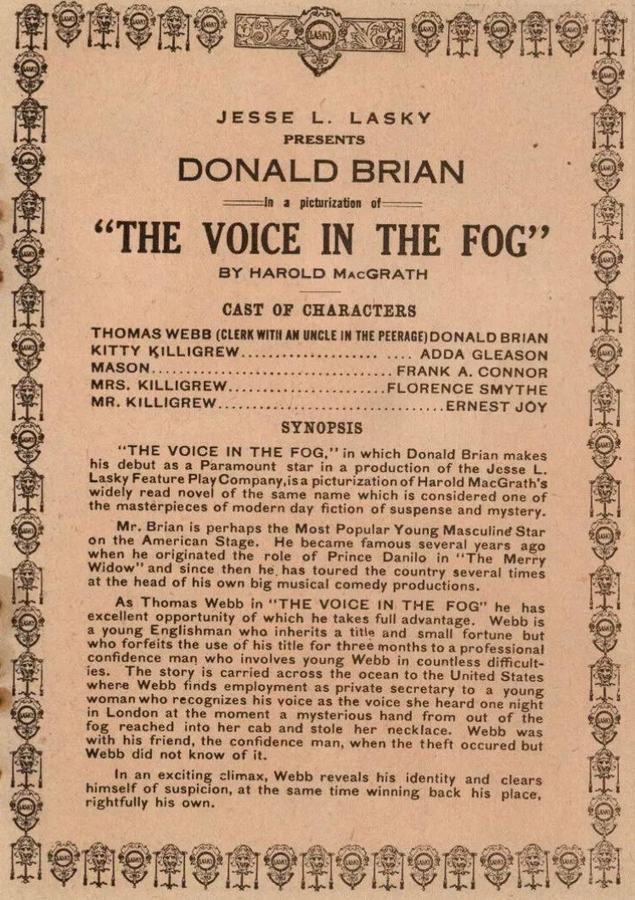
Because synchronized dialogue is still a laboratory phantom, the actors must vocalize without decibels. Donald Brian—Broadway’s erstwhile matinée king—leans on his dancer’s musculature to externalize rhythm: every limp of his club-foot detective lands on the down-beat of an invisible metronome. The performance is silent scat singing, a body improvising cadences it will never utter. Florence Smythe, dying of tuberculosis during production, allows the camera to harvest whatever vitality remains; her cheeks sink into violet dusk, becoming living tinting bath. You do not merely watch her—you witness pigment in motion.
Frank O’Connor, as the ventriloquist villain, keeps his lips sealed so rigorously that the absence of speech feels like negative space carved by ice auger. When he finally unhoods the dummy—a porcelain cherub with human teeth—the effect is less comic than charnel house. In 1915, audiences reportedly screamed, then apologized for screaming, unsure whether etiquette permitted outbursts in a respectable playhouse.
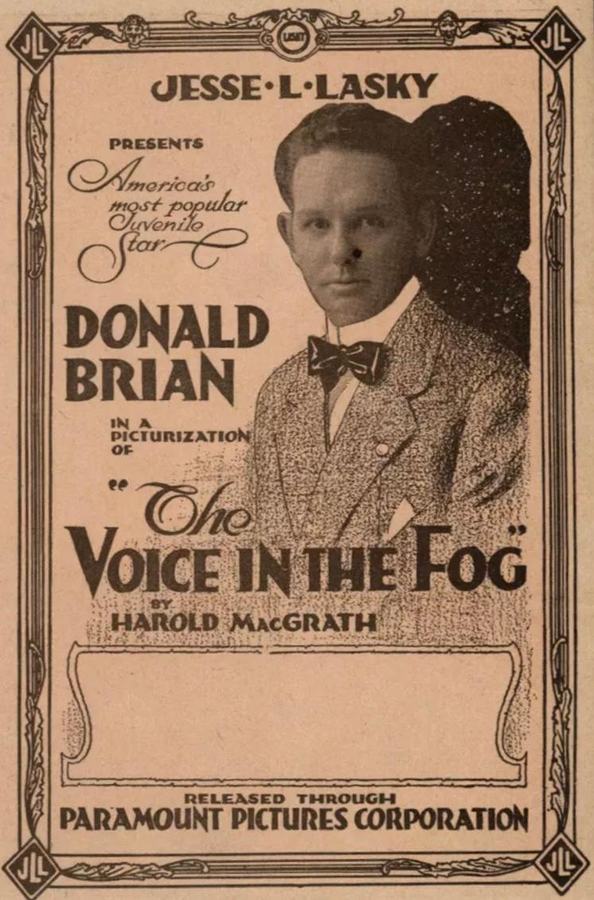
Cinematographer Gilbert Warrenton (later lensing for Through the Valley of Shadows) treats condensation like wet plaster, slathering it onto streets until facades melt into watercolor smears. The city—unnamed but unmistakably Frisco—becomes a cathedral of obscured exits. Warrenton’s trick? He back-lit the mist with magnesium flares, so the fog glows infernal orange while foreground faces sink into umber. Morally, nobody emerges unspotted.
High-society victims receive gramophone discs in violet paper. Drop the needle and out spills their own voice confessing crimes they never committed—yet the timbre is perfect mimicry. In an era when home recording was rarer than moon rocks, the premise lands like technological witchcraft. The film anticipates our current panic over algorithmic doppelgängers; only the carrier has shifted from shellac to cloud.
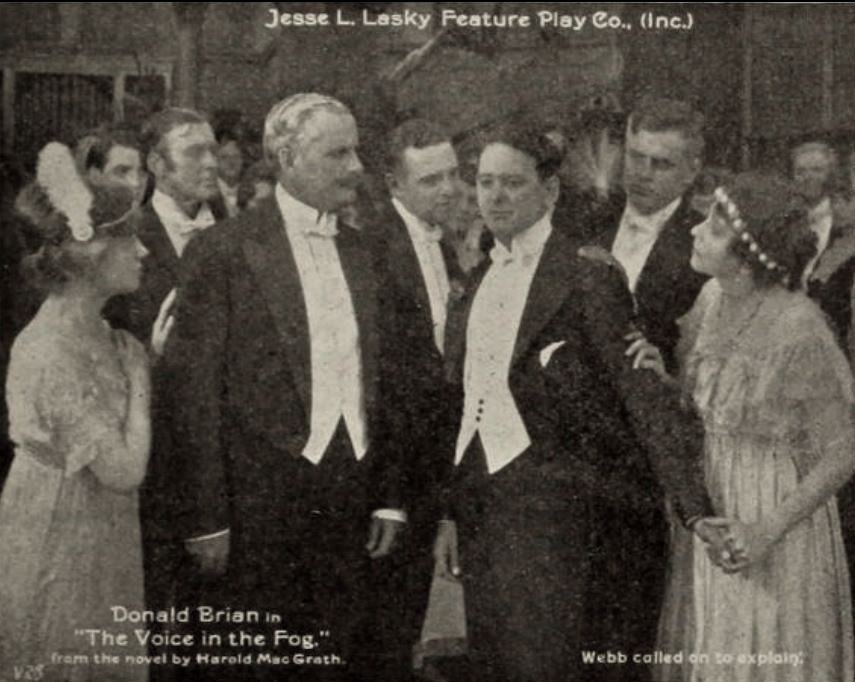
Most prints vanished in the 1917 Universal fire; one incomplete 35 mm nitrate reel surfaced at a Portland estate sale in 1998, fused into a single honey-colored brick. The UCLA Film & Television Archive rehydrated the stock in a glycerol bath, then scanned at 8K, revealing previously lost frames: a close-up of Adda Gleason’s glass-plate eyes reflecting the dummy’s face like a hand-tinted prayer card. Digital recombination with a Czech print (found mislabeled as Trilby) restores continuity to the lighthouse climax—though two jump cuts persist, now bridged by strobe-animated stills that flicker like Morse code.
Composer Alexei Aigui premiered a quartet-plus-electronics score at Il Cinema Ritrovato 2022. He threads vapor-drenched theremin with prepared piano—paperclips woven between strings to emulate ticking cylinders. Whenever the ventriloquist’s dummy appears, Aigui triggers granular samples of Édith Piaf’s "L’Accordéoniste", stretched until syllables yawn like canyon echoes. The effect: history folding in on itself, dead singers ventriloquizing new terrors.
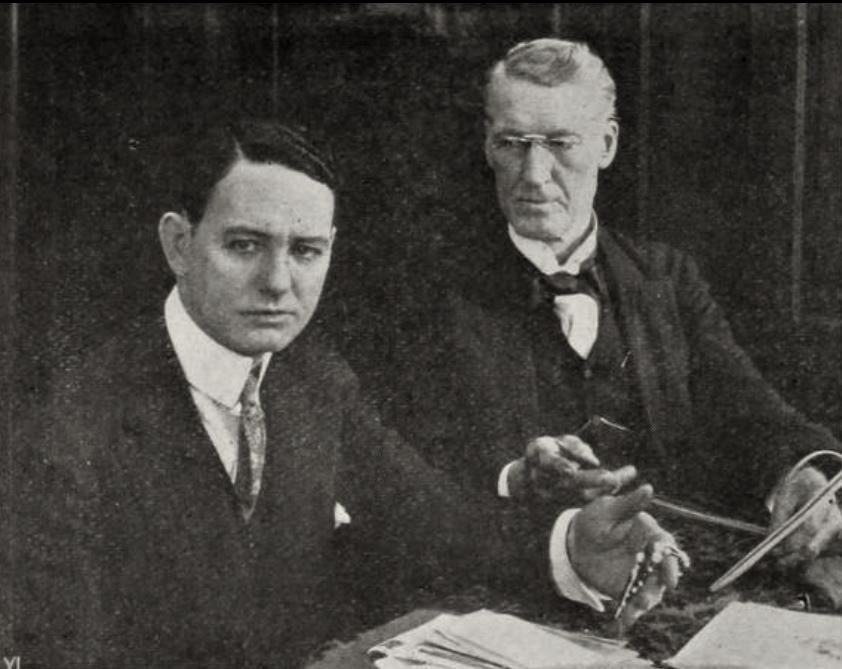
Unlike The Eternal City’s grandiose piazzas or Giro d’Italia’s open-road virility, The Voice in the Fog chooses claustrophobia. Its closest cousin is Trilby—both trade mesmeric control under gaslight—but while Trilby eroticizes domination, Voice weaponizes timbre itself. Sound becomes both rapier and gag.
Each female lead suffers acoustic exile: their speech is copied, twisted, re-delivered. Smythe’s diva loses her aria to a mechanical puppet; Gleason’s reformed pickpocket hears her own confession of relapse on a street-corner phonograph. The film thus stages an early meta-commentary on patriarchal ventriloquism: men literally throwing women’s voices back at them, distorted into guilt. Yet the women counter-hijack the apparatus: Gleason pickpockets the master disc, scratches a new groove into it, and turns the blackmail back on its architect. A proto-feminist rupture disguised as melodrama.
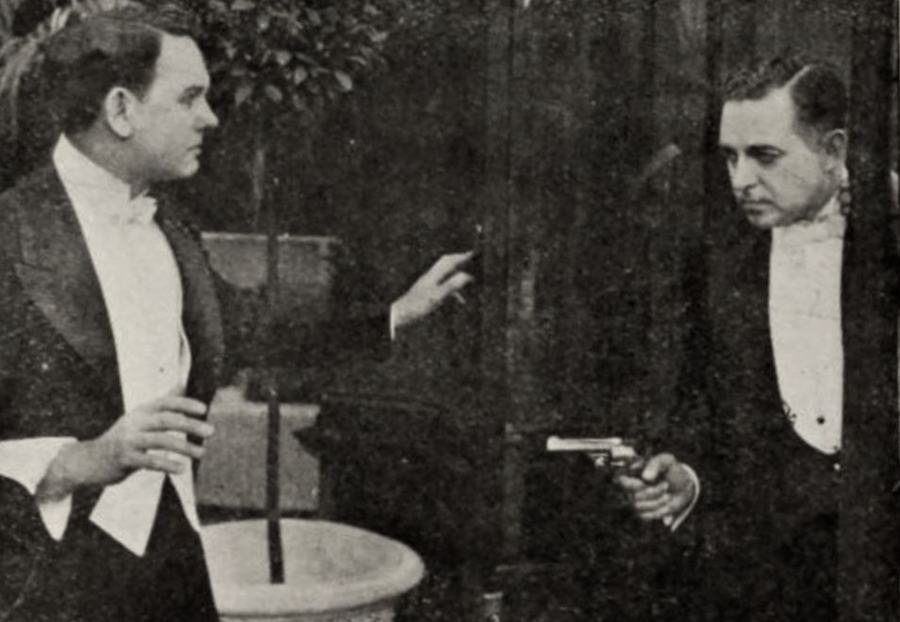
Shot for $46,000—half the cost of Three Weeks—the production recycles sets from Brady’s "The Blindness of Devotion." Note the same baroque elevator cage reappearing as a lighthouse staircase rotated ninety degrees. Ingenious economy: fog hides seams, while optical re-photography multiplies extras. Compare this thrift to modern tent-poles spending millions on digital mist; ingenuity always ages better than coin.
Moving Picture World hailed it as "a nerve-thrilling exploit into the land of shivery echoes," while Variety carped that "the story leaks like a rowboat in a hurricane." Both reviews obsess over sound in a silent medium, proof the central gimmick burrowed deep. Ticket sales reached $412,000 domestically—astronomous for 1915—yet the picture vanished from retrospectives for decades, eclipsed by war newsreels and Chaplin-mania.
Deepfake scams, voice-cloning robocalls, AI vocal covers—these headlines pirouette around the same ethical abyss The Voice in the Fog dramatized 109 years ago. The film whispers that identity is just another cylinder waiting to be cut. Watching it today feels like discovering your diary read aloud on a podcast—except the reader wears a porcelain mask and demands payment in fear.
The 2022 restoration streams on Criterion Channel (4K SDR, mono PCM) and plays select rep houses in 35 mm. Seek the UCLA print if possible; the sea-blue tints of reel four—signifying "night in the brain"—survive only there. Home-projector owners should note the gamma hovers at 2.2; anything brighter bleaches the amber intertitles into buttermilk.
Great cinema sometimes arrives swaddled in its own obsolescence, daring us to decode its crackle. The Voice in the Fog is such a relic—yet its anxieties stream in hi-def through your wireless earbuds every time a cloned voice asks for your credit-card PIN. Listen carefully: history is throwing its voice, and the dummy is wearing your face.
IMDb —
1924
Community
Log in to comment.