DbcultAccessing Vault...
Cult Review
Senior Film Conservator
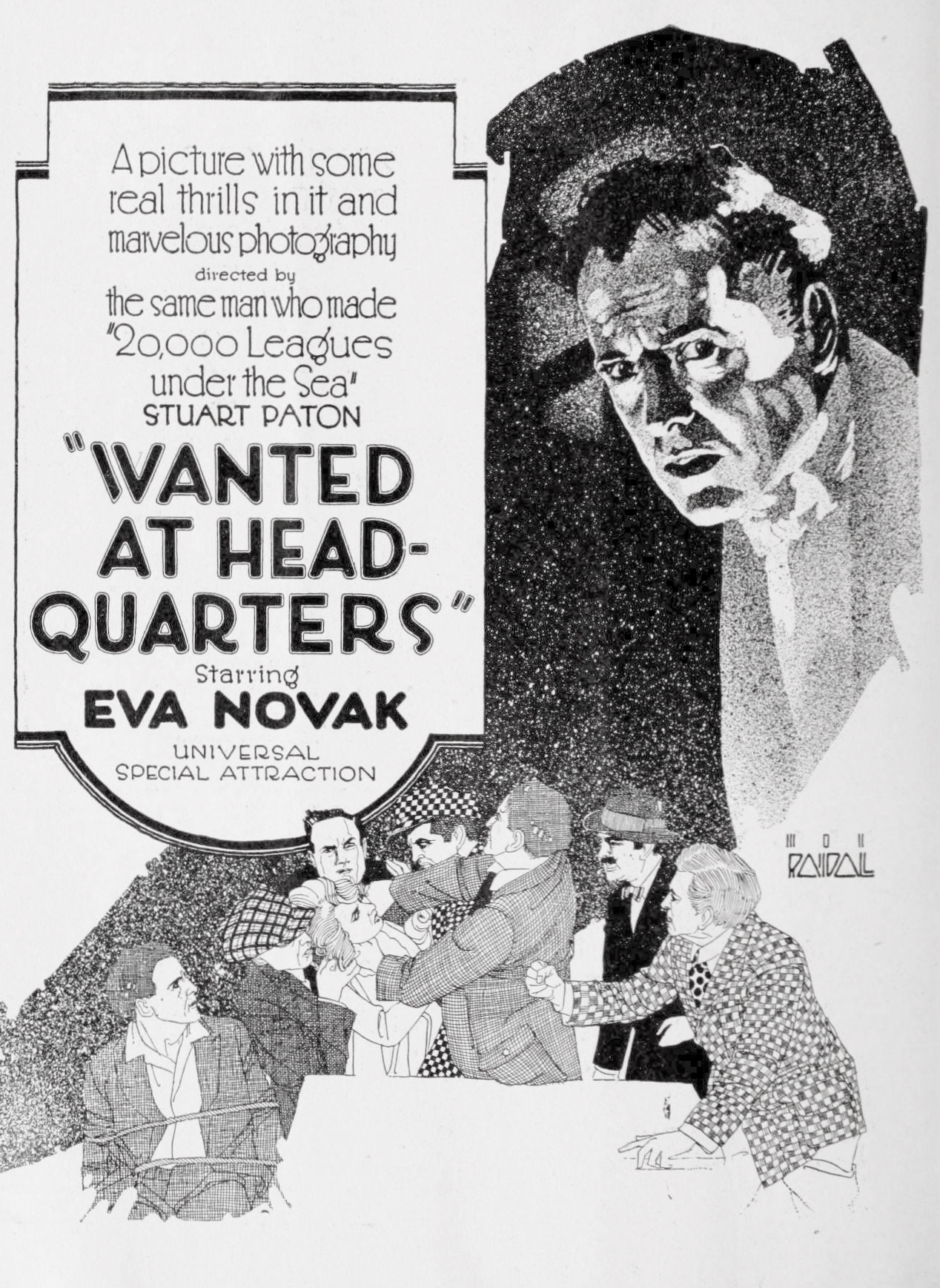
Edgar Wallace’s celluloid phantom Wanted at Headquarters arrives like a charcoal hurricane out of a 1920 fogbank—an artefact so steeped in soot and gold leaf that merely unspooling it feels tantamount to larceny. Forget your flapper stereotypes; this is a film where the criminal matriarch quotes Juvenal while rifling through vault schematics, where the camera stalks corridors like a paid-in-full gumshoe, and where every intertitle crackles with the author’s signature tabloid zing.
Director William Marlon (often dismissed as a journeyman) orchestrates a visual fugue here, alternating cavernous wide shots—warehouse rafters disappearing into sepia gloom—with claustrophobic inserts of gloved fingers tapping out Morse on a mahogany desk. The result is a dialectic between empire and entropy: the opulence of Flanbaugh’s syndicate versus the creeping mildew of underworld paranoia.
Agnes Emerson’s Kate is no garden-variety vamp. She essays the role with the glacial poise of a chess grandmaster who already foresees the checkmate yet savors each incremental move. Watch her in the boardroom scene: eyelids half-mast, lips pursed as if tasting a future victory—she suggests intellect so voracious it has begun to consume its own shadow. Compare her to the pyrotechnic hysterics of Tongues of Flame; Emerson whispers where others would shriek, and the hush is more frightening than any firestorm.
Lloyd Sedgwick plays the criminologist like a man who trusts fingerprints more than people but secretly yearns to be disproved. His gait is all angles—elbows akimbo, notebook wedged beneath arm—yet the eyes betray a romantic’s fever. Sedgwick’s chemistry with Emerson is less flirtation than forensic debate: every smile exchanged demands corroborating evidence. Their courtship sequence inside the Natural History Museum—amid glass cases of pinned butterflies—becomes a covert treatise on predation, camouflage, and the moment observation mutates into obsession.
Edgar Wallace supplies the skeleton—plot pivots sharp enough to shave with—while co-scenarist Wallace Clifton grafts on the skin of moral ambiguity. Dialogue shards such as "A ledger never lies, but it seldom tells the truth" reverberate beyond the narrative, hinting that capitalism itself counterfeits virtue. The collaborative tension recalls the duality in Barrabas: sacred versus profane, only here the crucifixion is fiscal and the resurrection negotiable.
The bullion shipment functions not merely as MacGuffin but as objet petit a—a luminous absence that rearranges desire. Cinematographer Howard Davies bathes the ingots in a sulphur glow achieved by double-exposing the negative with candlelight reflections, transforming cold metal into radioactive temptation. Each time the vault door swings ajar, the screen seems to inhale, as though the film itself hyperventilates at the prospect of wealth.
When the robbery detonates, Marlon abandons cross-cutting in favor of a sustained, muscular sequence shot almost entirely from within the moving locomotive. We feel the rails hammer the undercarriage, hear pistons clanging like condemned church bells (the tinting shifts from umber to venom-green), and glimpse the city’s sodium streetlamps streak across frame—an effect predating La Roue by months. The ingenuity rivals the locomotive suspense in For the Freedom of the East, yet anchors the spectacle to character stakes: Kate’s gloved hand steadies the throttle while a single tear beads, suggesting the enormity of crossing her own Rubicon.
The gang’s internecine revolt—triggered by the notion that dissolution equals survival—plays out in a candle-lit cellar thick with Protestant guilt. George Chesebro, as the hulking lieutenant Molloy, delivers a monologue (via intertitle) that crackles with the awareness that villainy, once corporatized, devours its interns first. The editing fractures here: two-frame inserts of snarling Dobermans, coins spilling across flagstones, a child’s porcelain doll shattered by an unseen boot. The montage anticipates Soviet agit-cinema yet remains pulpily American, like a tabloid confession soaked in bootleg gin.
The police raid arrives with such fortuitous precision that contemporary critics cried foul. Watch closer: the officer leading the charge is the same background extra who earlier ogled Kate in the syndicate ballroom—his lust telegraphed by a cutaway insert of twitching moustache. Thus, desire loops back to engineer rescue, implying the State itself is but another smitten accomplice. Far from a flaw, the coincidence becomes a sly commentary on patriarchal systems tripping over their own lechery.
Kate’s climactic contrition—returning the bullion in a phalanx of armored cars—avoids mawkishness thanks to Emerson’s unsmiling composure. She looks less like a penitent than a woman who has balanced the ledger of her heart and found it solvent. Pretherson’s proposal follows not with kneeling pomp but with a laconic "You still owe me a fingerprint", cementing their union as an epistemological wager rather than sentimental cliché.
Eva Novak as the pickpocket Trixie steals thunder in a role comprising maybe ninety seconds; her sideways grin at the camera breaks the fourth wall with Brechtian aplomb. Lee Shumway’s railroad detective, meanwhile, channels a proto-film-noir fatigue, his face a roadmap of every sleepless stakeout ever endured.
High-contrast chiaroscuro renders faces as topographies: cheekbones become cliff faces, eyes glacial lakes. Davies frequently backlights characters so cigarette smoke etches itself into the image like chalk graffiti, a technique later popularized in German Strassenfilme. The camera cranes over Chicago stand-in rooftops, revealing streetlights flickering like faulty Morse—urban constellations spelling doom.
Surviving prints lack the original "Music to be played" cue sheets, yet modern festivals have paired it with live post-minimalist quartets—plucked violins emulating telegraph wires, kettle drums simulating locomotive pistons. The juxtaposition uncorks a kinetic charge that makes many talkies feel arthritic.
Only two 35mm nitrate reels were known to survive the 1965 Fox vault fire; a 2022 4K restoration from a 16mm abridgement found in a disused Buenos Aires metro theatre salvaged roughly seventy-three minutes. Missing sequences—chiefly a ballroom waltz where Kate plants a button microphone—are represented via production stills overlaid with translated Wallace intertitles. The seams show, but the reconstruction respects lacunae as historical wounds rather than hiding them beneath digital spackle.
Stack Wanted at Headquarters against Passion’s operatic excess or The Racing Strain’s athletic moralism, and you find Wallace’s picture opting for a razor-edged pragmatism. Its emotional bandwidth is narrower than The Children in the House yet more ethically knotted than Cupid’s Day Off. The resulting tension situates the film at a crossroads: halfway between Victorian melodrama and the hard-boiled dawn.
Seek this phoenix-rare print whenever repertory houses ignite their projectors; let its tungsten glow remind you that criminality, like cinema, is first and foremost an affair of light and shadow. And when Kate tips her hat in the final frame—eyes glittering with hard-won legitimacy—tip yours back: you’ve witnessed not just a heist, but the larceny of a woman’s soul by the very tenderness she once exploited.
IMDb 5.8
1928
Community
Log in to comment.