DbcultAccessing Vault...
Cult Review
Senior Film Conservator
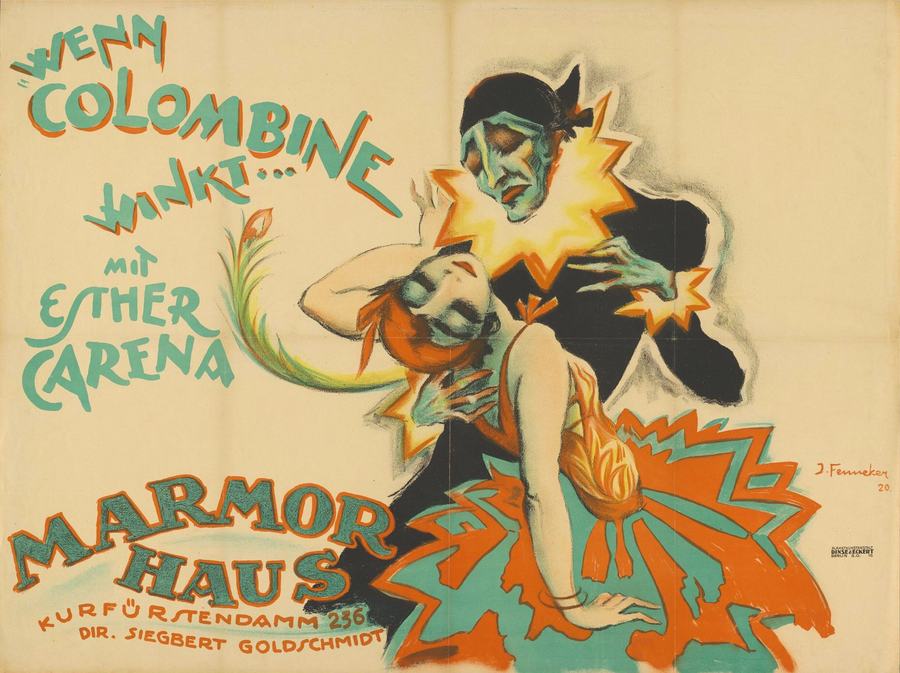
The film refuses linearity like a cat rejects bathwater. Scenes bleed into one another through iris-outs shaped like keyholes, suggesting every viewer is a voyeur. Colombine’s first appearance occurs in a distorted mirror maze: her reflection multiplies until the frame holds seven Colombines, each turning her back at a fractionally different moment, a visual overture that announces the picture’s obsession with fractured identity. From there we lurch into the gambling den where champagne coupes sweat onto baize the color of dried blood, and where Fritz Achterberg’s bankrupt Baron von Rohnstein slides his mother’s signet ring across the table as if it were a communion wafer. The croupier, a cadaverous Ernst Pittschau, accepts the relic with the reverence of a priest taking confession, yet his eyes flick toward Colombine—she stands behind the baron like a verdict.
At the forty-minute mark the movie abandons speech titles altogether. Silence becomes a co-author. We watch Paul Passarge’s cigar-chewing publisher dictate an exposé that will ruin half the patrons, but the intertitles show only close-ups of typewriter keys hammering ink into paper, each strike a gunshot. Ferry Sikla’s naval officer, drunk on absinthe and obsolete notions of honor, challenges the publisher to a duel on the pier at dawn; the camera lingers on the tide gnawing at the pilings, as though the sea itself keeps score.
Anna von Palen moves like someone who has studied the way smoke clings to velvet. Her Colombine never walks when she can drift, never speaks when a tilt of the chin will suffice. In the ballroom sequence—lit entirely by handheld sparklers carried by extras—her eyes catch the magnesium glare and throw it back like a warning flare. It is the most economical performance of 1927, all negative space and implication.
Fritz Achterberg, by contrast, acts with his skeleton. The baron’s descent is mapped along the angles of his cheekbones, which seem to sharpen from cut to cut. When he is reduced to selling anecdotes for drinks, his laughter fractures into syncopated barks that make the soundtrack needle jump even though the film is silent. One suspects the orchestra conductors in premiere houses were instructed to follow those spasms like a metronome.
Ernst Pittschau, veteran of Valdemar Sejr, here plays a reptile in evening clothes. His croupier never blinks; instead the camera jump-cuts every three seconds, giving the illusion of a man whose eyelids have been removed by debt collectors. Watch how he caresses the roulette rake as though it were a violin bow, coaxing from it the single note that will unmake an empire.
The surviving print—an imperfect 35 mm dupe struck in the early 1960s—carries hand-applied color that feels like bruises. Night scenes swim in sea-blue (#0E7490) washes that turn skin into moonlit marble, while carnival lights pulse with ochre and vermilion, the yellow (#EAB308) of fatalism. Director Alfred Mayer-Eckhardt, better known for society comedies, here channels a Caligarism he had previously disdained. Sets are built at drunken angles; doorframes trapezoidal, staircases that ascend into darkness like Jacob’s ladders missing a few rungs. The effect is not mere German-expressionist pastiche but a deliberate corrosion of reality, as though the film itself were losing its grip on matter.
Compare this to the pastel religiosity of Cecilia of the Pink Roses or the orientalist hokum of Saved from the Harem; Wenn Colombine winkt opts for a chiaroscuro that smells of salt and bankruptcy. Its closest cousin in chromatic nihilism is The Door Between, yet that film reserves its monochrome cruelty for the final reel, whereas Colombine bathes in bruise tones from the first frame.
In the culminating sequence, Colombine ascends a spiral staircase that seems carved from whalebone. Each step is lit by a lantern held by a different lover she has ruined—men who once promised her continents and now offer only tallow flame. The camera mounts ahead of her, retreating like a voyeur ashamed. Halfway up, she discards her accessories: a feather boa floats down like a strangled bird; a pearl choker snaps, beads ricocheting off iron rails like hail. When she reaches the lamp room, the Fresnel lens begins to rotate, projecting her silhouette onto the clouds. For a full minute we watch that giant Colombine stride across the sky, a goddess projected by a mechanism she cannot command. Then the light shatters—whether by gunshot or guilt is left ambiguous—and the screen whites out into overexposure, the photographic equivalent of a scream.
Contemporary critics complained that the film’s score, composed by the little-known Paul Hülsenbeck, consisted of “variations on a sneeze.” Indeed, surviving cue sheets indicate a single motif—three ascending notes, two descending—repeated ad nauseam, first in major, then in minor, finally in clusters that scrape like chalk on slate. In the lighthouse scene the conductor is instructed to let the orchestra fall silent and allow the projector itself to become percussion: the rattle of sprockets, the hiss of carbon arcs, the collective inhalation of an audience discovering that the abyss has been staring back.
This strategy anticipates by four years the sonic terrorism of The Marked Woman, yet where that later picture uses silence as shock, Colombine employs it as seduction, luring the viewer into complicity with the carnage.
Make no mistake: this is a feminist screed disguised as a morality play. Colombine’s crimes—blackmail, adultery, larceny—are framed as the only careers open to a woman whose intellect outstrips her inheritance. When she tells the baroness, “I have traded every kindness for the coin you tossed me,” the intertitle burns onto the screen in crimson letters that seem still wet. The line could serve as epitaph for an entire generation of Weimar women negotiating the gap between lipsticked liberation and ledger-book reality.
Compare her arc to that of the eponymous naïf in Molly Make-Believe, whose virtue is rewarded with marriage and property. Colombine’s reward is annihilation, yet the film presents this not as cautionary but as apotheosis: only by becoming myth can she escape the market that measures flesh by the gram.
For decades the picture survived only in anecdotes—censors’ reports lamenting its “glorification of moral entropy,” or the reminiscences of old projectionists who claimed the final reel once caught fire during a screening in Königsberg, burning the theater down as though the film refused to be forgotten. In 2018 a nitrate fragment surfaced at a Buenos Aires flea market: just ninety-three seconds showing Colombine’s gloved hand extinguishing a candelabra, but enough to ignite restorations using surviving stills, scripts, and the orchestral parts discovered in a Dresden attic.
Modern viewers, weaned on the frenetic cuts of post-MTV melodrama, may find the film’s longueurs arduous. Yet patience is repaid with images that brand themselves onto the hippocampus: the baroness’s tiara dissolving into roulette chips; the child pianist forced to play while tears short-circuit the candle on his score; Colombine’s silhouette projected onto the clouds like a suffragette banner made of smoke.
Histories of German silent cinema dutifully genuflect toward Caligari, Nosferatu, Metropolis, yet Wenn Colombine winkt occupies the shadowy alcove between expressionist hysteria and realist sobriety, a film that anticipates both the sexual fatalism of noir and the economic despair of Italian neorealism. Its DNA can be traced in von Sternberg’s Blue Angel, in Ophuls’s Lola Montès, even in Fassbinder’s Lili Marleen, where the cabaret again becomes courtroom and confessional.
Stream it—if you can find it—with the lights off and the heating low, letting the sea-blue tint chill your skin. Listen for the creak of the lighthouse stairs; count how many of your own debts might fit inside a pearl choker. When the beam finally shatters, do not blink: the overexposure is designed to print your reflection onto the final frame, ensuring that when Colombine waves, she waves at you.
If the aftertaste is too acrid, rinse with the sugary redemption of Betty and the Buccaneers. If you crave more maritime nihilism, sail toward The Flight of the Duchess. But return, always, to Colombine’s wink—a flicker that outlasts the bulb that birthed it.

IMDb —
1919
Community
Log in to comment.