DbcultAccessing Vault...
Cult Review
Senior Film Conservator
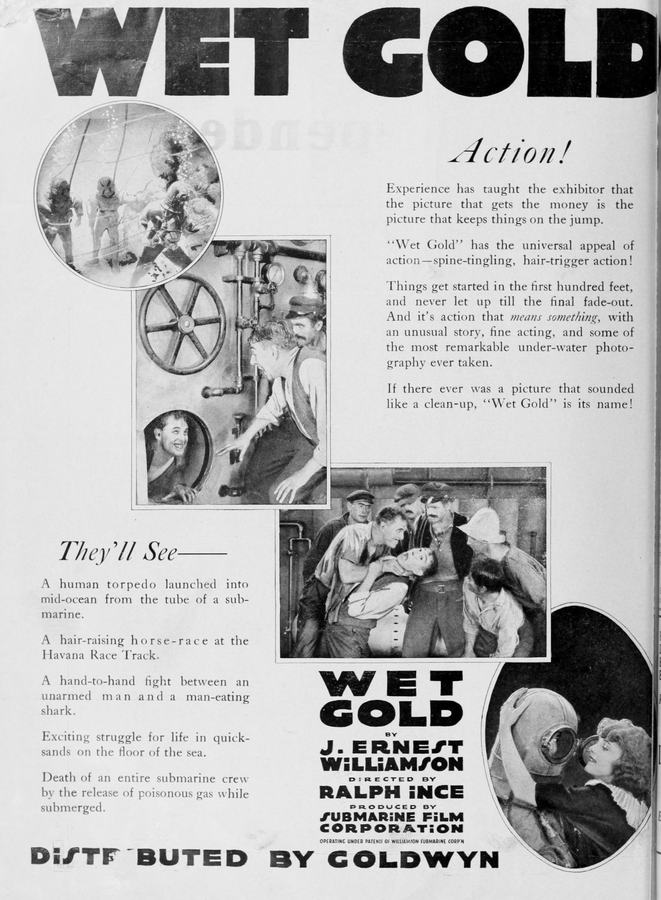
The abyss has always held a peculiar magnetism for the cinematic lens, yet few pioneers delved into its crushing pressures with the audacity of J. Ernest Williamson. In his 1921 masterwork, Wet Gold, the ocean is far more than a static backdrop; it is a living, breathing antagonist that dictates the rhythm of the narrative. This isn't merely a tale of sunken treasure; it is a visceral confrontation between early 20th-century industrial ambition and the primal mysteries of the deep.
To understand the weight of Wet Gold, one must first acknowledge the technical wizardry of the Williamson brothers. Using their patented "photosphere"—a submersible tube and chamber system—they brought the actual floor of the ocean to audiences who had previously only seen painted backdrops. Unlike the stylized artifice found in Evangeline, where the environment serves a poetic, pastoral function, the underwater sequences here possess a gritty, documentary-like quality that remains haunting a century later.
The lighting in these depths is a triumph of accidental expressionism. The way the sunlight filters through the Caribbean brine, casting long, wavering shadows across the coral, creates a sense of unease that no studio lighting could replicate. It is this commitment to the physical reality of the ocean that elevates the film above the standard adventure fare of its era, such as Fighting for Love, which relies more on theatrical tropes than environmental immersion.
Ralph Ince portrays John Cromwell with a rugged, weary stoicism that feels surprisingly modern. Cromwell is not the pristine hero of a fairy tale; he is a man marked by his associations with the criminal underworld. When we first encounter him escaping the "pirates," there is a palpable sense of desperation in his movements. Ince avoids the over-the-top gesticulation common in the silent era, opting instead for a performance grounded in physicality and silent resolve.
His chemistry with Aleen Burr’s Grace Hamilton provides the film’s emotional anchor. While Grace begins the film in a somewhat traditional role, her evolution during the marooning sequence shows a grit that mirrors the heroines in A Daughter of the Law. She is not merely a prize to be won but a participant in the struggle for survival. The Hamilton family dynamic, led by Harry McNaughton’s Colonel, adds a layer of Southern courtliness that contrasts sharply with the salt-crusted brutality of the pirates.
Every great adventure requires a foil of significant gravity, and Chipman serves this role with menacing efficiency. The pirates in Wet Gold are not the swashbuckling caricatures of later Hollywood iterations; they are modern scavengers, motivated by a cold, calculating avarice. This depiction of villainy is far more grounded than the whimsical antagonists in Chris and His Wonderful Lamp. Chipman represents the dark side of the industrial age—the belief that everything, even the treasures of the past, is ripe for the taking through brute force.
The tension reaches its zenith when Cromwell is accosted while in his diving gear. The vulnerability of the diver—tethered to the surface by a literal lifeline—is a metaphor for the precariousness of the human condition. In these moments, the film shifts from a treasure hunt to a psychological thriller. The silence of the medium works in its favor here; the lack of dialogue amplifies the rhythmic hiss of the imagined air pump and the muffled thuds of struggle beneath the waves.
Williamson, who also handled the writing, displays a keen understanding of narrative tension. The shift from the sun-drenched streets of Havana to the claustrophobic confines of a submarine shows a sophisticated grasp of atmospheric contrast. While films like Hit or Miss might struggle with tonal consistency, Wet Gold maintains a singular focus on the mounting stakes of the treasure hunt.

The middle act, involving the marooning of the Hamilton party, serves as a crucial pause, allowing the audience to feel the isolation of the characters. It is a sequence that echoes the existential weight found in Livets Omskiftelser, where the environment itself becomes a judge of character. Cromwell’s escape and subsequent infiltration of the pirate submarine are choreographed with a kinetic energy that belies the technical limitations of 1921 cameras.
The finale of Wet Gold is nothing short of spectacular. The destruction of the submarine is handled with a level of practical effects work that would make modern directors envious. There is a tactile quality to the debris and the rushing water that CGI simply cannot replicate. This visceral ending provides a catharsis that is both earned and visually stunning. It reminds us that for all its technical innovation, Wet Gold is at its heart a morality play about the destructive nature of unchecked greed.
When comparing the film's intensity to other contemporary works like The Brute Breaker, one sees a distinct difference in how conflict is resolved. While The Brute Breaker focuses on individual physical prowess, Wet Gold uses the machinery of the modern world—submarines, diving suits, explosives—to heighten the drama. It is a film that looks forward to the techno-thrillers of the future while remaining rooted in the classic adventure tradition.
To truly appreciate Wet Gold, one must place it within the broader tapestry of international silent cinema. Consider the social critiques present in Parasites of Life or the heavy melodrama of Drankersken. Wet Gold occupies a different space; it is a film of action and exploration. It shares more DNA with the rugged individualism of Let 'er Go or the stoic masculinity of Silnyi chelovek.
Even when compared to European imports like Die beiden Gatten der Frau Ruth or the patriotic fervor of For sit Lands Ære, Williamson’s work stands out for its pure, unadulterated spectacle. It doesn't rely on complex social hierarchies or nationalistic tropes; it relies on the universal human desire to uncover what is hidden. It is this elemental appeal that has allowed the film to endure, even as the technology that created it became obsolete.
As a critic, one often encounters films that are historically significant but narratively hollow. Wet Gold avoids this trap. While the plot—a treasure map, a beautiful daughter, a band of pirates—is familiar, the execution is revelatory. The film captures a moment in time when the world was still full of "blank spaces" on the map, and the ocean floor was the final frontier.
The cast, particularly Ralph Ince and Alicia Turner, deliver performances that bridge the gap between the theatricality of the 19th century and the naturalism of the 20th. They inhabit their roles with a sincerity that prevents the film from descending into camp. Even smaller character studies like The Girl Problem or the whimsical Cinders lack the sheer scope and ambition that Williamson poured into every frame of this production.
In the final analysis, Wet Gold is a testament to the power of the cinematic imagination. It took a medium that was barely twenty years old and plunged it into the depths of the ocean, proving that there were no limits to where the camera could go. It remains a cornerstone of the adventure genre, a shimmering piece of cinematic gold that has lost none of its luster over the decades. For those seeking to understand the origins of the blockbuster, or for those who simply love a well-told tale of high-seas peril, this film is an essential, immersive experience.
Reviewed by the Deep Sea Chronicler. All rights reserved.

IMDb —
1923
Community
Log in to comment.