DbcultAccessing Vault...
Cult Review
Senior Film Conservator
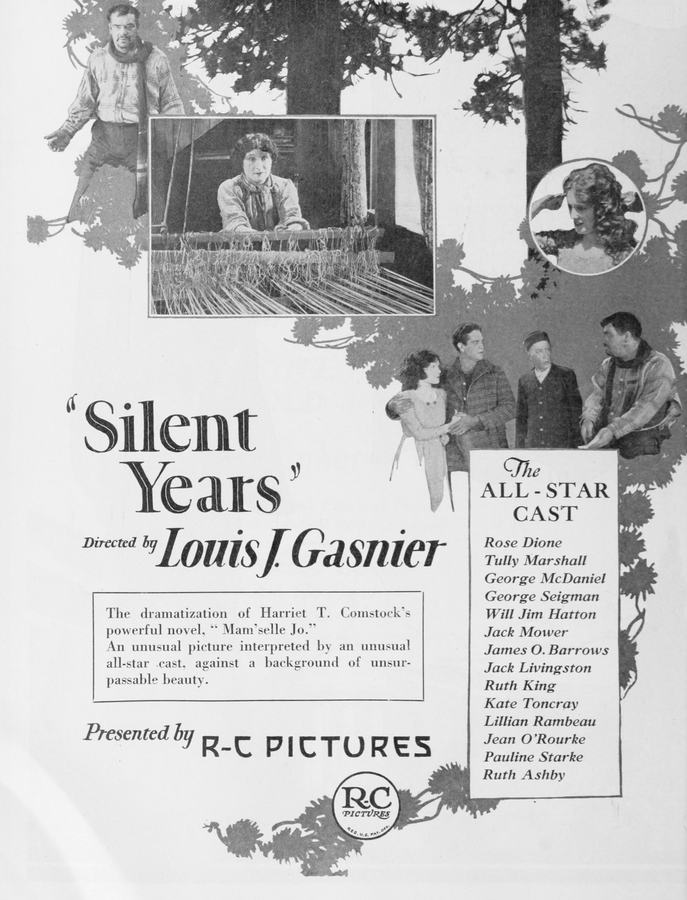
*Silent Years* does not demand attention—it *inspires* it. A film that breathes in the stillness of its setting, it mirrors the slow, deliberate rhythm of a farmer plowing through stubborn soil. George A. McDaniel’s Jo Morey is not a heroine in the traditional sense; she is a force of nature, her silence louder than the river that carves the St. Lawrence Valley. The film’s opening scenes linger on the cracked earth, the creak of wooden beams in her father’s barn, and the distant hum of a steam engine—a metaphor for the encroaching modernity that Jo resists with every furrowed brow.
The narrative pivots on an act of quiet defiance: Jo’s inheritance of a barren farm and her refusal to let it remain so. Her sister’s invalidity becomes both a burden and a bond, a duality that director Eve Unsell underlines with haunting close-ups—fingers brushing a sister’s fevered skin, the tremble of a hand clutching a ledger. When Henry Langley (Jack Mower) enters, his proposal is less a declaration of love than an ambush of Jo’s autonomy. His refusal to wait, his marriage to the wealthier Mary Malden (Ruth Ashby), is a narrative betrayal that lingers like the scent of burnt fields.
Eight years later, the film’s true pulse quickens. A baby, left at Jo’s doorstep with a note that demands secrecy, becomes the axis around which the story spins. The child, Donelle (Ruth King), is both a gift and a curse. Her presence fractures the valley’s social fabric, the villagers’ whispers a chorus of judgment. Tom Gavot (Jack Livingston), with his earthy pragmatism, emerges as a counterpoint to Jo’s idealism—a man who understands the land’s fickle nature, who protects Donelle from the village’s scorn with a simplicity that borders on wisdom.
Mary’s return is a crescendo of pathos. Her claim to Donelle is not born of maternal instinct but of societal expectation—she marries Langley not out of love, but to secure her status. Pauline Starke’s performance as Mary is a masterclass in performative restraint; her eyes betray more than her words ever could. Jo’s rejection of her is not cruelty but conviction. The film’s moral core lies in Jo’s refusal to be swayed by guilt or obligation. She is the land itself—uncompromising, enduring.
The cinematography by James O. Barrows is a silent character in this drama. Wide shots of the valley emphasize Jo’s isolation, while tight close-ups on her hands—plowing, stitching, cradling—capture the labor that defines her existence. The score, sparse and melancholic, feels like the wind through the trees, a reminder that time is both a witness and a thief. The film’s most striking moment comes when the priest (Will Jim Hatton) reveals Donelle’s parentage to Jo’s father, Pierre (George Siegmann). His reaction—a mix of pride and sorrow—is etched into the screen with the weight of generations.
Comparisons to Harriet T. Comstock’s *Lions and Ladies* or *The Birth of a Nation* are inevitable, but reductive. Unlike D.W. Griffith’s epic, *Silent Years* finds grandeur in the mundane. It is a film about the quiet heroism of women like Jo, who transform desolation into sustenance. The script’s dialogue is sparse, allowing the actors to convey subtext through glances and gestures. Ruth Ashby’s Mary, for instance, is never villainized; her choices are contextualized within a patriarchal framework that stifles female agency.
The final act is a masterstroke of ambiguity. Donelle’s revelation of her parentage is not a tear-jerker but a quiet reckoning. Her flight to Tom, their proposal, and Pierre’s eventual acceptance are rendered with a grace that avoids sentimentality. The film’s resolution is not tidy; it is a balm for the audience’s own unresolved tensions. Jo’s joy at her child’s happiness is not triumph but relief—a recognition that some sacrifices, however painful, are not in vain.
Technically, the film is a marvel. The use of light and shadow in the farmhouse scenes is reminiscent of German Expressionism, yet the tone remains distinctly American. The editing by Kate Toncray is taut, each cut a heartbeat. Even the sound design, minimal as it is, contributes to the film’s emotional texture—the creak of a chair, the rustle of paper, the distant cry of a bird, all layered to create an aural landscape as rich as the visual one.
For modern audiences, *Silent Years* is a time capsule and a provocation. It challenges the myth of the rugged individualist by showing how interconnectedness and quiet solidarity can sustain a community. The film’s themes of adoption, class, and gender roles are as urgent today as they were in 1920. In an era of noise, its silence is profound—a reminder that not all stories need grand gestures to resonate.
In conclusion, *Silent Years* is more than a rural drama; it is a meditation on the cost of care and the price of freedom. It joins the pantheon of early cinema’s most underappreciated gems, standing shoulder-to-shoulder with *Heart Strings (1920)* and *Anima allegra* in its exploration of human resilience. For those seeking a film that lingers long after the credits roll, this is it.
IMDb —
1923
Community
Log in to comment.