DbcultAccessing Vault...
Cult Review
Senior Film Conservator
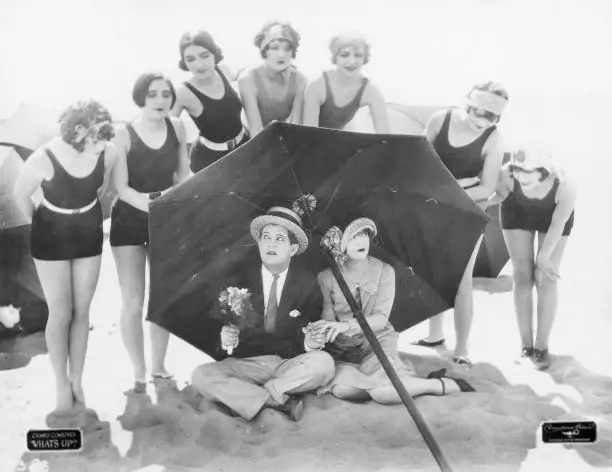
Is this film worth watching today? Short answer: Yes, but only if you have a high tolerance for the frantic, unrefined energy of 1920s slapstick that prioritizes physical motion over narrative logic.
This film is for silent comedy completists and those who enjoy the 'comedy of errors' trope taken to its absolute physical extreme. It is NOT for viewers looking for the sophisticated pathos of a Chaplin film or the structural perfection of Buster Keaton.
1) This film works because it uses a single, mundane prop—the umbrella—to create a cascading series of misunderstandings that feel genuinely organic to the chaos of urban life.
2) This film fails because the middle section featuring the mustache disguise feels like a repetitive stall before the much more effective drag sequence begins.
3) You should watch it if you want to see a raw, unpolished example of early 20th-century amusement park culture captured on location, which serves as a fascinating historical time capsule.
In 'What's Up?', the umbrella is not just a tool for staying dry; it is a weapon of social destruction. The opening sequence, where Cliff Bowes attempts to find Rose Shirley amidst a sea of identical black canopies, is a masterclass in low-budget frustration. It highlights a recurring theme in 1920s shorts: the struggle of the individual to maintain identity in a rapidly modernizing, crowded world.
When Cliff accidentally assaults Rose’s father, thinking he is a rival or a thief, the film sets its hook. Unlike the more polished Plain Clothes, which relies on a more traditional detective narrative, 'What's Up?' thrives on the sheer kinetic energy of the mistake. The violence here is blunt and unsentimental. It works. But it’s flawed.
The choreography of the umbrella fight is surprisingly complex. Bowes uses his thin frame to weave through the crowd, creating a visual rhythm that mimics the pitter-patter of the rain. It’s a loud movie that doesn’t make a sound. The frustration is palpable, and for a modern audience, it mirrors the modern annoyance of navigating a crowded subway or airport.
The film’s second act relies on the trope of the disguise. First, we have the mustache—a classic silent film staple. It’s a failure of imagination; the mustache is too small, too obvious, and serves only to bridge the gap to the film’s real centerpiece: the drag sequence. When Cliff dons women's clothes, the film shifts from a simple chase into a bizarre romantic farce.
The father falling for Cliff-in-drag is a bold, if predictable, choice. What makes it stand out is Bowes' performance. He doesn't try to be a 'convincing' woman; he plays the role with a desperate, wide-eyed terror that makes the father's attraction feel even more absurd. It’s a subversion of the masculine hero archetype that was common in films like Let's Go.
This sequence also introduces the 'other woman' subplot. The moment she identifies the father as a 'masher' (a 1920s term for a harasser) turns the hunter into the hunted. It’s a sharp pivot that keeps the pacing from sagging. The crowd turning on the father provides a satisfying, if chaotic, sense of justice that balances Cliff’s own misfortunes.
Much of the third act takes place in an amusement park, a setting that filmmakers of the era loved for its built-in kinetic energy. We see this used in other films like Beaches and Peaches, but here it feels more claustrophobic. The use of the 'small autos' (early bumper cars or cycle-cars) is the film’s technical highlight.
The transition from the park enclosure to the open water is a jarring, surreal moment. One minute they are circling a wooden track, and the next, they are splashing into the ocean. This lack of logical transition is exactly what makes 'What's Up?' feel like a fever dream. It’s not interested in the laws of physics or geography; it only cares about the next splash.
The cinematography during the chase is remarkably stable for 1923. The camera captures the vibration of the small cars, giving the viewer a sense of the bone-shaking reality of these early thrill rides. It’s a visceral experience that holds up better than the film’s more dated jokes about mustaches.
Yes, the physical humor is universal. While the social mores of 'mashing' and formal dating rituals have changed, the panic of being caught in a lie or a bad disguise remains timeless. The umbrella sequence, in particular, is a relatable bit of observational comedy that predates the modern sitcom by decades.
However, if you are looking for character development, look elsewhere. Cliff and Rose are ciphers. They exist only to be moved around the board like chess pieces in a very loud, very wet game. The film is a sprint, not a marathon.
Pros:
The location shooting at the amusement park is vibrant and historically fascinating. Cliff Bowes has a unique, jittery energy that differentiates him from the more stoic stars of the era like those in Exile. The pacing in the final five minutes is breakneck and genuinely exciting.
Cons:
The 'other woman' character is underdeveloped and serves only as a plot device. The initial conflict with the umbrellas goes on a beat too long. The film lacks the emotional resonance found in contemporary dramas like Assunta Spina.
'What's Up?' is a chaotic, messy, and occasionally brilliant piece of silent ephemera. It doesn't aim for the stars; it aims for the funny bone and the water trough. While it lacks the polish of a major studio production like The Four Horsemen of the Apocalypse, its low-stakes madness is refreshing.
It is a film of moments rather than a cohesive whole. The umbrella fight, the drag reveal, and the watery finish are three distinct peaks in a landscape of otherwise standard slapstick. It’s a fun, short ride that reminds us that even a hundred years ago, a bad date could turn into a literal car wreck. Watch it for the history, stay for the splash.
IMDb 5.3
1934
Community
Log in to comment.