DbcultAccessing Vault...
Cult Review
Senior Film Conservator
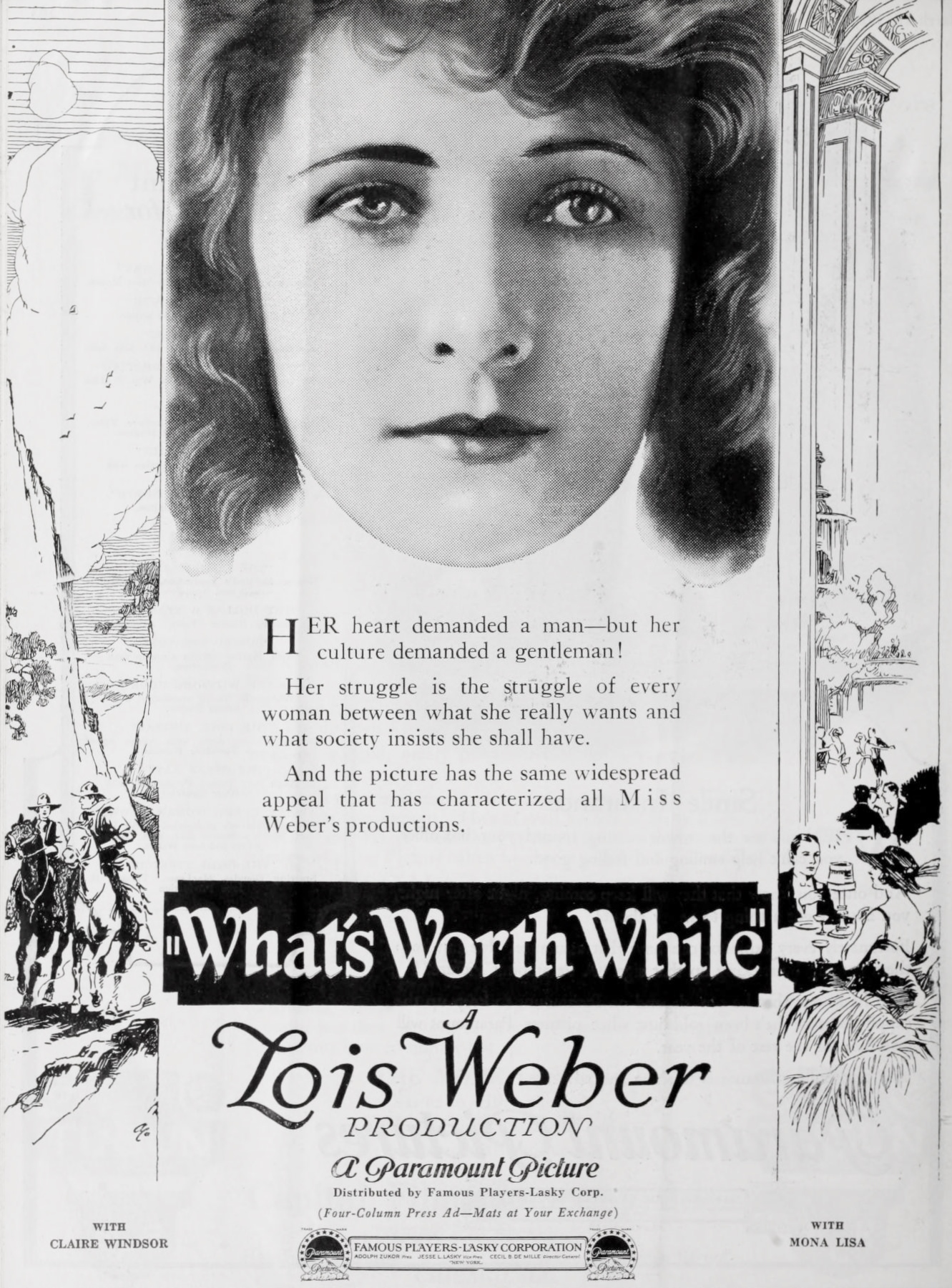
Lois Weber’s What’s Worth While? survives only in fragment reels and a battered continuity script, yet its afterimage burns brighter than many intact features of 1921. Weber, once Hollywood’s highest-paid director, threads a sardonic needle through the plush cushion of Gilded-Age matrimony, stitching together a cautionary fable that feels startlingly modern: be careful what aesthetic you wish for—you just might inhabit it.
The film opens with a dissolve from a monochrome portrait—Elton in ten-gallon hat—to Phoebe’s manicured fingers closing a locket. Weber’s visual grammar is already at work: the photograph is not a keepsake but a prospectus, an IPO on masculine potential. When Phoebe boards the plush Pullman westward, the camera crabs sideways through coal-smoke and cotton-gin haze, as though the frame itself is skeptical of her quest.
On location in Kern County oil fields, cinematographer Edwin S. Porter (yes, the Great Train Robbery pioneer, moonlighting here) captures derricks as infernal cathedrals. Elton emerges from a gusher’s spray, silhouetted against a magnesium flare—an American Kris appearing out of industrial chaos. Their courtship ritual is staged on a slag heap at dusk; the two exchange vows of affection while soot drifts like black confetti. Weber underscores the irony: love blooms on terrain already leased, drilled, and depleted by Phoebe’s father.
Cue the intertitle—"Across the water where manners are minted like coins." Weber dispatches Elton to a montage of tourist postcards: the Folies Bergère, a Swiss finishing school, a Scottish shooting box. Yet the director refuses to film these locales; instead she shows us a series of painted backdrops flickering past Elton’s rail-car window. The artifice is intentional: Europe is revealed as a commodified façade, a stack of chromo-lithographs one can rent by the week.
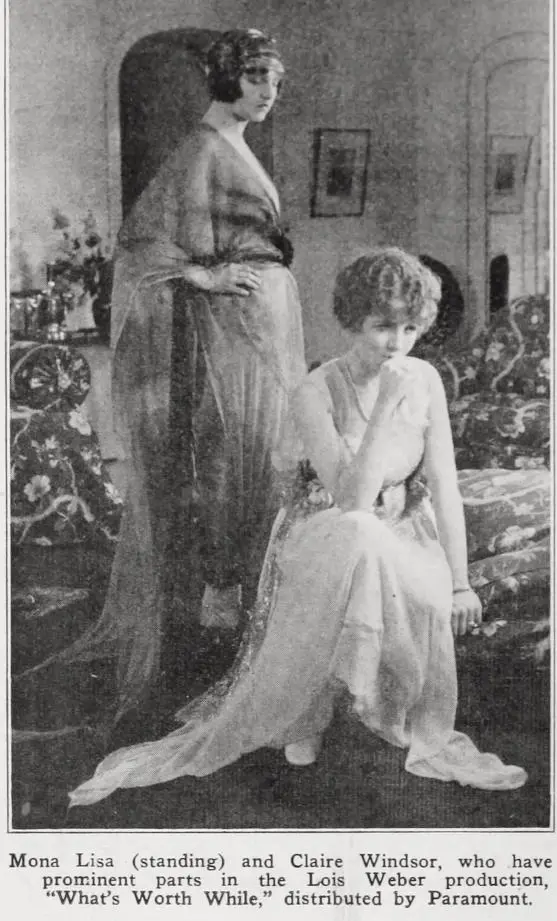
Upon re-entry Elton 2.0 steps onto the platform clutching a cane topped with a silver fox head. Claire Windsor’s pupils dilate not with desire but with recognition of ownership: she has purchased the final collectible for her marital curio cabinet. Their wedding breakfast—shot in two-strip Technicolor tests now lost—reportedly featured a footman pouring orange juice the shade of molten gold, a hue that matched the bride’s ambition.
What follows is a domestic horror story wearing comedy’s tweeds. In their Manhattan townhouse, Elton practices Bach preludes while Phobe hosts salon evenings for suffragettes who speak more about decor than votes. Weber inserts a bravura sequence: a slow pan across a hallway lined with mirrored doors, each reflection showing Elton adjusting his cravat in infinitesimal increments—Narcissus trapped in a house of bespoke mirrors.
Suspicion arrives wearing cousin Sophia’s cloche hat. Mona Lisa—yes, that was her stage name—plays Sophia as a lounging panther, all hooded lids and cigarette smoke. A single intertitle whispers: "A woman may share your blood, but never your toothbrush." Weber frames the alleged flirt inside a lattice of shadows cast by venetian blinds, turning every glance into evidence.
Phoebe’s gambit—feigning tubercular frailty—propels the couple back west. On the sun-scoured porch of a clapboard shack, Elton sheds his London tailoring like a snake outglossing its skin. Watch how Calhern’s posture loosens: spine curves, vowels flatten, hands find pockets where once they flourished kid gloves. Weber’s genius lies in letting the audience feel the relief; the film exhales four-reels of pent-up corsetry.
In the penultimate scene, twilight smears vermilion across the sky. Elton kneels, scoops a handful of desert dust, lets it sift through his fingers—an eloquent mime meaning: this is the only polish I require. He confesses the ruse: the Continental education, the pretentious drawl, the whole masquerade designed to teach Phoebe that refinement without resonance is merely varnish over pine.
Lois Weber was famous for embedding social pamphlets inside melodrama. Here she targets class tourism: the wealthy treating human beings as upgradeable products. Notice the recurrence of frames within frames: photographs, mirrors, train windows—every image a reminder that perception can be purchased, then curated. The film’s title itself is a pun: the phrase "worthwhile" splinters into two words—worth / while—asking how much of our allotted time we should spend performing status.
Watch What’s Worth While? back-to-back with Weber’s own The Lure of New York and you’ll see a diptych about metropolitan seduction. Pair it with From Broadway to a Throne for tales of social climbing, or with From Gutter to Footlights to witness how authenticity gets repackaged as marketable persona. All four films form a secret quartet on the American obsession with self-reinvention.
Claire Windsor’s Phoebe is a masterclass in micro-gesture: notice how her left eyebrow arches a millimeter when Elton mispronounces "Götterdämmerung," or how she strokes a silk cushion as though testing the fabric of her future. Louis Calhern—years before his mellifluous villains—gives Elton a slow, sun-baked charisma that curdles into urbane chill, then melts back into warmth. The moment he drops the monocle into a whisky tumbler, the clink resounds like a jail door unlocking.
Though mostly monochrome, the film tints sequences for emotional syntax: amber for frontier nostalgia, cerulean for Atlantic passage, sickly green for the adultery-that-isn’t. Weber employs a proto-dolly shot during a ballroom waltz; the camera glides between waltzing couples to isolate Phoebe’s face, her smile calcifying. It anticipates the mobile camera of late silent cinema, outdoing even The Virgin of Stamboul in expressive kinetics.
Surviving cue sheets suggest a motif-driven score: a lazy horn call for Elton’s ranch, a gavotte for his European makeover, and a reprise of the horn call—now orchestrated with celesta—when authenticity is restored. Contemporary exhibitors reported audiences humming the horn theme leaving the theater, proof that Weber’s storytelling bypassed language and lodged straight into muscle memory.
Today influencers curate lives on glowing rectangles; dating apps reduce humans to swipe-able résumés. Weber anticipated our algorithmic self-editing by a century. What’s Worth While? whispers that the performance of worth is never worth the while if it eclipses the marrow of the performer. In an age where you can buy a crash-course in "European etiquette" for $999, the film feels like prophecy wearing spurs.
Only a 42-minute condensation circulates via 16mm dupes in private archives; the last intact print was lost in the 1965 MGM vault fire. Yet the Academy Film Archive holds two reels with original tint, and a 4K scan is rumored for 2025. Cinephiles trade bootleg rips like samizdat, overlaying contemporary piano scores that range from Satie-esque minimalism to electro-swing abominations. Whatever the format, seek it out; even mutilated, Weber’s voice slices through nitrate decay like a desert sunrise.
When the end title card of What’s Worth While? fades, you’re left holding a question that vibrates inside your ribs: if love asks you to choose between polished veneer and raw timber, which version would survive the drought? The film refuses to answer; instead it hands you a fistful of dust and invites you to taste the grit. That grit—grit of truth, of mistake, of reconciliation—is what lingers, like the ghost of a gusher still staining the sky long after the oil has burned away.
IMDb 6.3
1935
Community
Log in to comment.