DbcultAccessing Vault...
Cult Review
Senior Film Conservator
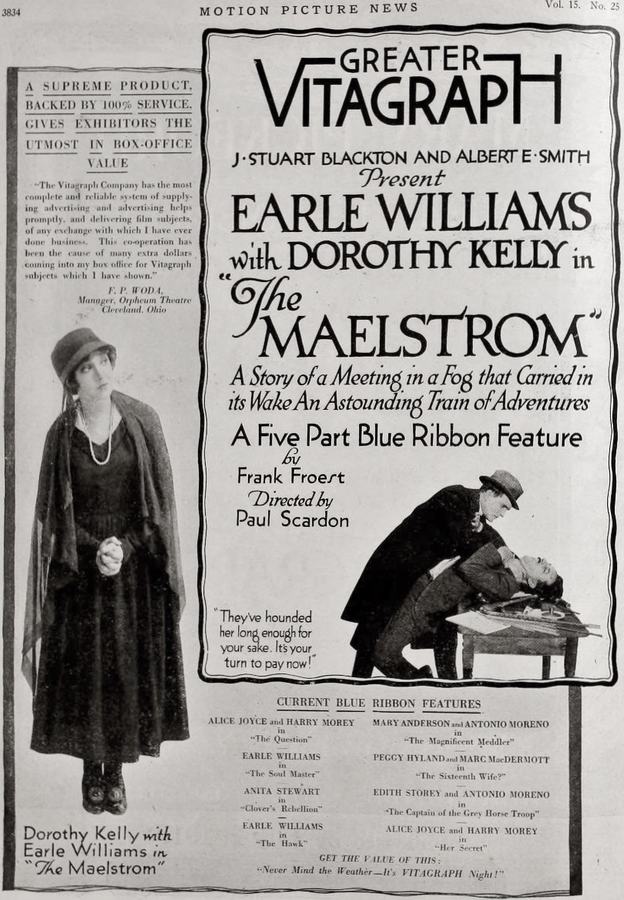
There are films that merely tell a story, and then there are those that ensnare you, pulling you into their very fabric with an irresistible, almost predatory grip. John S. Robertson’s 1917 cinematic offering, The Maelstrom, belongs unequivocally to the latter category. From its very inception, the film establishes an atmosphere of disquiet and impending doom, a testament to its masterful construction and the burgeoning sophistication of silent-era narrative. It’s a work that doesn't just present a plot; it unfurls a tapestry of fate, deception, and the precariousness of innocence, all against a backdrop that feels both intimately familiar and chillingly alien. As an early example of the crime thriller, it stands as a pivotal piece, demonstrating how powerful visual storytelling could be, even in the absence of spoken dialogue. This is a film that demands attention, rewarding viewers with a complex narrative and a pervasive sense of dread.
Our unwitting protagonist, Jimmie Hallet, portrayed with a compelling blend of naiveté and burgeoning resolve by Gordon Gray, is a man thrust into the eye of a storm he never anticipated. His initial foray into the narrative is perhaps one of the most exquisitely crafted sequences in early cinema, a testament to the power of suggestion and the evocative potential of a simple setting. A dense, almost sentient fog blankets the city streets, a visual metaphor for the obfuscation of truth and the ambiguity of human intentions. It is within this atmospheric shroud that destiny, or perhaps sheer misfortune, intervenes. A spectral figure, a young woman cloaked in urgency and mystery, materializes from the swirling vapor. She presses a clandestine bundle of papers and a single, fateful address into Jimmie’s hands, then vanishes as abruptly as she appeared, leaving behind only the lingering scent of intrigue and a profound sense of bewilderment. This opening gambit, conceived by writers Garfield Thompson, Edward J. Montagne, and Frank Froest, immediately establishes a tone of high-stakes mystery.
Jimmie, driven by a curiosity that borders on the fatalistic, succumbs to the siren call of the unknown. His journey to the specified address is not merely a physical progression but a descent into a world alien to his own. The swift, brutal blow of a blackjack that renders him unconscious serves as a violent baptism into this new reality, a stark severing from his mundane existence. This narrative device, while a staple of the thriller genre, is executed here with a stark efficiency that immediately elevates the stakes. It's a moment that echoes the sudden, life-altering shifts seen in films like The Unfortunate Marriage, where characters find their lives irrevocably altered by a single, unforeseen event. Gray’s performance in these early moments is crucial; he conveys Jimmie’s initial bewilderment and subsequent dawning horror with a nuanced physicality that transcends the limitations of silent film acting. His wide eyes, hesitant steps, and eventual collapse speak volumes without a single word, drawing the audience into his rapidly escalating nightmare.
The true horror of Jimmie’s predicament solidifies upon his awakening. The discovery of Greye-Stratton’s lifeless body is a visceral shock, not just for Jimmie, but for the audience. The realization that the enigmatic girl from the fog was Stratton’s daughter, Peggy, adds a layer of tragic irony and personal entanglement to the unfolding drama. Dorothy Kelly, as Peggy, delivers a performance that oscillates between vulnerability and veiled strength, a complexity that hints at deeper currents beneath her initial frantic actions. She is not merely a damsel in distress; she is a catalyst, a figure whose desperate act ignites the entire convoluted plot. Her character's introduction, much like the mysterious figures in The Waxen Doll, serves to draw the protagonist into a perilous, unforeseen reality where trust is a luxury few can afford. Kelly masterfully uses subtle facial expressions and body language to convey Peggy's fear, grief, and the hidden knowledge she carries, making her an intriguing and sympathetic figure.
The immediate consequence of this discovery is Jimmie’s entanglement with the forces of law and order. Questioned by the police, he finds himself caught in the classic "wrong man" scenario, a trope that The Maelstrom elevates through its relentless pacing and the palpable sense of injustice that permeates Jimmie's every interaction. The film masterfully builds tension, not just through the external pressures of the police investigation, but through Jimmie’s internal struggle as he grapples with the inexplicable circumstances that have conspired against him. The police, represented by figures like Robert Gaillard, are portrayed as relentless, their suspicion a constant, suffocating presence. This psychological depth, even in a silent feature, is remarkable, a testament to the directorial prowess of John S. Robertson and the evocative power of the screenplay penned by Garfield Thompson, Edward J. Montagne, and Frank Froest. The audience feels Jimmie's desperation, his isolation, and the terrifying weight of a justice system poised to condemn him based on circumstantial evidence alone. This predicament makes his journey not just an external adventure, but an internal battle for his very identity and freedom.
Beyond the immediate threat of police suspicion, Jimmie is soon drawn into the murky depths of a criminal underworld, dominated by the enigmatic and ruthless figure of Ling. Bernard Siegel, in the role of Ling, crafts a villain whose menace is conveyed through subtle gestures and piercing gazes, a truly unsettling presence that rivals the shadowy antagonists of contemporary thrillers like The Yellow Menace. Ling's gang is not merely a collection of thugs; they represent a systemic corruption, a hidden society operating just beneath the veneer of civility. Their reach seems limitless, their methods brutal, and their grip on the city's underbelly absolute. The film excels in portraying the sheer scale of this criminal enterprise, making Jimmie’s struggle feel not just personal, but a fight against an overwhelming, pervasive evil that threatens to consume him entirely. The supporting cast members, including Frank Crayne, Earle Williams, and Denton Vane as members of Ling's formidable organization, contribute to the sense of an omnipresent threat, their silent performances adding layers of silent intimidation.
The narrative expertly weaves together the murder mystery with the gangster plot, ensuring that neither aspect overshadows the other. Instead, they become inextricably linked, forming a complex web of deceit, betrayal, and violence. Jimmie’s mission, therefore, becomes twofold: to clear his name and to dismantle the machinations of Ling’s formidable organization. The stakes are perpetually high, and the film rarely allows for moments of respite, propelling the audience forward with an almost breathless urgency. This relentless drive is a hallmark of Robertson’s direction, demonstrating an early understanding of how to sustain suspense across an extended runtime without relying on dialogue. The tension is a living entity, constantly tightening its grip, making every close call and every narrow escape feel genuinely earned. The intricate dance between the police investigation, Jimmie's personal quest for truth, and the insidious influence of Ling's criminal empire creates a narrative density that is remarkable for its time.
John S. Robertson’s direction is nothing short of visionary for its era. He leverages the nascent language of cinema to great effect, transforming simple elements into powerful narrative tools. The recurring motif of fog, for instance, is not merely a weather condition but a character in itself, obscuring vision, distorting reality, and symbolizing the moral ambiguity that pervades the story. The use of low-key lighting, chiaroscuro effects, and stark compositions creates a visual lexicon that enhances the film’s noirish sensibilities, long before the term "film noir" was even coined. The camera work, while perhaps rudimentary by modern standards, is remarkably dynamic, guiding the viewer's eye and emphasizing crucial details. Robertson masterfully employs close-ups to capture the raw emotions of his actors and wide shots to establish the oppressive atmosphere of the city, making every frame contribute to the overarching sense of unease.
The pacing is another area where The Maelstrom truly shines. Despite its silent nature, the film never drags. Each scene serves a purpose, advancing the plot, developing character, or ratcheting up the tension. The editing maintains a brisk rhythm, allowing the story to unfold with a compelling momentum. This mastery of cinematic rhythm is a trait shared by many groundbreaking silent films, such as the dramatic intensity found in Dikaya sila, where the emotional beats are precisely timed to maximize impact. Robertson understands that silence, far from being a limitation, can be a powerful amplifier of suspense and emotion, allowing the audience to project their own fears and anxieties onto the screen. The judicious use of intertitles ensures that vital plot points are communicated clearly, but never at the expense of the visual narrative, which remains paramount. The director's keen eye for visual storytelling allows the film to communicate complex ideas and intense emotions with remarkable clarity, proving that a picture truly is worth a thousand words.
Beyond the compelling narrative and astute direction, the performances elevate The Maelstrom to a higher echelon of early cinema. Gordon Gray, as Jimmie Hallet, carries the emotional weight of the film with remarkable grace. He portrays a man whose life is upended, forced to navigate treacherous waters, and his journey from bewildered innocence to determined resolve is utterly convincing. His expressions, subtle shifts in posture, and reactive gestures convey a rich inner life that transcends the absence of spoken dialogue. From his initial shock to his growing courage, Gray’s performance is a masterclass in silent acting, making Jimmie’s plight deeply resonant and empathetic. It's a performance that holds its own against the more celebrated protagonists of the era, showcasing Gray's undeniable talent and his ability to command the screen through sheer presence.
Dorothy Kelly, as Peggy Stratton, is equally captivating. Her character is not simply a plot device but a complex individual grappling with loss, fear, and a desperate need for justice. Kelly imbues Peggy with a resilience that belies her initial fragility, making her transformation throughout the film both believable and engaging. Her interactions with Gray are charged with a subtle chemistry, hinting at a burgeoning connection amidst the chaos, without ever resorting to overt sentimentality. The supporting cast, including Bernard Siegel's chilling portrayal of Ling, John S. Robertson (who also directed, a common practice in early cinema), Robert Gaillard, Frank Crayne, Earle Williams, Denton Vane, and Julia Swayne Gordon, all contribute to the rich tapestry of the film, each bringing a distinct presence to their roles. Siegel, in particular, manages to create a truly memorable antagonist, his quiet menace more terrifying than any overt display of violence. His performance brings to mind the understated but profound evil found in characters from films like Marionetten, where the villain's presence looms large over the narrative, shaping events through sheer force of will and intimidation rather than brute strength. The ensemble works in perfect concert, each actor understanding the nuances required to convey their character's motivations and emotional states without the benefit of dialogue.
At its core, The Maelstrom is a profound exploration of fate and the arbitrary nature of misfortune. Jimmie Hallet's initial encounter in the fog is a pure accident, yet it sets in motion a chain of events from which he cannot escape. The film delves into the psychological impact of being falsely accused, the terrifying prospect of losing one's freedom and reputation due to circumstances entirely beyond one's control. It’s a theme that resonates deeply, touching upon universal anxieties about justice and the fragility of truth in a world rife with deception. The screenplay, crafted by Thompson, Montagne, and Froest, is remarkably intricate, balancing multiple plot threads without ever losing its focus on Jimmie’s personal ordeal. The narrative suggests a world where individuals are often pawns in larger, unseen games, a concept that echoes the existential questions posed by films like The Eternal Question, albeit through a more action-oriented lens.
The film also subtly touches upon themes of class and societal stratification. Ling's gang operates in the shadows, preying upon the vulnerable and exploiting the system. The contrast between Jimmie's respectable, if unassuming, life and the brutal realities of the criminal underworld highlights the stark divides within society. This social commentary, while not overtly didactic, adds another layer of depth to the narrative, making it more than just a simple crime thriller. It invites viewers to consider the unseen forces that shape lives and the precariousness of one's position within the societal structure, much like the challenging social narratives found in films such as The Country Mouse or Miss Peasant, albeit in a vastly different genre context. The film's ability to weave these deeper social observations into a taut, engaging thriller speaks volumes about the sophistication of its narrative design.
More than a century after its release, The Maelstrom remains a potent and captivating cinematic experience. Its ability to generate palpable suspense, develop compelling characters, and explore complex themes without the aid of spoken dialogue is a testament to its artistic merit and the enduring power of visual storytelling. It stands as a significant work in the early history of the thriller genre, laying groundwork for countless films to follow. The film’s intricate plot, where every clue and every encounter feels significant, ensures that the audience is constantly engaged, piecing together the puzzle alongside Jimmie. The sheer ingenuity of its narrative construction, combined with its atmospheric visual style, makes it a timeless piece of entertainment.
For enthusiasts of silent cinema, or indeed anyone with an appreciation for well-crafted mystery and suspense, The Maelstrom is an absolute must-see. It’s a film that transcends its historical context, speaking to universal anxieties and human resilience. It reminds us that even in the most bewildering and dangerous circumstances, the human spirit can find the resolve to fight for truth and justice. Its influence, though perhaps subtle, can be traced through the lineage of crime dramas and mystery thrillers, showcasing how early filmmakers were already pushing the boundaries of narrative and visual expression. The intricate plotting and the sense of a grand, unfolding conspiracy might even draw parallels to the epic scope of character journeys found in films like Peer Gynt, despite their vastly different thematic ambitions. The lasting impact of The Maelstrom lies in its demonstration that true suspense is built not on dialogue, but on visual cues, character stakes, and relentless narrative drive, elements that continue to define the genre today.
In conclusion, The Maelstrom is far more than a historical curiosity; it is a vibrant, thrilling piece of cinematic art that deserves wider recognition. Its seamless blend of gripping mystery, character-driven drama, and a pervasive sense of danger makes it an exhilarating watch. The performances are compelling, the direction is innovative, and the screenplay is a masterclass in intricate plotting. It’s a film that grabs you from its opening frames and doesn't release its hold until the final, satisfying resolution. It serves as a powerful reminder of the sophisticated storytelling capabilities of early cinema, proving that even without sound, a film can deliver a profoundly impactful and memorable experience. If you seek a journey into the heart of early cinematic suspense, where shadows speak louder than words and every twist feels earned, then prepare to be swept away by The Maelstrom. It’s a testament to the fact that compelling storytelling, regardless of the technological era, remains the true enduring power of film, capable of enthralling audiences across generations.
IMDb 6.7
1933
Community
Log in to comment.