DbcultAccessing Vault...
6.3/10
Senior Film Conservator
A definitive 6.3/10 rating for a film that redefined the boundaries of cult cinema. When Hell Freezes Over remains a cornerstone of transgressive art.
Is 'When Hell Freezes Over' worth watching today? Short answer: yes, but with significant caveats, primarily for its historical value and unique premise rather than its modern entertainment appeal. This film is an essential watch for animation historians, silent film enthusiasts, and those curious about the nascent stages of cinematic comedy. It is decidedly not for viewers seeking contemporary humor, complex narratives, or high-fidelity animation.
Stepping into the world of “When Hell Freezes Over” is akin to opening a time capsule, a glimpse into the very primordial soup of animated storytelling. It’s a work that, despite its simplicity and brevity, manages to lodge itself in the mind through sheer peculiarity. The premise alone — Hell, but it’s frozen, and Mutt and Jeff have to fix it — is so wonderfully absurd, so utterly unexpected for its era, that it demands attention. This isn't just a film; it's a historical artifact, a comedic oddity, and a testament to the boundless imagination that defined early cinema.
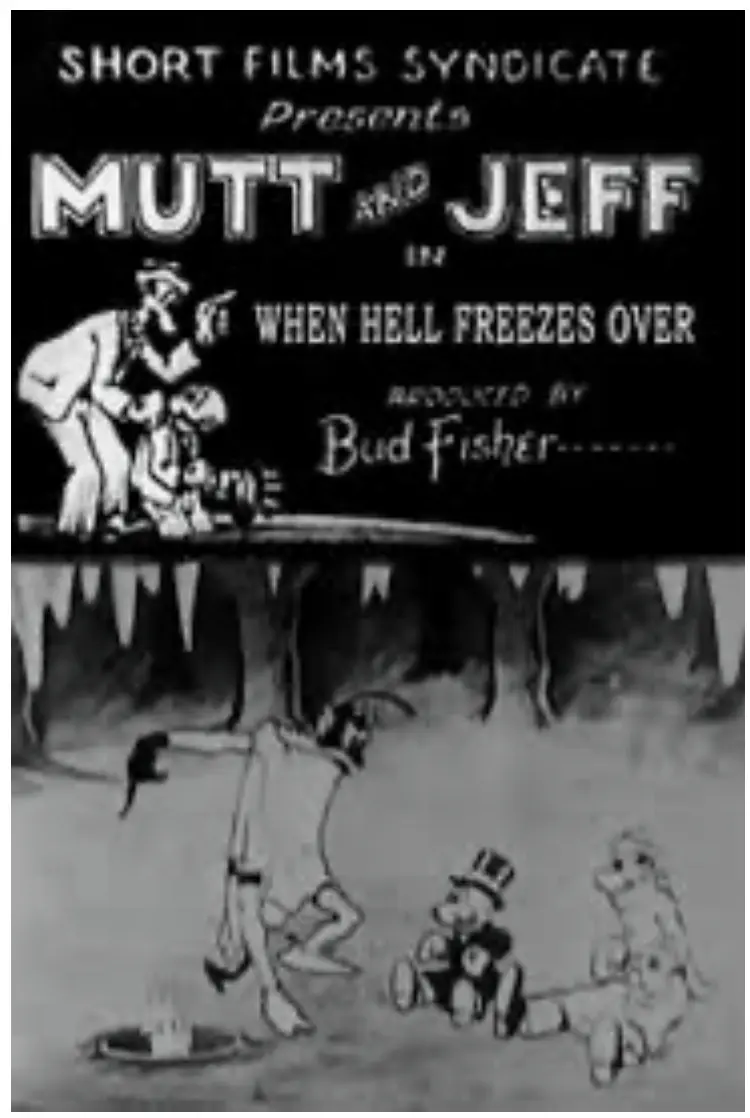
The plot, as straightforward as it is, carries a surprising amount of conceptual weight. Created by Bud Fisher, the mastermind behind the iconic Mutt and Jeff comic strip, the film takes these beloved characters and places them in an eschatological dilemma. The Devil himself, a surprisingly affable figure for the Prince of Darkness, recruits Mutt and Jeff to solve his rather chilly problem. This twist on the traditional fiery Hell is the film's greatest conceptual strength, providing a fresh canvas for slapstick and visual gags that would have been familiar to audiences of the time, yet delivered in an entirely novel setting.
The very idea of a frozen Hell is, in itself, a stroke of genius. It’s a theological paradox presented as a comedic setup, inviting viewers to ponder the implications while simultaneously chuckling at the ensuing chaos. This isn't a deep philosophical treatise, mind you, but for a short animated film from the silent era, it exhibits a remarkable cleverness in its foundational concept. It challenges expectations, which is something even modern blockbusters often struggle to achieve.
Bud Fisher, primarily known as a cartoonist, brought his distinctive style and narrative rhythm to the nascent world of animation. Working with Charles R. Bowers, a key figure in early animation known for his surreal and inventive shorts, the film showcases a particular brand of visual humor. The animation itself is rudimentary by today's standards, often jerky and lacking the fluidity we now expect. Yet, within these limitations, there’s a raw energy, a handmade quality that is undeniably charming.
The characters, Mutt and Jeff, are instantly recognizable from their print origins. Their exaggerated forms and simple expressions translate well to the animated medium, allowing for clear communication of their reactions to the bizarre circumstances. Bowers' influence is palpable in the creative problem-solving and the almost dreamlike quality of the frozen Hellscape. It’s an interesting collaboration, bridging the gap between static comic panels and the dynamic possibilities of moving pictures.
One might compare the pioneering spirit here to other experimental works of the era, such as the early stop-motion efforts seen in George Méliès's films, or even the narrative ambition found in live-action features like The Salvation Hunters, though their mediums diverge significantly. The point is, this was a time of pure, unbridled experimentation, and “When Hell Freezes Over” is a prime example of that audacious spirit.
The humor in “When Hell Freezes Over” is, admittedly, very much of its time. It relies heavily on slapstick, visual puns, and the inherent absurdity of the situation. Mutt and Jeff's attempts to light fires using various increasingly ludicrous methods — from rubbing sticks together to trying to melt ice with tiny matches — are the core of the comedic action. The gags are simple, direct, and designed for immediate, often broad, reactions.
For a modern audience, much of this humor might feel quaint, perhaps even a little slow. The pacing, typical of silent-era animation, allows each gag to play out fully, sometimes to the point of feeling drawn out. However, if one adjusts their expectations and views it through the lens of early 20th-century entertainment, there’s a certain innocent charm. The frustration of the Devil, portrayed with surprisingly human exasperation, adds another layer to the comedy, making him less a figure of dread and more a harried manager of a malfunctioning afterlife.
The film's most successful comedic moments often come from the sheer visual irony: the juxtaposition of ice and fire, the Devil shivering, and the eternal damnation being swapped for eternal frostbite. It’s less about witty dialogue (non-existent, naturally) and more about the power of the visual gag to transcend language and time, even if its punch has dulled slightly with age. It’s not gut-bustingly funny by today's standards, but it's clever. It works. But it’s flawed.
Charles R. Bowers and Bud Fisher, as the primary creative forces, essentially direct the 'performances' of their animated characters. Mutt and Jeff, through their distinctive designs, convey much with minimal movement. Mutt’s tall, gangly frame and Jeff’s shorter, rounder stature are central to their physical comedy. Their reactions — wide eyes, frantic movements, exasperated gestures — are the bedrock of their characterizations.
The Devil, too, is a standout. Far from a terrifying entity, he's presented as almost a bureaucratic figure, burdened by the collapse of his domain's primary function. His 'performance' is marked by a surprising degree of pathos and comedic frustration, making him relatable despite his infernal status. This humanization of a classic villain is an unconventional observation for a film of this period, adding a layer of unexpected depth to what could have been a one-note antagonist.
The lack of dialogue means that every emotion, every intention, must be communicated through visual cues. The animators do a commendable job within their technical limitations, ensuring that even without spoken words, the audience understands the predicament and the characters' reactions to it. It's a testament to the power of pure visual storytelling, a skill often overlooked in an age of constant exposition.
Bud Fisher, as the writer and likely primary creative director, guides the film with a clear, albeit simple, vision. The pacing is deliberate, allowing each comedic beat to land. There are no rapid-fire cuts or complex camera movements; the 'camera' is largely static, observing the action unfold. This simplicity is both a strength and a weakness. It allows for clarity in the gags but can also contribute to the feeling of slowness for contemporary viewers.
The visual tone, or 'cinematography' in an animated context, is striking. The icy Hell is rendered with stark lines and a monochromatic palette (as expected for the era), emphasizing the cold, barren landscape. The contrast between the expected fires and the actual ice is visually potent, even in black and white. The character designs are consistent with the Mutt and Jeff brand, ensuring immediate recognition and familiarity for the audience. The background elements, while minimal, effectively convey the sense of a grand, frozen underworld.
This film works because of its genuinely original premise, its historical significance as an early animated work by a comic strip pioneer, and its charmingly simple execution of visual comedy. It’s a foundational piece, demonstrating the nascent power of animation to subvert expectations.
This film fails because its humor is largely dated, its pacing can feel slow to modern audiences, and its technical limitations are starkly apparent when viewed through a contemporary lens. It demands a sympathetic, historical viewing context.
You should watch it if you are an animation historian, a scholar of silent cinema, or simply someone fascinated by the evolution of comedic storytelling and early cinematic experimentation. It offers a unique window into a bygone era of creativity.
Absolutely, for the right audience. 'When Hell Freezes Over' is a fascinating relic. It offers a unique look at early animated comedy. It highlights the creative genius of Bud Fisher and Charles R. Bowers. The premise remains remarkably fresh, even today. It's a short, accessible piece of film history. It provides context for how animation developed. It's certainly not a laugh-a-minute riot by modern standards. But its historical and conceptual value is immense. It stands as a testament to imagination during cinema's formative years.
“When Hell Freezes Over” is more than just a forgotten cartoon; it’s a fascinating snapshot of early cinematic innovation and comedic sensibility. While its humor and animation style are undeniably products of their time, requiring a certain degree of historical appreciation from the viewer, its core concept remains surprisingly fresh and audacious. Bud Fisher and Charles R. Bowers crafted a piece that challenges expectations, even in its simplicity. It's a testament to the power of an original idea, executed with the raw, pioneering spirit of early animation.
For those willing to step back in time and appreciate cinema as it was being invented, this film offers a unique and thought-provoking experience. It serves as a valuable reminder that even in the most basic forms, creativity can flourish and leave a lasting impression. It’s not a film you’ll necessarily roar with laughter at, but it’s one you’ll certainly remember for its sheer audacity and historical charm. It’s a piece of cinema history that deserves to be unfrozen and examined, not just as an artifact, but as a surprisingly witty prelude to the vast world of animation that would follow. Go in with the right mindset, and you'll find it's a surprisingly cool trip to Hell.
IMDb 6.5
1929
Community
Log in to comment.