DbcultAccessing Vault...
6.9/10
Senior Film Conservator
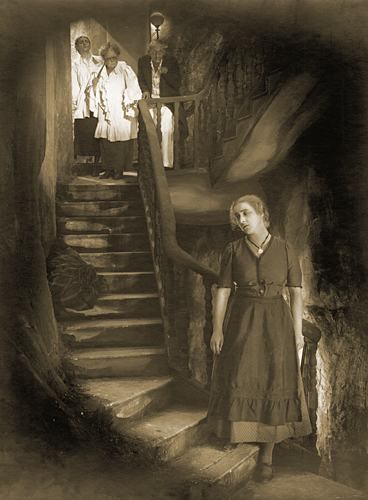
A definitive 6.9/10 rating for a film that redefined the boundaries of cult cinema. Hintertreppe remains a cornerstone of transgressive art.
Carl Mayer, the poet of post-war disillusion, never wrote a single spoken word for Hintertreppe; instead he carved chiaroscuro fissures into the celluloid so that silence itself screams. The film opens on a spiral staircase shot from below—its iron treads resemble the inside of a conch shell, as though every servant who ever climbed left an echo trapped in rust. That image is the first bruise: the staircase is both artery and noose, the only route between the coal cellar where the maid scrubs until her knuckles bleed and the mansard where the mailman stores undelivered dreams.
Fritz Kortner’s body becomes the film’s central text: his spine contorts like a question mark that can never be straightened into an answer. Watch the way he removes his cap—two hesitant jerks, as if the air itself might fine him for presumption. In 1921, German audiences had barely survived a war that left 80,000 men with facial wounds; Kortner’s hobble is the returned repressed, the nation’s own crooked silhouette.
Henny Porten, usually the embodiment of bourgeois virtue, here dilutes her star wattage into something milkier, almost translucent. Her maid is not a proto-feminist rebel but a girl who confuses upward mobility with upward staircases. When she reads the forged letters, her pupils quiver like tea leaves in a disturbed cup; each tremor is a stanza of false hope.
William Dieterle—later Hollywood’s biopic maestro—plays the golden catch with the laconic cruelty of someone who has never needed to articulate desire. He lounges against doorframes as if the world were a chaise longue. Notice the moment he first kisses the maid: he tilts her chin not to see her better but to catch his own reflection in her eyes. Narcissus with a cigarette holder.
The Berlin of Hintertreppe is not the expressionist fever dream of Caligari but a documentary of soot: laundry slapping like wet flags, horse manure drying into mosaic tiles, telegraph wires slicing the sky into saleable parcels. Director Leopold Jessner keeps his camera at waist level, the viewpoint of a child or a dog—someone accustomed to staring at boots. Only twice does he permits himself an overhead godshot: once when the mailman pockets the first letter, and once when the ice cracks under the maid’s weight. In both instances, the camera hovers like a conscience that arrived too late to the scene of the crime.
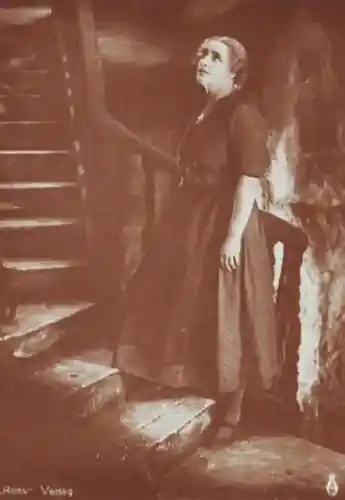
Mayer’s script is a masterclass in dramatic irony without subtitles. The forged letters are never shown in close-up; we infer their content from the way the maid presses them to her collarbone or the dandy flicks ash onto the envelope flap. The absence of words turns viewers into co-authors, forced to hallucinate the perfumed lies that grease the plot.
Compare this strategy to Midnatssjælen, where intertitles spill like drunken diary entries, or Wenn Tote sprechen, which drowns in gothic monologue. Hintertreppe trusts the spectator’s voyeuristic literacy: we overhear rather than read, peep rather than parse.
The film’s rhythm is a slow asphyxiation. Each scene lasts exactly until the emotional oxygen runs out, then jump-cuts to the next suffocation. A recurring visual motif: hands scrubbing, folding, sealing, shredding. Hands are the true face here—Kortner’s knuckles scarred by letter-sorting paper cuts, Porten’s fingertips pruney from bleach, Dieterle’s manicured nails reflecting chandeliers he will never polish himself.
Listen to the score if you get the chance—Eduard Prüß’s 1995 reconstruction for the Munich Film Museum. Violins saw against woodwinds in intervals that feel like missed stamps on a passport. The percussion imitates the clack of a letter press, turning romantic anticipation into bureaucratic dread.
Some historians slot Hintertreppe into the Kammerspielfilm cycle, those claustrophobic chamber dramas that reject expressionist caricature in favor of psychological grit. Yet the film slips that category the way Kortner slips his orthopedic brace: it is too mythic to be purely social-realist. The love triangle resembles a secular nativity gone sour—no star, no magi, only the stink of tallow and the straw of a manger stuffed into a Berlin attic.
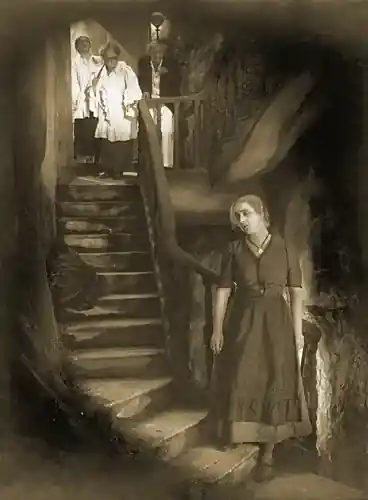
Gender politics? The maid’s body is the currency exchanged between two versions of masculinity: the cripple’s emotional capitalism (hoarding affection like war ration stamps) versus the aristocrat’s sexual feudalism (collecting hearts as tribute). Neither man desires her autonomy; each wants a mirror that flatters his wound. The tragedy is less death than discovery: she realizes she has been the envelope, not the letter.
Visually, the film’s palette anticipates the amber rot of nitrate decay. Cinematographer Willy Goldberger lights night interiors with a single gas mantle, letting shadows pool like ink blots. Faces emerge from darkness the way memories surface under hypnosis—partial, guilty, ready to evaporate.
Watch for the scene where the mailman practices forging signatures on a cabbage crate. Kortner makes the ink bottle tremble so violently that the quill scratches a hole through the paper. For a second, the camera lingers on the tear; it looks like a vagina, a birth canal for words that should never have been conceived. The moment is wordless but louder than any manifesto about the violence of literacy.
Legacy-wise, Hintertreppe is the missing link between One Week’s slapstick anarchy and Torchy’s Double Triumph’s narrative velocity. Its DNA resurfaces in Hitchcock’s Letter from an Unknown Woman and even in Kiarostami’s Certified Copy: stories where forged affection becomes more authentic than the original because desire is always counterfeit we agree to honor.
Restoration status: 2K scan from a 35 mm nitrate print discovered in the estate of an Argentinean collector, 2019. The tinting follows 1921 Ufa protocols—amber for interiors, viridian for exteriors, rose for the lovers’ first tryst. The ice sequence retains its original blue-tone, now so fragile it flickers like a retina about to detach.
Where to see it: streaming on Mubi in rotation, or Blu-ray from Masters of Cinema (region-free) with a 42-page booklet featuring a transliterated diary of Henny Porten detailing the sub-zero Berlin shoot (“My breath froze into tiny daggers that pricked my lips—perfect for a woman learning the texture of betrayal”).
Final note: the last shot is not the drowning but the mailman’s crutch floating downstream, a lonely exclamation mark without its sentence. The film refuses catharsis; it wants the audience to limp out of the cinema carrying the phantom ache of a limb never owned. Ninety minutes of Hintertreppe and the world’s staircases will forever creak under the weight of letters you were never meant to read.
IMDb 5.4
1930
Community
Log in to comment.