DbcultAccessing Vault...
4.8/10
Senior Film Conservator
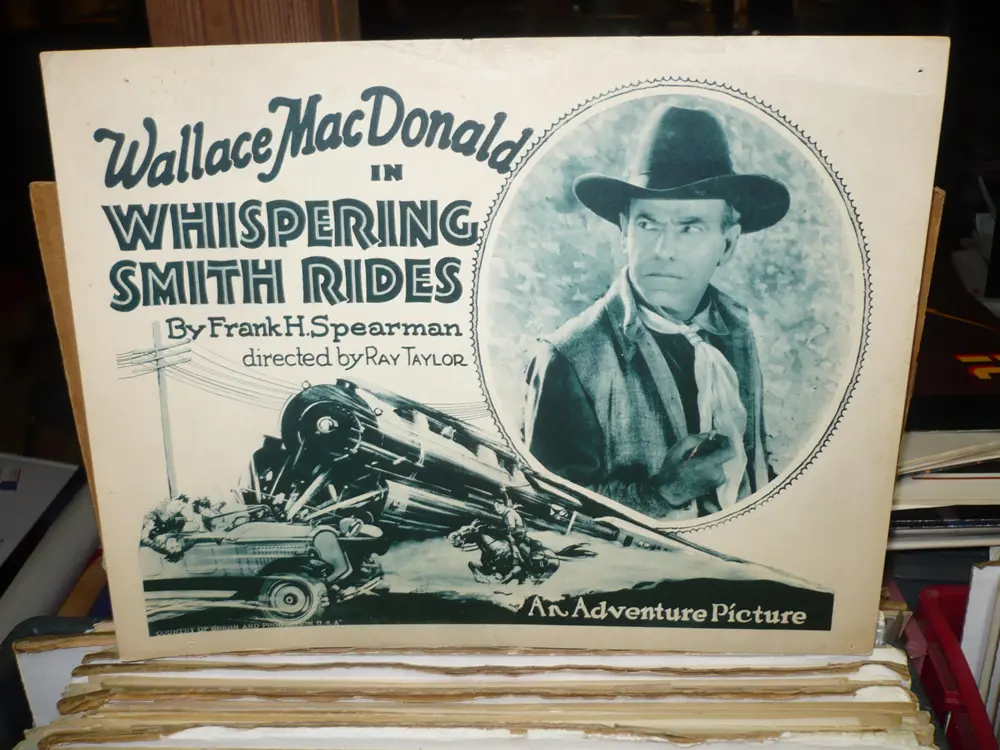
A definitive 4.8/10 rating for a film that redefined the boundaries of cult cinema. Whispering Smith Rides remains a cornerstone of transgressive art.
Does Whispering Smith Rides offer a compelling cinematic experience for contemporary audiences? Short answer: yes, but with significant caveats that demand a particular viewing lens. This film is an essential, if imperfect, window into early Western filmmaking, a foundational text for understanding the genre's evolution.
It is unequivocally for the dedicated cinephile, the Western historian, and anyone with a profound appreciation for the raw, unpolished charm of early 20th-century cinema. Conversely, those seeking modern pacing, complex character arcs, or high-fidelity production values will likely find it a challenging, perhaps even frustrating, watch. It demands patience and an understanding of its historical context.
This film works because: It perfectly encapsulates the nascent appeal of the Western archetype, delivering a straightforward narrative of good versus evil with an earnest conviction that is often missing from more cynical contemporary works.
This film fails because: Its technical limitations and often simplistic characterizations prevent it from truly transcending its era, leaving modern viewers with little to grasp beyond its historical significance.
You should watch it if: You are fascinated by the origins of the Western genre, appreciate the foundational performances of early Hollywood, or are a completist eager to trace the lineage of cinematic storytelling.
Whispering Smith Rides, for all its antiquated charm and noticeable limitations, serves as a fascinating artifact. It’s not merely a film; it’s a blueprint, a foundational text from a time when the Western was still finding its spurs. Directed with a pragmatic eye by J.P. McGowan, who also features in the cast, the film embodies the spirit of early genre filmmaking: direct, unpretentious, and driven by a clear narrative imperative.
The screenplay, credited to Arthur Henry Gooden, Gardner Bradford, and Frank H. Spearman, leans heavily into established tropes, yet it does so with an almost refreshing lack of self-awareness. There’s a purity to its storytelling, an unwavering commitment to the moral clarity that defined many early Westerns. This isn't a film that seeks to deconstruct the myth; it aims to solidify it.
The narrative, centered around the enigmatic lawman Whispering Smith, is a testament to the power of a strong, silent protagonist. Henry Hebert, in the titular role, embodies this archetype with a stoicism that, while perhaps stiff by today's standards, was likely considered the epitome of masculine resolve in its time. He doesn't deliver grand monologues; his presence speaks volumes, a quiet force for justice against the boisterous villainy of Dick La Reno's character, whose bluster is a stark, effective contrast.
One could argue that the film’s greatest strength lies in its unadorned approach. There are no elaborate special effects, no complex subplots designed to trick the audience. It’s a straightforward tale of a good man riding into a bad town, cleaning it up, and riding out. This simplicity, while a potential weakness for some, is precisely what makes it so valuable for understanding the genre's origins. It’s a raw, unfiltered expression of the American frontier myth, before cynicism or revisionism had truly taken root.
However, this simplicity also means that the film often lacks the depth that later Westerns would explore. Character motivations are painted in broad strokes; the villains are purely evil, the heroes purely good. There’s little room for moral ambiguity, which can feel jarring to modern sensibilities accustomed to more nuanced portrayals. It’s a black-and-white world, both literally and figuratively, and for some, that starkness may be too much to overcome.
The acting in Whispering Smith Rides is a fascinating study in early cinematic performance. Henry Hebert as Smith is the embodiment of the stoic Western hero. His performance is characterized by a quiet intensity, a gaze that conveys more than words. Consider the scene where Smith first confronts the corrupt sheriff; Hebert’s subtle shift in posture and the slight narrowing of his eyes communicate an unspoken threat far more effectively than any dramatic dialogue could. It’s a performance built on presence, not theatrics.
The supporting cast, while often playing to type, delivers earnest portrayals. Dick La Reno, as the primary antagonist, is suitably menacing, his sneering expressions and aggressive physicality leaving no doubt about his villainy. Merrill McCormick provides a memorable turn as one of the henchmen, his shiftiness almost palpable even through the grainy film stock. These are not performances that delve into psychological complexity, but rather ones that serve the narrative function of their characters with admirable clarity.
Rose Blossom, as the romantic interest, brings a touch of vulnerability and strength to her role. While her character might be seen as secondary to the male-driven plot, her interactions with Smith add a crucial human element, grounding the larger-than-life hero. Her reaction shot during the climactic shootout, a mixture of fear and resolute hope, is a surprisingly effective moment, breaking through the otherwise rigid performances.
It’s easy to dismiss these performances as melodramatic or unsophisticated when viewed through a modern lens, but that would be a disservice. They operate within the stylistic conventions of their time, a period where visual storytelling was paramount and dialogue often secondary. The exaggerated gestures and clear facial expressions were necessary to convey emotion without the benefit of sophisticated sound design or complex editing. It’s a different language of acting, one that demands an appreciative ear for its historical context.
J.P. McGowan’s direction is functional, efficient, and surprisingly adept at capturing the vastness of the Western landscape. The film makes excellent use of its locations, showcasing sweeping vistas that emphasize the isolation and grandeur of the frontier. There's a particular shot early in the film, a wide-angle view of Smith riding alone across an expansive plain, that immediately establishes the character's solitary nature and the epic scale of his journey. This shot, while simple, is incredibly effective in setting the tone.
The action sequences, while not as frenetic as contemporary blockbusters, are staged with a clear sense of geography and consequence. The horse chases possess a genuine sense of speed and danger, a testament to the bravery of the stunt performers and the practical nature of early filmmaking. The climactic shootout, though brief, is edited with a briskness that keeps the tension high, focusing on key moments of impact rather than prolonged exchanges of gunfire.
Cinematographer Harry Todd, working within the technical limitations of the era, manages to create some striking images. The use of natural light is prevalent, giving the outdoor scenes an authentic, almost documentary feel. Interior shots, while sometimes lacking in depth due to lighting constraints, are composed effectively to highlight character interactions. The close-ups, though infrequent, are impactful, drawing the viewer into the characters' emotional states, as seen in the pained expression of a townsman after a confrontation, emphasizing the community's suffering.
However, the pacing can feel uneven to modern viewers. There are moments where the narrative slows considerably, dwelling on exposition or character interactions that might be condensed in a contemporary film. This deliberate pace, while perhaps reflecting the rhythm of life in the Old West, requires a certain level of commitment from the audience. It’s a film that asks you to settle into its world, rather than rushing you through it.
The thematic bedrock of Whispering Smith Rides is classic Western fare: the triumph of individual justice over systemic corruption, the taming of the wild frontier, and the enduring appeal of the morally upright hero. The film’s tone is consistently earnest, even reverent, towards these ideals. There’s a palpable sense of moral clarity that underpins every scene, positioning Smith as an almost mythic figure, an embodiment of order in a chaotic world.
This unwavering commitment to its themes is both a strength and a potential weakness. It avoids the moral ambiguities and psychological complexities that would later define films like The Man Who Forgot, offering instead a simpler, more direct narrative. The villains are unequivocally bad, driven by greed and malice, while Smith represents an unshakeable moral compass. This stark dichotomy, while satisfying in its straightforwardness, leaves little room for deeper exploration of human nature.
The film also touches upon the nascent romanticism of the West, with the burgeoning relationship between Smith and the rancher's daughter. While not the central focus, it adds a layer of warmth and hope to the otherwise harsh landscape. This element, though underdeveloped by modern standards, serves to humanize Smith and provide a glimpse into the possibility of a settled life, a stark contrast to his solitary existence as a lawman.
One unconventional observation is how the film, despite its adherence to classic tropes, subtly hints at the transient nature of frontier justice. Smith's very name, 'Whispering Smith,' suggests a figure who arrives, resolves, and then fades, leaving behind a fragile peace. This fleeting quality, while not explicitly explored, adds a layer of melancholy to the heroic narrative, suggesting that the fight for order is an ongoing, perhaps endless, struggle. It's a surprisingly profound undercurrent in an otherwise straightforward tale.
Whispering Smith Rides is not a film for everyone. It is a product of its time, bearing the hallmarks and limitations of early 20th-century cinema. Yet, to dismiss it would be to overlook a crucial piece of cinematic history. This film is a sturdy, if somewhat unpolished, foundation upon which the entire Western genre was built. It works. But it’s flawed. It’s a testament to the enduring power of simple, heroic storytelling, delivered with an earnestness that transcends its technical shortcomings.
For those willing to engage with it on its own terms, to appreciate it as a historical document and an early example of genre solidification, Whispering Smith Rides offers a rewarding experience. It provides invaluable insight into the creation of the Western myth and the evolution of film as an art form. It’s not a masterpiece, nor is it a forgotten gem that will shock you with its modernity. Instead, it’s a robust, honest piece of filmmaking that deserves its place in the pantheon of early Westerns. It’s a ride worth taking, provided you’re prepared for the dust and the quiet contemplation it demands.
IMDb 6.8
1915
Community
Log in to comment.