DbcultAccessing Vault...
5.9/10
Senior Film Conservator
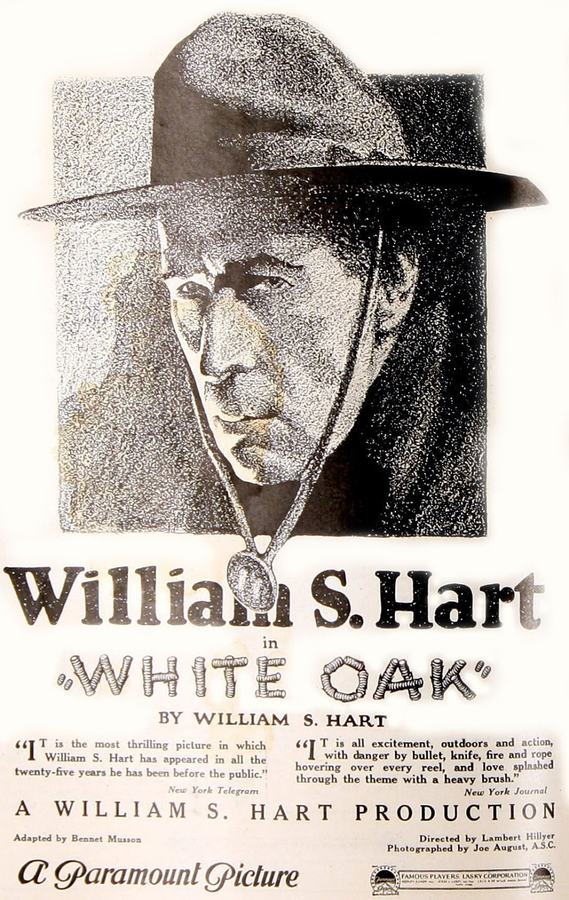
A definitive 5.9/10 rating for a film that redefined the boundaries of cult cinema. White Oak remains a cornerstone of transgressive art.
At its core, White Oak is a study in duality. Oak’s journey mirrors the landscape he traverses—beautiful, treacherous, and indifferent to human frailty. His sister Rose, portrayed with quiet fragility by Helen Holly, is a symbol of innocence eroded by the greed of men like Granger, a character who embodies the corrupting influence of power. Granger’s alliance with Chief Long Knife, a performance by Chief Standing Bear that balances dignity with menace, introduces a layer of cultural tension that feels both authentic and unsettling. The heist plot—centered on a wagon train—serves as the narrative fulcrum, but it is the subplots—Barbara’s loyalty, Oak’s self-destruction—that elevate the film beyond dime-novel simplicity.
The film’s greatest strength lies in its restraint. Unlike the overwrought melodramas of its era, White Oak unfolds with a deliberate, almost glacial pace, allowing the weight of each decision to settle before moving on. Consider the scene where Oak, having just learned of Granger’s plan, stares into the distance while the camera lingers on his profile. There are no grand declarations, only the flicker of a match in his hand and the distant howl of a wolf. This economy of expression is mirrored in the editing, which favors long takes and minimal cross-cutting, trusting the audience to read the subtext in a character’s gaze or the creak of a wagon wheel.
Chief Standing Bear’s portrayal of Chief Long Knife is a masterclass in nonverbal storytelling. He dominates the screen with a presence that is both regal and foreboding, his every gesture imbued with the gravity of a man who understands the cost of cooperation. His dynamic with Granger—played with a sly, reptilian charm by Alexander Gaden—is charged with unspoken tension, as if both men are aware that their alliance is a temporary truce in a larger war of survival. This is contrasted sharply with Barbara’s character, whose moral fortitude (exemplified in Helen Holly’s poised performance) becomes the emotional anchor for the audience. Her brother’s accusation of patricide—though baseless—serves as the catalyst for Oak’s self-sacrifice, a choice that reframes the traditional Western trope of the lone hero into a parable of communal responsibility.
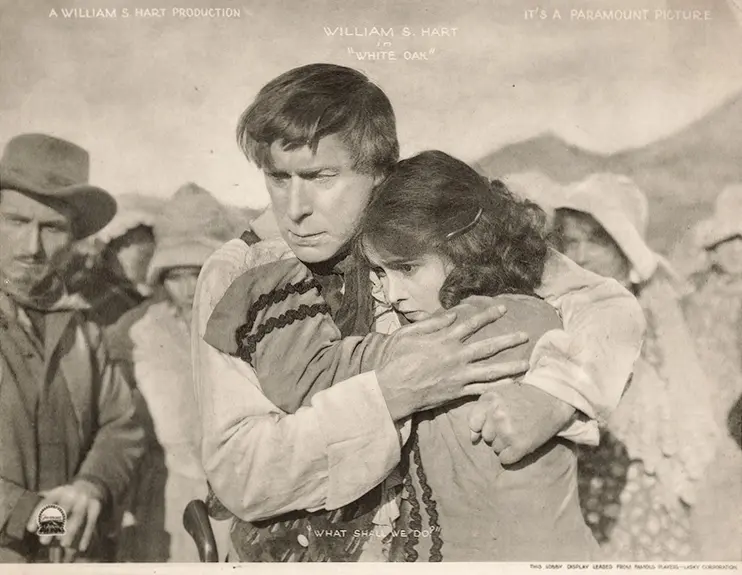
The film’s visual language is equally noteworthy. Photographer Bennet Musson (yes, the writer also operated the camera) frames the landscape as both a character and a challenge. The vast, unbroken horizons emphasize the isolation of the protagonists, while the cramped interiors of saloons and cabins mirror the claustrophobia of their moral dilemmas. Consider the use of light: scenes of deceit are bathed in harsh, angular shadows, while moments of redemption are illuminated by golden-hour warmth. These choices are not merely aesthetic—they are narrative tools, subtly guiding the viewer’s emotional investment.
One cannot discuss White Oak without acknowledging its debt to—and departure from—the Western tradition. Like Who’s Your Brother?, it explores familial loyalty as both a strength and a vulnerability, but its tone is darker, more introspective. The betrayal of Rose recalls the themes in The Brass Bullet, yet here, the violation is emotional rather than physical, making it all the more insidious. In contrast to The Home Trail, which emphasizes community over individualism, White Oak is a lone-ranger narrative, though Oak’s final act—accepting blame for a crime he didn’t commit—suggests that redemption lies not in isolation but in the collective conscience.
The film’s climax is a masterstroke of suspense. As Oak makes his way to the wagon train, the audience is left wondering whether his sacrifice will be in vain. The heist itself is a ballet of chaos, with Granger’s men and the Indians moving in a synchronized dance of violence. Yet, for all its action, the most harrowing moment comes in Barbara’s reaction to Oak’s arrest—a close-up that captures her tear-streaked face with aching clarity. This is where the film transcends genre: it becomes a tragedy of choices, where the line between justice and vengeance blurs until it is nearly indistinguishable.
Performances are uniformly strong, with Hart bringing a weathered authenticity to Oak Miller. His portrayal avoids the stoic heroism typical of Western protagonists; instead, Oak is a man of contradictions—compassionate yet vengeful, reckless yet calculating. The chemistry between Hart and his co-stars, particularly Helen Holly, is understated but potent, suggesting a love that is as much a burden as a solace. The supporting cast, from Bert Sprotte’s gruff but sympathetic sheriff to Vola Vale’s enigmatic townsfolk, adds texture without overwhelming the narrative.
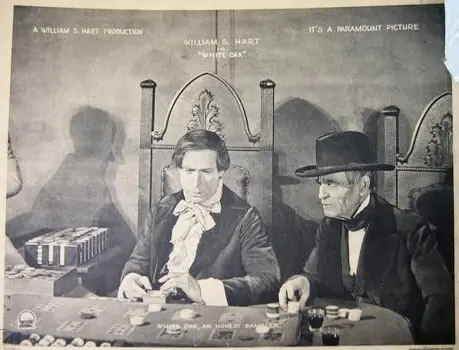
Technically, White Oak is a triumph of early cinema. The use of location shots (primarily in the Sierra Nevada) is breathtaking, with the mountains and rivers serving as both backdrop and metaphor. The editing, though rudimentary by modern standards, is precise, with transitions that echo the rhythm of a heartbeat. Musical accompaniment, provided by a live pianist in original screenings, would have enhanced the emotional swell of key scenes, though one imagines that the film’s power lies in its silence—the pauses between actions, the glances that speak volumes.
For modern audiences, White Oak may feel like a relic, but it is a beautifully preserved one. Its themes—of honor, sacrifice, and the moral ambiguity of justice—are timeless, and its craftsmanship is a testament to the ingenuity of early filmmakers. It shares DNA with Voices in its exploration of communication and misunderstanding, and with La Crociata degli Innocenti in its portrayal of systemic injustice. Yet, it is uniquely its own, a film that captures the spirit of the American West not as a mythic frontier but as a place where every step is a gamble and every decision a roll of the dice.
In the pantheon of silent Westerns, White Oak holds a special place. It is not a film for those who crave fireworks or fast-paced action, but for those who appreciate the slow burn of a story told with precision and passion. Its legacy is in its ability to make viewers feel the weight of Oak’s choices and the futility of his quest—not as a failure, but as a necessary part of the human experience. Like the white oak that gives the film its name, it is a story of resilience, of roots that dig deep into the earth even as storms rage above.
In conclusion, White Oak is more than a historical artifact—it is a bridge between the literary Western and the cinematic one. It challenges the viewer to look beyond the surface, to find meaning in the silences and beauty in the brutality. For those willing to engage with its complexities, it offers a reward as rich as the landscapes it portrays: a reminder that the true frontier is not the land to be conquered but the self to be understood.
IMDb 7
1933
Community
Log in to comment.