DbcultAccessing Vault...
Cult Review
Senior Film Conservator
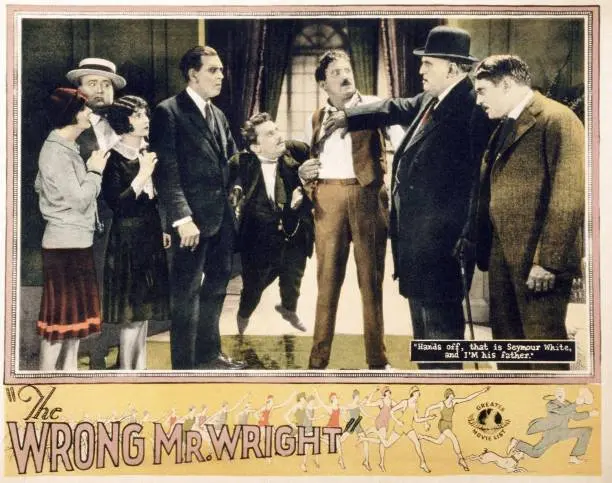
Should you invest your time in a silent farce from the late twenties? Short answer: yes, but only if you appreciate the intricate clockwork of stage-to-screen adaptations and the specific charm of Jean Hersholt. This film is for those who find joy in the 'slow burn' comedy of the silent era and the absurdity of social masks; it is not for viewers who require the fast-paced, high-stakes editing of modern slapstick.
The Wrong Mr. Wright (1927) stands as a fascinating artifact of a cinema in transition. Released just as the industry was beginning to hear the first whispers of the sound revolution, it relies heavily on physical presence and the rhythmic timing of its ensemble cast. While many silent comedies of the era, such as Hands Up, leaned into the grand spectacle of the American West, this film keeps its feet firmly planted in the carpeted hallways of high-society hotels. It is intimate, awkward, and surprisingly relatable in its depiction of social dread.
For the modern cinephile, the question of 'worth' usually comes down to whether the humor has aged into irrelevance. The Wrong Mr. Wright manages to avoid this trap by rooting its comedy in human insecurity rather than topical references. If you enjoy watching a man slowly dig himself into a hole of his own making, there is a timeless satisfaction to be found here. It works. But it’s flawed.
The film succeeds because it understands the mechanics of the 'cringe.' Unlike the melodrama found in The Return of Mary, the stakes here are purely social, which makes the protagonist's desperation feel oddly modern. However, the film fails to sustain its momentum in the second act, where the repetition of the 'mistaken identity' trope starts to feel like a narrative crutch rather than a source of genuine surprise.
1) This film works because Jean Hersholt brings a grounded humanity to a ridiculous situation.
2) This film fails because it relies too heavily on title cards to explain jokes that should have been visual.
3) You should watch it if you want to see the 'slow burn' mastery of Edgar Kennedy in its early form.
The brilliance of a farce lies in its geometry. In The Wrong Mr. Wright, director Scott Sidney uses the hotel setting as a character in itself. Doors become obstacles, and hallways become escape routes. There is a specific scene involving a revolving door that perfectly encapsulates the film's philosophy: motion without progress. Hersholt’s character is constantly moving, yet he remains trapped by his own deception.
Comparing this to the atmospheric tension of Söhne der Nacht, 1. Teil: Die Verbrecher-GmbH, we see a complete 180-degree turn in how 1920s cinema handled 'secrecy.' Where the German film uses secrecy for dread, Sidney uses it for a dizzying, almost exhausting comedy. The pacing is deliberate, perhaps too much so for those used to the frantic energy of Buster Keaton, but it allows the awkwardness to marinate.
The cinematography by Gilbert Warrenton is functional rather than revolutionary. It lacks the sweeping ambition found in Bismarck, but it serves the script's needs by focusing on the actors' faces. In a silent comedy, the 'joke' is often in the reaction, not the action. Warrenton understands this, keeping the camera tight on Hersholt’s increasingly sweaty brow as the real Mr. Wright approaches.
Jean Hersholt is often remembered for his kindly, paternal roles in later years, but here he shows a nimble comedic sensibility. He doesn't play the protagonist as a hero; he plays him as a coward. This is a brave choice. Most leading men of the 1920s, even in comedy, wanted to maintain a shred of dignity. Hersholt throws dignity out the window in the first ten minutes.
His performance is a masterclass in 'underplaying.' While the supporting cast—particularly the energetic Dorothy Devore—operates at a high frequency, Hersholt remains the still center of the storm. His reactions to the over-the-top advances of Mathilde Comont are a highlight. He uses his eyes to convey a sense of 'how did I get here?' that resonates across the decades.
Contrast this with the more traditional romantic lead performance in A Kentucky Cinderella. Hersholt isn't interested in being the object of desire; he is interested in being the object of pity. It’s a subtle distinction that makes the film's eventual resolution feel earned rather than scripted. He makes the 'Wrong Mr. Wright' a man we want to see succeed, even if he doesn't deserve to.
One cannot discuss this film without mentioning Edgar Kennedy. Known for his 'slow burn'—a slow, deliberate facial reaction to frustration—Kennedy provides the perfect foil for Hersholt’s frantic energy. Every time the plot threatens to become too whimsical, Kennedy enters to ground it in a very human sense of annoyance.
There is a specific moment where Kennedy’s character realizes he has been speaking to the wrong person for five minutes. The way he slowly closes his eyes and rubs his forehead is a piece of comedic business that would influence generations of comedians, from Laurel and Hardy to the cast of Seinfeld. It’s a reminder that comedy doesn't always need a punchline; sometimes, it just needs a person who has had enough.
This level of character-driven humor is what separates The Wrong Mr. Wright from more generic fare like Smith's Baby. It’s not just about the situation; it’s about how these specific, flawed people react to it. The chemistry between Kennedy and Hersholt is the film's secret weapon, turning a standard stage play adaptation into something that feels alive.
While the film is charming, it is undeniably a product of 1927. The gender dynamics are, to put it mildly, dated. The central conflict of a man running away from an 'aggressive' woman is played for laughs in a way that feels a bit uncomfortable today. However, if we view it through the lens of the era’s social anxieties, it becomes an interesting study of the 'New Woman' and the male reaction to shifting social norms.
The film also suffers from the 'intertitle bloat' common in late silent films. Writers Harold Shumate and James Madison clearly had a witty script, but sometimes the text on screen interrupts the visual comedy. For example, a joke about the hotel bill is explained in a long paragraph of text when a simple shot of the protagonist’s empty wallet would have sufficed. It lacks the visual shorthand of something like The Fox and the Crow.
Yet, there is a warmth here that is missing from more cynical modern comedies. The film doesn't hate its characters; it just finds them ridiculous. This gentleness is a hallmark of many films from this period, including Midst Peaceful Scenes. It is a comedy of errors where no one truly gets hurt, and everyone ends up exactly where they belong.
Pros:
The ensemble cast is top-tier for 1927. The 'hotel farce' setting is utilized effectively to create a sense of mounting claustrophobia. The film serves as a great introduction to Jean Hersholt’s versatility before he became typecast in more serious roles.
Cons:
The second act drags significantly as the 'mistaken identity' trope is milked for every possible drop. Some of the physical comedy feels a bit repetitive compared to the innovations of Chaplin or Keaton from the same era. The resolution is somewhat predictable.
The Wrong Mr. Wright is not a revolutionary masterpiece, but it is a highly competent, frequently funny example of the silent era’s 'sophisticated' comedy. It lacks the raw power of For the Freedom of the World or the experimental edge of La p'tite Lili, but it makes up for it with sheer charm and excellent character work. It is a film that rewards patience. If you sit with it and let the awkwardness build, the payoff is genuinely satisfying. It’s a solid three-star experience that serves as a perfect evening watch for those who want to step back into a world where the biggest problem a man could face was being mistaken for the wrong Mr. Wright. It’s light, it’s airy, and it’s a delightful reminder of how much can be said without a single word being spoken.
IMDb —
1935
Community
Log in to comment.