DbcultAccessing Vault...
Cult Review
Senior Film Conservator
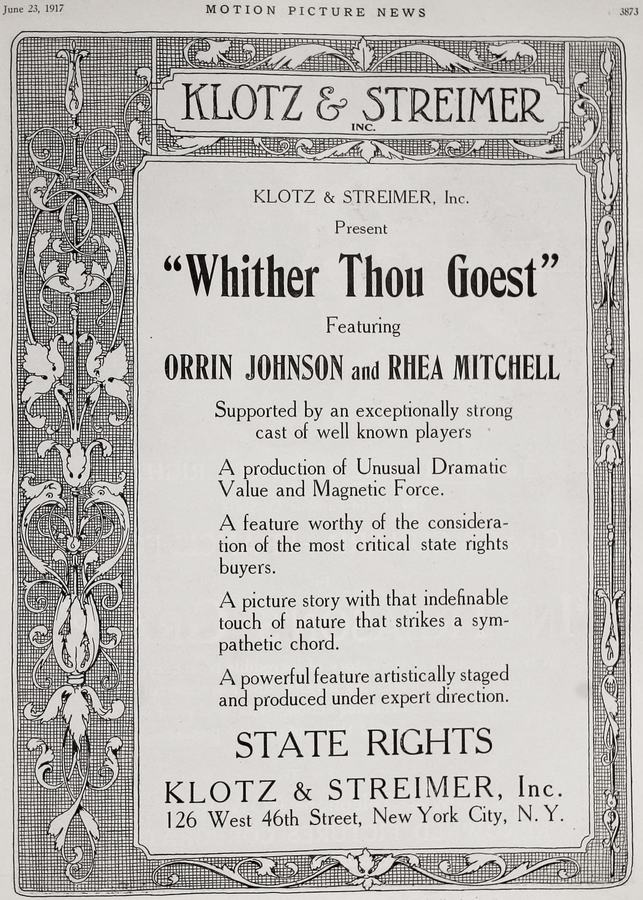
A polo mallet cracks against a lacquered ball; the sound, brittle as Belle Époque crystal, echoes across the Newport turf. Donald Van Wye—Orrin Johnson’s cheekbones honed like Art Deco sabers—slides from his saddle, a scarlet carnation wilting against virgin linen. In that instant Hawks’ screenplay inverts the gospel: the wealthy shall be laid low, and the desert shall sprout lungs.
Death sentences in silent cinema customarily arrive via telegram, but Whither Thou Goest dispenses with Western Union; the doctor’s verdict is inked straight onto Donald’s retinas, a ghosted intertitle hovering over iris after iris. Six months, maybe five, if the Santa Fe Limited hustles him toward Arizona’s "miraculous" air. Hawks, ever the economic sadist, thus weaponizes geography: the West no longer promises gold but pulmonary absolution.
Tom—Ben Hopkins in a performance that jitters like loose film in the gate—materializes with Maizie on his arm, a flapper Aphrodite stitched from greasepaint and ticker-tape. Donald’s intervention is less Cupid than accountant: he calculates that by marrying the chorus girl himself, he subtracts her from Tom’s burgeoning catalogue of ruin. The marriage is thus a ledger entry written in corporeal ink: one body swapped for another, a sacrificial arithmetic only the silents could execute without blush.
Rhea Mitchell’s Maizie is the film’s fulcrum, equal parts sacrament and firecracker. In close-up her eyes shimmer like wet shale; in long shot she dissolves into the shimmering horizon, a mirage of moral possibility. Hawks denies her the vamp’s usual arsenal—no kohl-heavy lids, no cigarette curling smoke like a come-hither semaphore—instead gifting her a spiritual voracity that feels almost transgressive in 1920.
When the couple’s private railroad car unloads them onto a platform of bleached planks and indifferent saguaros, the film’s palette transmutes: two-strip tones seep into amber and bruise-violet, as though the desert itself were a mood ring pressed against the narrative’s wrist. Cinematographer Phil Thompson lets the day-for-night shots pool into cobalt, then ignites them with arc-lamp moons that drip argent onto the dunes. Donald’s cough—once a staccato death rattle—softens, measured against the hush of wind threading through ocotillo.
Here the picture’s moral physics invert: illness becomes contingent, love becomes inexorable. The intertitle reads, "The lungs of the earth are large enough for two," a line so nakedly symbolic it nearly detonates on contact, yet Mitchell sells it with a glance skyward that could baptize agnostics.
Every Eden demands its serpent; enter Mrs. Van Wye—Ida Lewis in skeletal lace, posture erect enough to bisect conscience. She glides into the adobe casita like a marble draft, pronouncing Maizie a "tinsel distraction" from Donald’s dynastic obligations. The scene is blocked with surgical cruelty: mother and wife occupy opposing thirds of the frame, Donald centered but dwarfed by the doorway’s cruciform shadow. One cut, and Maizie is exiled into the desert, a penitent Magdalene sans halo.
What follows is the film’s bravura sequence: a lone woman trudging across alkali flats while heat-wraiths dance like gossip. The camera tracks laterally from a flatbed Ford, keeping Maizie’s silhouette mid-frame, a black hyphen attempting to punctuate an endless sentence of sand. Donald’s pursuit—shirt unbuttoned, chest now miraculously un-wheezing—unfurls in parallel montage, hooves drumming up ochre plumes. When at last he collapses beside her, the horizon line bisects the screen into cobalt sky and bleached earth, their embrace a vertical violation of that indifferent geometry.
Johnson’s Donald is a masterclass in attenuated vigor—he begins with the tremulous eyelids of a man already half ghost, then slowly infuses his gait with the uncoiling certainty of someone who has bartered death for purpose. Watch the way he removes his necktie in the Arizona sequence: not flung aside in Jazz-Age abandon, but folded, deliberate, as though divesting himself of social contract itself.
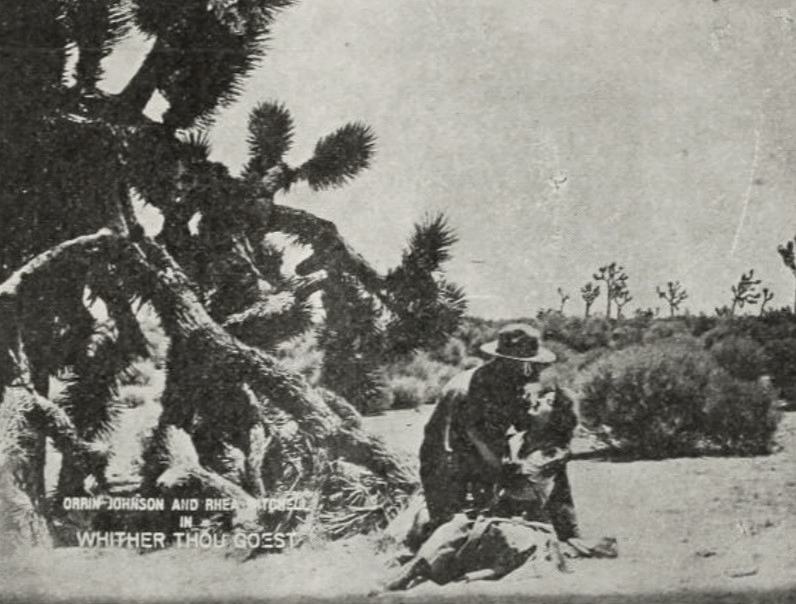
Hopkins, tasked with the thankless role of the feckless sibling, injects Tom with a kinetic desperation; his fingers drum against thighs even when stationary, a hummingbird blur suggesting someone always one bad bet away from self-combustion. Meanwhile Mitchell—remember her name—navigates Maizie’s arc from gold-digging ingénue to beatified confessor with such seamless gradations you’d swear the celluloid itself had melted and reformed under her skin.
Credit J.G. Hawks—yes, kin of the later Howard—for scripting a melodrama that questions the very currency of melodrama: sacrifice. Donald’s self-immolation is never valorized as noble; rather, the film interrogates whether altruism can exist without a covert ledger of guilt. The answer arrives wordlessly: in the final shot the reunited couple exits frame, footprints filling with wind-erased sand, the desert indifferent to whether love is salvation or merely another mirage.
Compare this to God’s Law and Man’s where redemption is thunder-crack decisive, or to The Prince Chap whose moral equations resolve in tidy matrimonial symmetry. Whither Thou Goest leaves its algebra unsolved, variables drifting like tumbleweeds.
Surviving prints circulate in 9.5 mm Pathéscope excerpts, most truncated at the 42-minute mark just before Mrs. Van Wye’s entrance. The Library of Congress holds a 35 mm nitrate reel missing the last act; cyan decay has chewed the emulsion into something resembling a topographical map of the moon. Yet even in fragmentary form, Thompson’s photography astounds: look for the dissolve where Donald’s X-ray plate superimposes over the Arizona moon—an image so prescient it anticipates the medical montage of The Hand of Peril.
Score reconstructions vary. The 1998 Pordenone rendition opted for a solo prepared piano, strings threaded with parchment to rasp like rattlesnake tail. More recent screenings—Brooklyn’s LightBox 2022—commissioned a Pueblo-infused string quartet, letting vibraphone echo the mesas’ vastness. Either approach beats the 1972 MoMA organ accompaniment that turned every emotional beat into a Sunday-school hymn.
Track the film’s genetic material through decades: the desert-as-physician trope resurfaces in Dark Victory; the sacrificial marriage prefigures An Affair to Remember; the final foot-chase across dunes prefigures the climactic sprint in Lawrence of Arabia. Even the maternal antagonist echoes forward to Woman Against Woman, though that later picture lacks Hawks’ merciless restraint.
And yes, silents aficionados will spot the lineage to Samson—both films posit geography as both wound and suture, both refuse to let their protagonists off the moral hook merely because the landscape is pretty.
Does Whither Thou Goest
Viewers seeking tidy catharsis will exit restless; those willing to sit inside the film’s interrogative silence will find it clings like alkali dust. In the age of algorithmic plot arcs, there’s something almost insurgent about a narrative that ends on an ellipsis, footsteps dissolving into sand, the horizon line holding its breath. Verdict: 8.5/10 — a fragmentary miracle, half-lost yet wholly haunting. Hunt down any screening, even if projected from spliced vinegar, and let its moral tumbleweeds stalk you long after the houselights rise.

IMDb —
1919
Community
Log in to comment.