DbcultAccessing Vault...
Cult Review
Senior Film Conservator
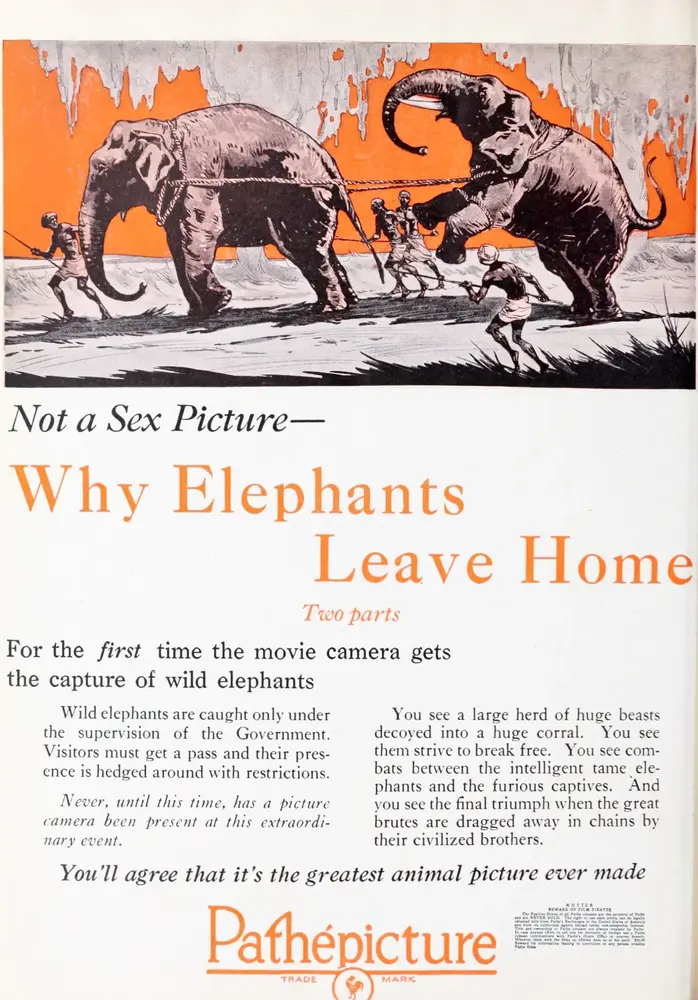
The film Why Elephants Leave Home arrives like a sun‑bleached photograph from a forgotten archive, yet its visual language feels startlingly modern. Shot in the dense thickets of Ceylon, the camera follows a procession of indigenous laborers and their domesticated elephants as they embark on the dreaded "Elephant Kraal"—a massive, community‑driven roundup designed to curb the agricultural havoc wrought by the untamed herd. The opening frames linger on the swaying canopy, the amber light filtering through leaves, establishing a tone that oscillates between reverence for the natural world and an undercurrent of colonial anxiety.
The narrative’s backbone is the methodical choreography of the Kraal itself. First, a troupe of tame elephants, their skin polished to a glossy sheen, are positioned as living lures. Their trainers—seasoned native men whose faces are etched with years of forest knowledge—signal with subtle gestures: a flick of the ear, a low rumble, a raised trunk. These cues, almost invisible to the untrained eye, set in motion a cascade of reactions among the wild elephants, who, drawn by the familiar scent and sound, begin to converge.
As the herd approaches, the film deftly intercuts close‑ups of trembling foliage with wide shots of the massive beasts, underscoring the tension between fragility and brute force. The domesticated elephants, now acting as both decoys and enforcers, surge forward, their weight shifting the balance of power. They push, they prod, they guide the wild group toward a labyrinth of felled trees—a makeshift stockade that will become the focal point of the drama.
Central to the film’s emotional resonance is the portrayal of the native participants. Their agility, honed through generations of navigating the jungle’s treacherous terrain, is highlighted in a series of kinetic sequences where they dart between massive trunks, wielding ropes with a practiced ease. The camera lingers on their faces—sweat‑slicked, eyes narrowed—conveying a mixture of resolve and reverence. This focus on indigenous agency counters the often‑simplistic colonial narratives of the era, offering a nuanced glimpse into a community that is both victim and executor of the colonial agenda.
The film’s sound design amplifies this dynamic. The low, resonant trumpeting of the wild elephants forms a bass line, while the sharp cracks of rope and the rhythmic thudding of hooves provide percussive accents. When a domesticated elephant lunges, its massive foot lands with a thud that reverberates through the frame, a visceral reminder of the sheer physicality at play.
While Why Elephants Leave Home stands alone in its focus on the Kraal, it shares thematic DNA with other wildlife spectacles. The tension between human control and animal autonomy mirrors the struggle depicted in Shifting Sands, where desert caravans grapple with the capriciousness of nature. Likewise, the use of domesticated animals as instruments of capture evokes the moral ambiguity explored in One Touch of Sin, where trained dogs are employed to hunt poachers. These intertextual connections enrich the viewing experience, positioning the film within a broader cinematic conversation about humanity’s dominion over the animal kingdom.
The cinematography employs a muted palette—earthy browns, deep greens, and the occasional burst of ochre—that reflects the film’s setting while allowing the occasional flash of the three signature hues to punctuate key moments. When the domesticated elephants first breach the perimeter, a sliver of dark orange (#C2410C) flashes across the screen, a visual cue that signals both danger and progress. In quieter interludes, the soft glow of yellow (#EAB308) bathes the forest floor, creating a fleeting sense of hope amidst the chaos. The sea‑blue (#0E7490) appears in the distant river that runs parallel to the Kraal, its tranquil surface a stark contrast to the pandemonium on land.
Compositionally, the director favors low‑angle shots that amplify the elephants’ imposing stature, juxtaposed with high‑angle vistas that reveal the intricate geometry of the stockade. This dual perspective reinforces the film’s central paradox: the enormity of the animals versus the meticulous human engineering designed to contain them.
The film’s pacing mirrors the ebb and flow of the Kraal itself. Early scenes unfold at a measured tempo, allowing viewers to absorb the cultural context and the logistical enormity of gathering thousands of participants. As the herd is coaxed closer, the editing accelerates, cutting between frantic rope‑pulling, the thudding of hooves, and the panicked flailing of the wild elephants. This crescendo reaches its apex when the final elephant, a towering matriarch, is finally subdued, her massive limbs tangled in a web of rope and branch. The subsequent release of tension is handled with a delicate, almost reverent, slow‑motion sequence that lingers on the exhausted faces of the laborers, their breaths forming mist in the humid air.
Beyond its visual spectacle, Why Elephants Leave Home offers a window into the colonial administration’s strategies for resource management. The Kraal, while ostensibly a protective measure for agriculture, also serves as a display of governmental authority, reinforcing the power dynamics between the colonizers and the indigenous populace. The film subtly critiques this power structure by foregrounding the expertise of the native participants, thereby suggesting that the success of the operation hinges less on imperial decree and more on local knowledge.
The documentary‑style narration, delivered in a measured, authoritative tone, provides factual context without overtly romanticizing the spectacle. This restraint lends the film an air of authenticity that distinguishes it from contemporaneous adventure epics, where exoticism often eclipsed factual representation.
While the film eschews traditional acting performances, the naturalistic portrayals of the laborers—captured through candid, unscripted moments—function as a form of performance art. Their coordinated movements, the silent communication between man and beast, and the collective effort to secure the herd constitute a choreography that is both functional and poetic.
Director Katherine Hilliker’s hand is evident in the deliberate pacing and the balanced juxtaposition of human and animal agency. Her decision to employ domesticated elephants as both narrative catalysts and visual anchors showcases an acute awareness of the film’s thematic core: the paradox of control versus coexistence.
The soundscape, a layered tapestry of natural and human‑made noises, is perhaps the film’s most compelling technical achievement. The low, resonant rumble of an elephant’s call is mixed with the crisp snap of rope, creating an auditory rhythm that mirrors the visual editing. The score, sparse yet evocative, relies on low‑frequency strings and occasional percussive beats that underscore moments of tension without overwhelming the natural ambience.
Decades after its release, the film continues to inform contemporary discussions about wildlife management, human‑animal conflict, and the ethics of colonial interventions. Its meticulous documentation of the Kraal offers a rare historical record that scholars of environmental history and film studies alike reference when exploring early 20th‑century approaches to conservation and control.
Modern wildlife documentaries, such as those produced by National Geographic, echo Hilliker’s blend of immersive footage and contextual narration, suggesting that Why Elephants Leave Home helped lay the groundwork for the genre’s evolution.
The film’s enduring power lies in its ability to convey a moment of collective human effort against the backdrop of an untamed natural world. It captures the raw, unfiltered drama of a society grappling with the consequences of its own expansion, while simultaneously celebrating the extraordinary intelligence and cooperation of the elephants themselves. In an era where wildlife narratives often lean toward sensationalism, Why Elephants Leave Home remains a sober, visually arresting testament to a bygone epoch, inviting viewers to contemplate the delicate balance between stewardship and domination.
For those intrigued by the intersection of anthropology, ecology, and cinema, the film offers a rich tapestry of insights. Its relevance persists, echoing in modern debates about habitat encroachment, the ethics of animal capture, and the lingering shadows of colonial policy.
IMDb 4.2
1914
Community
Log in to comment.