DbcultAccessing Vault...
5.1/10
Senior Film Conservator
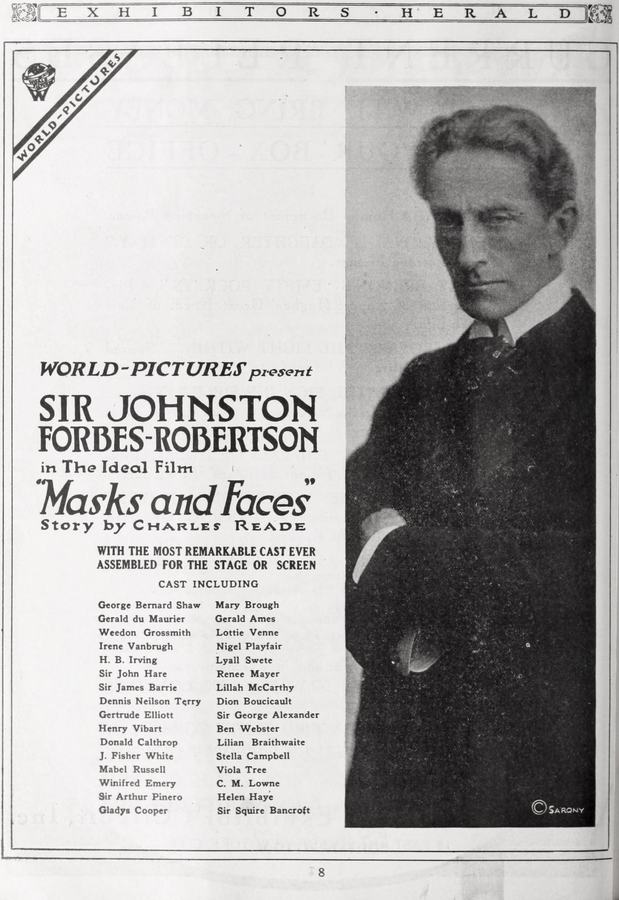
A definitive 5.1/10 rating for a film that redefined the boundaries of cult cinema. Masks and Faces remains a cornerstone of transgressive art.
In the vast tapestry of cinematic history, certain narratives resonate with an almost primal force, delving into the very core of human identity, vulnerability, and the transformative power of illusion. "Masks and Faces," a film whose genesis lies in the brilliant minds of writers Charles Reade, Tom Taylor, and Benedict James, stands as a poignant testament to this enduring fascination. It is a work that, even across the chasm of time, compels us to ponder the delicate interplay between the roles we play, the truths we conceal, and the profound impact one individual can have on another's existential trajectory. This isn't merely a story; it's a psychological drama, an intricate dance of performative art and therapeutic intervention, wrapped in the guise of a compelling narrative.
At its heart, "Masks and Faces" introduces us to a premise as audacious as it is tender: an actress, leveraging the very essence of her craft, undertakes the monumental task of curing an aged gentleman of his debilitating melancholy, born perhaps from a lifetime of superficial flirtations and a profound disconnect from genuine emotion. Her method? To pose as his long-lost or ideal wife, conjuring a specter of domesticity and unwavering affection that slowly but surely coaxes him back from the precipice of despair. This isn't a simple trick; it's a meticulously orchestrated psychological intervention, a performance designed not for an audience in a theatre, but for a singular, fragile soul in desperate need of revival. The film, through its insightful portrayal, asks us to consider the boundaries of truth and artifice, and whether a manufactured reality can, in fact, pave the way for a deeper, more authentic healing.
The genius of "Masks and Faces" lies in its profound understanding of human psychology, particularly the way in which our perceptions shape our reality. The aged flirt, a character whose superficiality has perhaps served as a lifelong defense mechanism against deeper emotional engagement, finds himself trapped in a cycle of ennui. His flirtatious pursuits, once a source of fleeting validation, now offer only emptiness. It is into this void that the actress, portrayed with magnificent nuance by Irene Vanbrugh, steps. Vanbrugh’s performance is a masterclass in controlled theatricality, imbuing her character with not just the skill of an actress, but the empathy of a healer. She doesn't just mimic a wife; she embodies the very essence of what this man has perhaps unconsciously yearned for – stability, unconditional regard, and a reflection of his own potential for dignity.
The narrative unfolds with a delicate precision, charting the gradual erosion of the gentleman's cynicism and the slow blossoming of trust. J. Fisher White, as the aged flirt, delivers a portrayal that is both pathetic and endearing, allowing the audience to witness his transformation from a figure of almost comic superficiality to one capable of profound emotional depth. His initial resistance, born of habit and perhaps a lingering suspicion, gives way to a poignant acceptance, as the illusion crafted by the actress begins to feel more real, more comforting, than the fragmented reality he has constructed for himself. This therapeutic deception is not without its moral complexities, prompting viewers to consider the ethics of such an elaborate charade, even when its intentions are benevolent.
The power of "Masks and Faces" is significantly amplified by its truly exceptional cast, a veritable who's who of theatrical luminaries of its era. Beyond Irene Vanbrugh and J. Fisher White, the film benefits immensely from the contributions of Matheson Lang, Gerald du Maurier, Donald Calthrop, and Lilian Braithwaite, each bringing a distinct texture to the film's intricate social fabric. Lang, with his commanding presence, and du Maurier, often celebrated for his suave portrayals, likely add layers of societal context and perhaps even counterpoints to the central deception. The supporting players, including Nigel Playfair, Johnston Forbes-Robertson, and the legendary Henry S. Irving, though perhaps in smaller roles, lend an unparalleled gravitas and authenticity to every scene. Their collective presence transforms the film from a simple plot device into a vibrant, believable world where the stakes of emotional manipulation feel genuinely high.
The nuanced performances extend to the likes of Lyall Swete, Gerald Ames, and Helen Haye, whose portrayals contribute to the rich tapestry of reactions and relationships surrounding the central act of impersonation. Renee Mayer, Viola Tree, and Lillah McCarthy further flesh out the world, potentially depicting other facets of society or the theatrical community, offering diverse perspectives on the nature of performance and public perception. Even fleeting appearances by renowned figures such as Mary Brough, Gertrude Elliot, Charles Hawtrey, Henry Vibart, Fabia Drake, Weedon Grossmith, Dion Boucicault Jr., Gladys Cooper, Ben Webster, Ellaline Terriss, Dennis Neilson-Terry, Lottie Venne, Stella Mervyn Campbell, and C.M. Lowne serve to elevate the film, transforming it into a historical document of acting prowess. Their collective talent ensures that every interaction, every reaction to the actress's grand illusion, is imbued with a compelling sense of reality, making the audience question where the performance ends and genuine emotion begins.
Originating from the literary and theatrical traditions, the narrative of "Masks and Faces" inherently possesses a dramatic structure well-suited for the screen. Charles Reade and Tom Taylor, whose original play laid the groundwork, were masters of Victorian melodrama and social commentary. Their insights into human character and societal facades are brilliantly translated by Benedict James for the cinematic medium. The film, in its silent or early sound incarnation, would have relied heavily on visual storytelling, the expressive power of the actors' faces, and meticulous staging to convey the complex emotional shifts. The juxtaposition of the theatrical stage – where the actress hones her craft – with the domestic setting where she performs her ultimate role, creates a powerful meta-commentary on the nature of reality itself.
The use of close-ups, subtle gestures, and carefully composed frames would have been paramount in conveying the aged flirt's internal struggle and the actress's unwavering resolve. The narrative, while seemingly simple, delves into profound questions: Can love be feigned into existence? Can a lie, however benevolent, lead to truth? The film navigates these ethical quandaries with grace, suggesting that the intention behind an act often dictates its ultimate moral weight. The "cure" is not a magical transformation but a painstaking re-education of the heart, a testament to the idea that sometimes, to heal, one must first believe in an ideal.
"Masks and Faces" stands as a significant work, particularly when viewed alongside other films of its era that grappled with themes of identity, societal roles, and the nature of performance. Its exploration of an actress taking on a role that bleeds into real life finds a fascinating parallel in films like David Garrick. While Garrick's story often centers on the actor's public persona and private struggles, "Masks and Faces" turns the theatrical lens inward, using performance as a direct catalyst for personal transformation. Both films, however, highlight the unique burden and power held by those who master the art of impersonation.
The film’s central conceit of a benevolent deception and the manipulation of appearances can also be seen echoing in narratives that explore societal expectations and hidden truths. One might draw a thematic link to films like The Honor of Mary Blake or even Sins of the Parents, where characters often navigate complex social landscapes, sometimes resorting to pretense or carefully constructed facades to protect themselves or others. In "Masks and Faces," the deception is not for self-preservation in the face of societal judgment, but a deliberate, compassionate act of healing, setting it apart while still engaging with the broader discourse on appearance versus reality.
Furthermore, the film's examination of an individual's journey from a state of emotional stagnation to one of renewed purpose resonates with the broader humanistic themes found in works like Civilization. While "Civilization" tackles grander societal conflicts and moral dilemmas on a national scale, "Masks and Faces" offers a micro-narrative of personal redemption, suggesting that profound shifts can occur not just through grand gestures, but through intimate, carefully cultivated acts of empathy. Both films, in their distinct ways, underscore the potential for humanity to transcend its baser instincts and strive for a more enlightened existence.
The poignant portrayal of a character adrift, much like the melancholic gentleman in "Masks and Faces," can find a distant echo in the solitary figures often depicted in films like The Rail Rider or The Remittance Man, though their struggles are often physical and external rather than internal and psychological. However, the underlying theme of seeking meaning or a place in the world remains a powerful connection. Even films like Le nabab, which might explore the fortunes and misfortunes of societal figures, can be seen as touching on the fragility of reputation and the internal lives of those in the public eye, themes that "Masks and Faces" explores through a more intimate lens.
The film also subtly touches upon the agency of women, particularly actresses, in a society that often confined them to specific roles. The actress in "Masks and Faces" is not merely a performer but an active agent of change, a concept that finds resonance in other narratives featuring strong female protagonists, such as The Lotus Dancer or The Waif, where women, through their unique talents or circumstances, carve out their own paths and influence those around them. This aspect adds another layer of social commentary to the film, highlighting the often underestimated power of those deemed merely entertainers.
"Masks and Faces" transcends its simple plot to become a profound meditation on the human condition. It reminds us that appearances can be deceiving, but also that artifice, when wielded with compassion and skill, can serve as a conduit to deeper truths. The film's enduring appeal lies in its exploration of universal themes: the search for identity, the desire for genuine connection, and the potential for redemption, even in the most unlikely of circumstances. It challenges us to look beyond the superficial, to question the masks we all wear, and to consider the profound impact of empathy and deliberate action.
The meticulous craftsmanship of the writers, coupled with the stellar performances of a truly legendary cast – from the captivating Irene Vanbrugh and the transformative J. Fisher White, to the myriad of talents like Matheson Lang, Gerald du Maurier, Lilian Braithwaite, Johnston Forbes-Robertson, and Henry S. Irving – ensures that the film remains a significant piece of cinematic heritage. It serves as a powerful reminder of an era when storytelling relied on nuanced acting and evocative visuals to convey complex emotional landscapes. In an age saturated with overt special effects, "Masks and Faces" offers a refreshing return to the fundamental power of human performance and narrative depth. Its subtle exploration of the psyche, its ethical dilemmas, and its ultimate message of hope continue to resonate, inviting new generations to peel back the layers of its compelling illusion. It is a film that, much like the actress at its core, orchestrates a beautiful, poignant, and ultimately healing deception, leaving an indelible mark on the viewer's consciousness.
In conclusion, "Masks and Faces" is more than just a historical artifact; it is a timeless exploration of humanity's capacity for both profound illusion and genuine connection. It masterfully uses the theatrical device to explore real-world psychological complexities, showcasing how the deliberate construction of an ideal can sometimes lead to the rediscovery of a lost self. Its legacy is not just in its narrative ingenuity but in its empathetic portrayal of the human spirit, forever seeking solace, meaning, and a reflection of its best self, even if that reflection is initially conjured from artifice.
IMDb —
1920
Community
Log in to comment.