DbcultAccessing Vault...
Cult Review
Senior Film Conservator
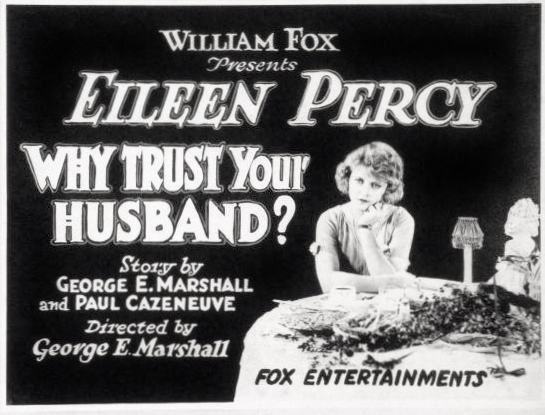
In the pantheon of pre-code cinema, few works marry farce with subtext as deftly as *Why Trust Your Husband*. Directed with a flair for visual wit by an ensemble of writers—Paul Cazeneuve, William M. Conselman, and George Marshall—the film is a masterclass in silent-era storytelling, where every glance, costume swap, and exaggerated gait serves as a linguistic device. The narrative hinges on the age-old trope of the unfaithful husband, yet subverts it by framing the chaos as a series of theatrical performances, a metaphor that both critiques and reinforces the era’s gendered power structures.
The masquerade sequence is not merely a plot device; it is the film’s thematic nucleus. By dressing in each other’s disguises, the husbands—Elmer Day, played with bumbling charm by Hayward Mack, and Gilbert Stone, portrayed with a smug self-satisfaction by Harry Myers—literalize their desire to escape societal expectations. Conversely, the wives—Eunice (Jane Miller) and Maud (Eileen Percy)—wield their disguises as tools of empowerment, infiltrating the very spaces their husbands sought to monopolize. This gendered reversal is underscored by the costumes themselves: Eunice’s costume, a blend of military rigidity and flamboyant excess, mirrors her husband’s own performative masculinity, while Maud’s elegant simplicity becomes a weapon of quiet subversion.
The film’s central conflict—sparked by the husbands’ lie about a "business engagement"—is a microcosm of patriarchal deceit. Their excuse to attend the masquerade is a thinly veiled attempt to reclaim autonomy in a world where their authority is increasingly contested by their wives. Yet, the women’s counter-strategies reveal the fragility of male privilege. Eunice’s investigation into her husband’s affair (with a woman who is, ironically, his aunt in reality) is not driven by jealousy but by a desire to expose the absurdity of his double life. This is where *Why Trust Your Husband* transcends mere slapstick: it becomes a commentary on the performative nature of identity, particularly in marital relationships.
The denouement in the police court is a masterstroke of absurdist justice. The legal system, represented by the bumbling constables, mirrors the societal structures the film critiques. The "explanations and reconciliations" that follow are less about resolution than about the reaffirmation of social norms—despite the chaos, the husbands retain their authority, and the wives, while victorious in their investigations, retreat into domesticity. This is not to say the film is regressive; rather, it uses this framework to highlight the futility of resisting entrenched power dynamics through farcical means.
The cast, though largely forgotten by modern audiences, delivers performances that are both technically proficient and deeply expressive. Jane Miller’s Eunice is a standout, her eyes conveying suspicion, determination, and exasperation without a single line of dialogue. Her physicality—particularly during the costume swaps—echoes the silent film era’s reliance on exaggerated gestures to convey emotion. Harry Myers’ Gilbert Stone, with his perpetual smirk and furtive glances, embodies the archetype of the untrustworthy husband, yet his eventual humiliation is rendered with a pathos that prevents the character from becoming wholly unsympathetic.
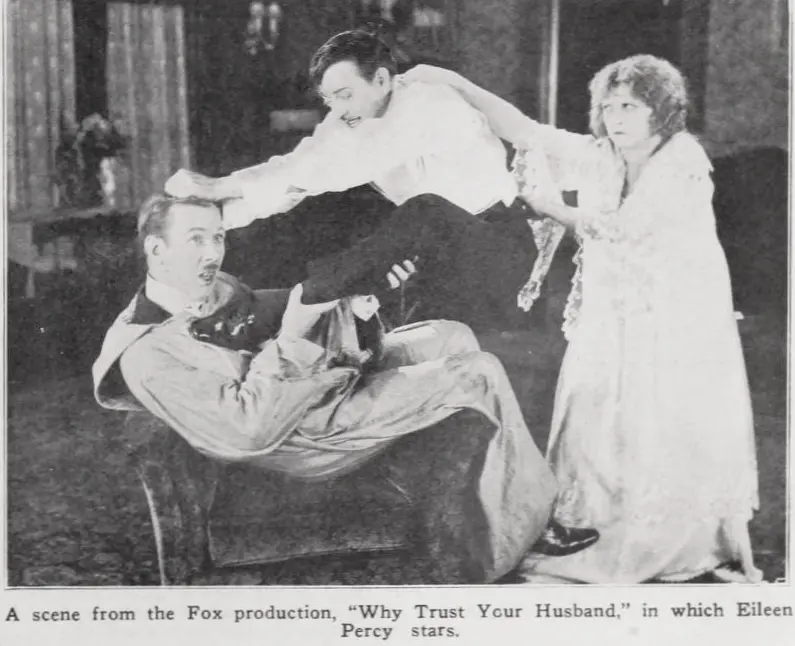
For its time, *Why Trust Your Husband* showcases remarkable technical ingenuity. The use of shadow play in the masquerade scenes, where silhouettes of the characters dance against the background, creates a dreamlike quality that enhances the film’s thematic duality. The set design, particularly the Stone residence and the police court, is meticulously crafted to reflect the social stratification of the era. The Stone household, with its opulent yet cluttered interiors, contrasts sharply with the stark, bureaucratic minimalism of the police station—a visual reminder of the moral ambiguity of the upper class.
In comparison to other films of the period, *Why Trust Your Husband* occupies a unique space. Unlike the overtly moralistic narratives of *The Wrong Woman* or the tragic realism of *The Girl from Bohemia*, this film leans into its farcical elements to critique societal norms. Its closest cousin is perhaps *The Foolish Age*, another comedy of manners that uses mistaken identities to explore generational and gendered tensions. However, *Why Trust Your Husband* distinguishes itself by its darker undercurrents; the humor is not merely for laughs but serves as a vehicle for social commentary.
Though the film’s plot may seem dated to contemporary viewers, its themes of identity, trust, and performance remain strikingly relevant. The masquerade, as a metaphor for the dual lives people lead, resonates in an age where digital personas often overshadow authenticity. Moreover, the film’s treatment of gender dynamics—while limited by the constraints of its time—offers a fascinating glimpse into early 20th-century anxieties about women’s growing independence. It is a relic of its era yet a precursor to modern narratives that continue to grapple with these issues.
*Why Trust Your Husband* is not without its flaws. The subplots involving the aunt and uncle (played by Milla Davenport and Harry Dunkinson) occasionally strain credulity, and the resolution, while clever, feels somewhat abrupt. However, these are minor quibbles in the context of a film that so successfully blends humor with insight. For enthusiasts of silent cinema, it is an essential viewing; for casual viewers, a gateway to appreciating the era’s nuanced storytelling. In the end, the film’s greatest achievement is its ability to make us question: in a world of masks, can trust ever be genuine, or is it merely another performance?
For further reading on films that explore similar themes of deception and identity, consider *The Shadow of Her Past* or *The Hole in the Wall*, both of which offer compelling contrasts to the farcical tone of *Why Trust Your Husband*.
IMDb —
1923
Community
Log in to comment.