DbcultAccessing Vault...
Cult Review
Senior Film Conservator
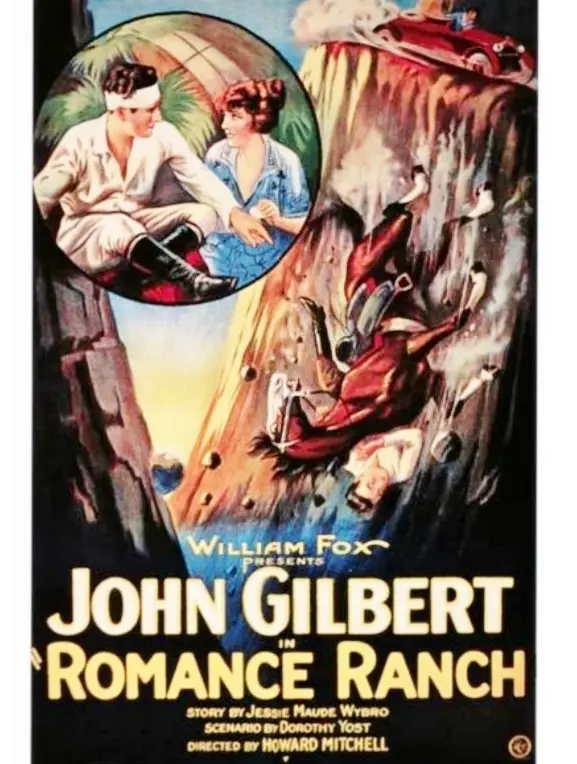
In the pantheon of silent cinema, few figures resonate with the same enduring magnetism as John Gilbert. Long before the advent of the 'talkies' threatened his career, Gilbert was the quintessential avatar of romantic intensity. In the 1924 Fox production Romance Ranch, we find him at a fascinating crossroads, blending the rugged individualism of the Western genre with the sophisticated yearning of a high-stakes melodrama. This film, directed with a keen eye for spatial dynamics by Howard M. Mitchell, serves as a testament to an era where visual storytelling achieved a level of poetic economy that modern blockbusters often struggle to replicate.
The film opens with a sequence that immediately establishes the weight of history. Carlos Brent's grandfather, played with a weathered dignity by Bernard Siegel, provides the catalyst for the entire drama. The revelation of the true ownership of the Hendley ranch isn't merely a plot point; it is a spiritual awakening for Carlos. The cinematography captures the vastness of the landscape, emphasizing the isolation of the characters and the immense value of the land they contest. Unlike the exotic escapism found in The Tents of Allah, which sought to dazzle with foreign locales, Romance Ranch finds its beauty in the familiar textures of the American frontier.
John Gilbert's performance is a masterclass in silent nuance. Every flicker of his eyes conveys the internal struggle between his duty to his lineage and his burgeoning desire for Carmen Hendley. Virginia Brown Faire, as Carmen, provides the perfect foil. She isn't merely a damsel to be won; she is the personification of the very land Carlos seeks to reclaim. Their chemistry is the engine that drives the film forward, turning what could have been a dry legal dispute into a visceral battle of wills. It reminds one of the emotional stakes in The Greatest Question, where the domestic sphere becomes a site of profound moral inquiry.
From a contemporary perspective, the film's resolution—Carlos abducting Carmen to secure his claim—raises significant ethical questions. However, within the context of 1920s narrative conventions, this act is framed as the ultimate romantic gesture. It is a synthesis of the 'caveman' archetype and the chivalrous knight. Brent realizes that to evict the Hendleys through the courts would be to destroy the woman he loves. By 'stealing' her, he preserves her family's dignity while asserting his own rights. This moral complexity is far more intriguing than the straightforward heroics found in films like The Fourth Musketeer.
The script, penned by Dorothy Yost and Jessie Maude Wybro, navigates these murky waters with surprising agility. They understand that the audience isn't looking for a lecture on property law; they want a validation of the heart's supremacy. The abduction is staged not as a violent crime, but as a desperate, passionate intervention. It is the cinematic equivalent of cutting the Gordian knot. Where a film like Gimme might focus on the material desires of its protagonists, Romance Ranch elevates the stakes to a cosmic level of fate and inheritance.
The visual language of Romance Ranch is remarkably sophisticated for 1924. The use of natural lighting in the outdoor scenes creates a sense of realism that contrasts sharply with the stylized interiors. The pacing is deliberate, allowing the tension to build as the secret of the letter looms over the characters. We see a similar attention to period detail in Marc'Antonio e Cleopatra, though Mitchell’s direction here is more focused on character intimacy than grand spectacle. The editing, particularly during the climax, creates a sense of urgency that mirrors Brent's internal desperation.
John Miljan delivers a performance of calculated menace as the antagonist. He represents the bureaucratic corruption that Brent must overcome. Unlike the whimsical tone of Casey at the Bat, there is a genuine sense of peril here. The stakes are tangible: the loss of a home, the loss of a legacy, and the loss of love. The film’s ability to balance these heavy themes while remaining an entertaining piece of popular fiction is a testament to the skill of the Fox Film production machine of the era.
"Romance Ranch is not merely a Western; it is a psychological landscape where the ghosts of the past dictate the passions of the present."
When we compare Romance Ranch to its contemporaries, its unique flavor becomes even more apparent. While Johanna Enlists offers a more lighthearted look at societal roles, Romance Ranch dives deep into the darker impulses of ownership and desire. It shares a certain thematic DNA with Os Fidalgos da Casa Mourisca in its obsession with ancestral homes and the weight of the past. Even in the more action-oriented Smiling Jim, we don't see the same level of romantic gravitas that Gilbert brings to the screen.
The film also serves as a fascinating precursor to the more psychological Westerns of the 1940s and 50s. It hints at the idea that the frontier is not just a place of physical danger, but a space where the social contracts of the East are tested and rewritten. In this regard, it is far more than a simple genre piece. It is a foundational text in the evolution of the American cinematic hero. Carlos Brent is a man who takes what is his, but only because he is guided by a moral compass that values human connection over legalistic victory. This distinguishes him from the purely duty-bound characters often seen in propaganda or instructional films like Britain's Bulwarks, No. 1: Women Munitioners of England.
Watching Romance Ranch today, one cannot help but feel a sense of melancholy regarding John Gilbert's future. Here, he is at the height of his powers—athletic, expressive, and undeniably charismatic. His ability to command the frame without uttering a single word is a skill that has largely been lost in the age of dialogue-heavy scripts. His performance here is as vital as anything found in Gypsy Love or the epic scope of Ashoka. He was an actor who understood that cinema is, first and foremost, a visual medium.
The supporting cast also deserves recognition. Evelyn Selbie provides a grounded presence that anchors the more heightened moments of the melodrama. The film avoids the slapstick tendencies of Beaches and Peaches, opting instead for a consistent tone of dramatic earnestness. Even the smaller roles are filled with actors who understand the specific requirements of the silent frame. This ensemble work ensures that the world of the ranch feels lived-in and authentic, rather than just a collection of sets.
In the final analysis, Romance Ranch is a pivotal work that illustrates the transition of the Western from a simple morality play into a complex exploration of character and desire. It utilizes the trope of the 'missing letter'—a device also seen in $1,000 Reward—not just as a plot convenience, but as a symbol of the delayed justice that haunts the Brent family. The resolution of the film, while perhaps jarring to modern sensibilities, offers a satisfying emotional payoff that reinforces the idea of love as a transformative force.
For those who wish to understand the power of silent cinema, Romance Ranch is essential viewing. It showcases the medium's ability to communicate complex emotional truths through movement, composition, and the sheer magnetic force of its stars. It is a film that demands to be seen not as a relic of the past, but as a living piece of art that continues to speak to our fundamental desires for belonging, justice, and connection. Whether you are a fan of Follow Me or prefer the historical sweep of grander epics, there is something in the dusty, romantic atmosphere of this ranch that will resonate with any true lover of the silver screen.

IMDb —
1930
Community
Log in to comment.