DbcultAccessing Vault...
Cult Review
Senior Film Conservator
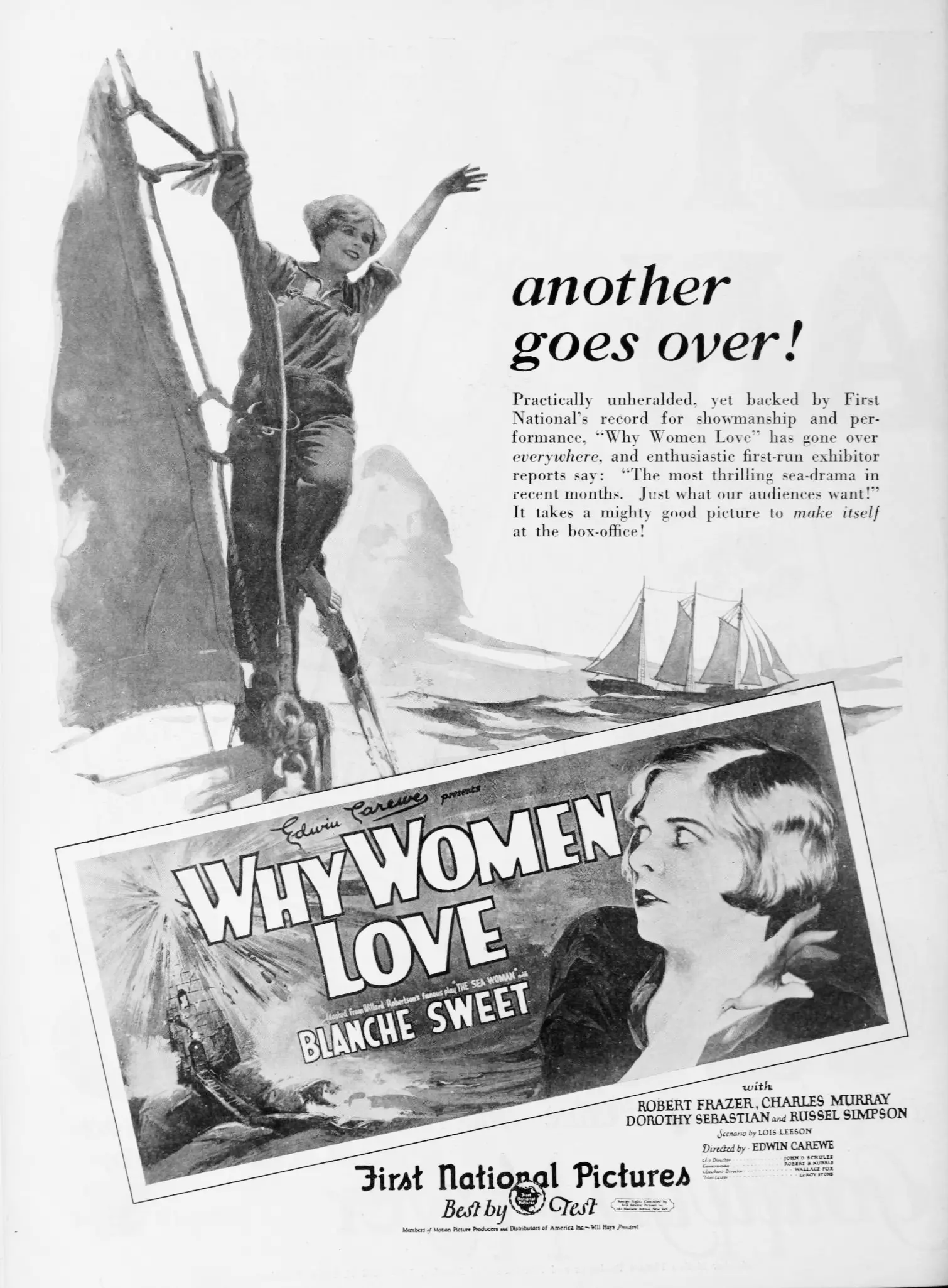
In the engulfing flames of a sunken oil tanker, Molla Hansen emerges as the sole survivor. Her ordeal is not yet over; her rescuer, Silas Martin, a lighthouse-keeper, meets a tragic fate. In his final moments, he implores Molla to take care of his daughter, Pearl, casting a shadow of obligation and duty that would ripple through Molla's life for years to come. Meanwhile, Captain Rodney O'Malley, Molla's departed fiancé, embarks on a long journey at sea, leaving behind a void that Molla struggles to fill.
Two years later, Pearl's world is shaken by the arrival of a charismatic character named Charley Watts, a rum-runner who quickly becomes entangled in her life. However, Pearl's trust in Charley wavers when she discovers his marital status. In a desperate act driven by jealousy and betrayal, Pearl locks Charley in the lighthouse tower, floods it with gas, and hurls a lighted lantern at him, a deed that tragically results in their deaths. The explosion is a signal to Captain O'Malley's ship, and with Molla, he is reunited after a period of separation.

The film’s narrative is a tapestry of emotional intensity, where the threads of love, betrayal, and revenge intertwine. Molla's journey from grief to vengeance is meticulously portrayed, with each step she takes towards exacting her revenge on those she deems responsible for the loss of her fiancé and her own survival. Her encounters with Ira Meers, the engineer who she believes to be the mastermind behind her fiancé’s departure, are pivotal moments that heighten the drama and tension.
Director Ralph Spence and writers Lois Zellner and Willard Robertson have crafted a film that is both a study in human psychology and a cautionary tale about the destructive power of unresolved emotions. The performances, led by Robert Frazer and Dorothy Sebastian, are nuanced and deeply affecting, particularly Sebastian's portrayal of Molla, who transitions from a survivor to a vengeful avenger. Her performance is a testament to the film's ability to explore complex emotional landscapes.

One cannot help but draw parallels between 'Why Women Love' and other films that explore similar themes of emotional turmoil and societal constraints. 'Youth to Youth' (1925) and 'Heart of Gold' (1926) offer a comparative insight into how different directors and writers have grappled with these themes in different eras. In 'Heart of Gold,' for instance, the protagonist's journey towards self-discovery is a stark contrast to Molla's path towards vengeance, highlighting the divergent ways in which these narratives can be told.
Moreover, the film's setting, the lighthouse, serves as a symbolic backdrop that mirrors the isolation and personal battles of its characters. The lighthouse, with its beacon casting light into the darkness, becomes a metaphor for Molla's quest for clarity and redemption. The film's use of the lighthouse as a recurring element adds a layer of visual and thematic significance, enhancing the narrative's emotional depth.

Technically, the film is a marvel of its time, with a stark contrast between the fiery aftermath of the oil tanker disaster and the serene beauty of the lighthouse. The cinematography, by Fred Warren, captures the drama and intensity of the scenes, particularly the climactic sequence where Pearl and Charley are locked in the lighthouse. The visual storytelling is a testament to the film's artistic vision, complementing the narrative’s emotional intensity.
On a technical note, 'Why Women Love' stands out for its meticulous attention to detail. The sets, particularly the lighthouse and the ship, are meticulously crafted, contributing to the film's authenticity and historical accuracy. The score, composed by James Hanley, complements the film's tone, providing a haunting and melancholic backdrop to the unfolding drama. The film's pacing, while sometimes slow, allows for a deep dive into its characters and themes, making it a more immersive experience.

However, the film is not without its flaws. The narrative at times feels contrived, with certain plot points that seem to serve more as a mechanism for advancing the story rather than organic developments in the characters' arcs. This can make the climax feel somewhat forced, detracting from the film's otherwise strong performances and thematic depth.
In conclusion, 'Why Women Love' is a compelling film that explores the complexities of love, loss, and the destructive power of unresolved emotions. Its nuanced performances and visual storytelling make it a highlight of its era. While it may not be without its flaws, it remains a significant work in the silent film genre, offering a rich tapestry of human emotion and societal commentary.
IMDb —
1927
Community
Log in to comment.