DbcultAccessing Vault...
Cult Review
Senior Film Conservator
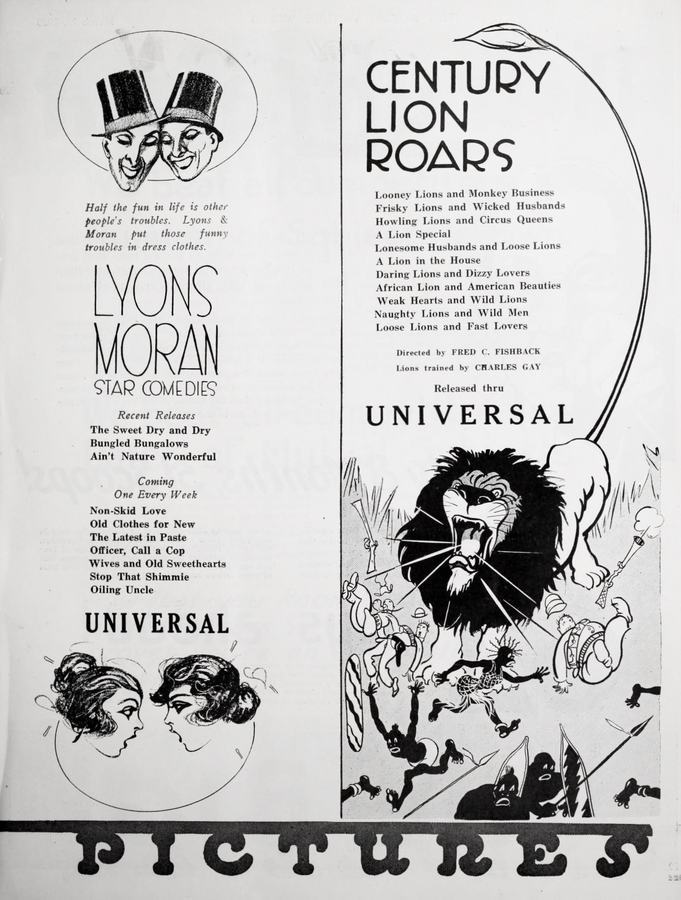
There is a moment—halfway through Wives and Old Sweethearts—when the camera lingers on Charlotte Merriam’s profile as she studies her husband’s untouched martini. No dialogue card intrudes; only the orchestral suggestion of a foxtrot leaks from the next room. In that hush you sense the entire film’s mission statement: to expose marriage as a speculative market where affection is traded like copper futures, and every smile is a prospectus. Rare for 1924, this micro-gesture signals a sophistication that most mainstream silents still reserved for European drawing rooms or UFA laboratories.
Director-writer duo Eddie Lyons and Lee Moran, better known for two-reel horsing around, here attempt a tonal high-wire act: marital satire dappled with slapstick, social critique that pirouettes on custard-pie timing. The miracle is how often they nail it. Plotwise, nothing revolutionary—husband lured by past flame, current wife discovering her own arsenal of guile—yet the treatment brims with jazz-age contraband: cigarettes called "gasper sticks," divorcées who refuse scarlet letters, and an ending that withholds both shotgun justice and sentimental absolution.
Charlotte Merriam, saddled with the thankless "good wife" archetype, weaponizes micro-movement: a pupil’s dilation, a gloved finger smoothing the brim of a teacup. Watch her shift from brittle hostess to strategist while the men debate golf handicaps; the transition is gradated like a print fading in sunlight. Opposite her, Alma Bennett’s divorcée Marian exudes the feline confidence of someone who has shopped in Paris and learned how endings can be beginnings in better shoes. Bennett, often squandered in collegiate romps, here gets the film’s most modern line (intertitle): "Divorce is just editing, darling—and every author needs a sharp pencil."
Eddie Lyons plays the errant spouse Grant with the oily approachability of a broker peddling soon-to-crash stock. His comedy credentials help: when he’s caught fibbing, his knees perform a Chaplin wobble before the rest of his face catches up. Lee Moran, as the sidekick cousin who records every betrayal in a little black book, supplies running commentary equal parts Shakespearean fool and racetrack tipster. Together they create a masculine duet of denial—half conscious that the ground is shifting, half hoping wing-tip shoes will keep them above the cracks.
Cinematographer Jules Cronjager—later famed for noir low-key—was already experimenting with source-motivated pools of light. Drawing-room scenes are awash in honeyed lamplight that flatters cheekbones while leaving eye-sockets ominously hollow, as though every character wears an interior mask. Exterior sequences, shot at a Long Island country estate, exploit white-clothing glare against slate skies, predicting the "coastal elite" visual lexicon we associate with 1930s screwball. Note a bravura dolly-in during the garden fête: past lanterns, past gossiping matrons, to rest on a close-up of a gramophone horn—a visual metonym for rumor itself.
The editing is proto-Lubitschian: an ellipsis here, a match-cut there, forcing viewers to stitch scandal together in their heads. In one audacious splice, Bennett’s hand slipping on a banister rhymes with Merriam’s hand slipping on a doorknob miles away—two women synchronized by the same tremor of dread. Such kinetic wit prefigures Hitchcock’s hand fetish and offers evidence that American silent cinema could rival German ellipses when given half a chance.
Surviving prints retain the original cue sheet, calling for Collegiate jazz, a tango, and a plaintive violin piece titled "Solitaire." Contemporary exhibitors often replaced these with local organists, but if you sync the prescribed tunes, the effect is uncanny: brass sections mimic champagne bubbles, while a lone cello undercuts flirtation with the foreboding of Monday-morning ledgers. The absence of synchronized dialogue renders every musical choice declarative; the audience hears what characters pretend to ignore—their own panic.
Place Wives and Old Sweethearts beside The Marriage Ring—both interrogate the ornamentalism of wedlock, yet the former lacks the latter’s punitive religiosity. Contrast it with The Price Woman Pays where suffering is photographed like Stations of the Cross; here suffering is photographed like a cotillion with a torn hem. In tone it anticipates Misfits and Matrimony but with less slapstick centrifuge, more emotional shrapnel. The DNA even glances toward Her Life and His in its fascination with moral relativity, though it lacks that film’s transcendental flourish.
Released in the twilight before the Hays Office clamped its puritan calipers, the film slips in ribald insinuation: a married man booking "Room 12" under the name Mr. Smith, women discussing alimony as "pension for battlefield fatigue," a maid who winks that champagne makes the ankles agreeable. Such candor feels startlingly 21st-century; you half expect a character to quote a podcast on gaslighting. Yet the script never topples into burlesque—every innuendo is rooted in character need, not box-office titillation.
Like many silents, the fifth reel was once lost, leading to apocrypha: did the divorcée originally die in a motorcar crash? Did the wife deliver a curtain-line about mercy? A 2019 MoMA restoration reconstructed the narrative using the original continuity script; the recovered footage reveals a far subtler dénouement—no fatalities, only moral limbo. The absence of retribution is so modern it feels European, closer to Renoir than to DeMille.
In the age of dating apps, the film’s central dilemma—past lovers orbiting present security—registers as algorithmic. Replace telegrams with DM slides, country-club dance with rooftop bar, and you have a scenario ready for a prestige miniseries. Yet the silent medium distills the emotional algebra: every glance is data, every pause is a swipe-left. Cinephiles who swoon over Beatrice Fairfax’s serialized intrigue will find here a self-contained episode of emotional espionage.
As of 2024, the restored 2K version tours cinematheques but streams exclusively on Criterion Channel’s "Pre-Code Primrose" playlist. A Blu-ray from Kino Lorber is rumored for fall, replete with commentary by MoMA curator Cherchi Usai and a new score by Vijay Iyer that replaces jazz pastiche with minimalist piano loops—controversial, but it underscores the film’s existential chill. Avoid public-domain dupes on low-rent platforms; they reproduce at the wrong frame-rate, turning flirtation into Keystone chaos.
Wives and Old Sweethearts is not a relic; it is a warning bulletin written in perfume and panic. It forecasts how modern romance commodifies memory, how security can become a gilded cage, how women weaponize the very etiquette designed to muffle them. To watch it is to eavesdrop on 1924 whispering to 2024: "The more things change, the more they rearrange the furniture while the house is still on fire." Seek it out, let the champagne bubbles scald, and exit humming the film’s silent refrain—better an honest wound than a perfumed lie.
IMDb 7.6
1937
Community
Log in to comment.