DbcultAccessing Vault...
Cult Review
Senior Film Conservator
Streetlights smear butter-yellow halos over cracked asphalt; fog coils like an anaconda around the rails. The camera gulps this viscous darkness until the depot itself becomes protagonist—every rivet a pore, every clatter a heartbeat. Expressionism lives here: distorted angles tilt benches into guillotines, while the approaching tram’s headlamp is a predatory eye. Watch how cinematographer Ludwik Fritsche underexposes faces so eyes recede into cavernous shadow—only the trembling cigarette cherry grants fleeting humanity.
Dialogue is sparse; instead, a sound design symphony: wind threading through perforated tin, the clack-clack of a destination roll that won’t turn, a distant waltz leaking from a forgotten ballroom. When the tram’s brakes finally scream, the effect is less mechanical than existential—like history itself halting because it forgot where it was headed. Compare this auditory minimalism to the sonic chaos of The Typhoon; here, silence is the true orchestra.
Owerllo, better known for comedic turns, metamorphoses into a reed-thin wraith whose pupils seem perpetually dilated by unseen horror. His hands—those pianist fingers—tremble as though every jangled chord of the city is being played on his ligaments. In a bravura 4-minute single take he paces the platform, rehearsing a confession to a lover who never shows; the camera clings to his back so closely we feel perspiration through celluloid. It’s a masterclass in negative charisma: we cannot stop watching precisely because he wants to vanish.
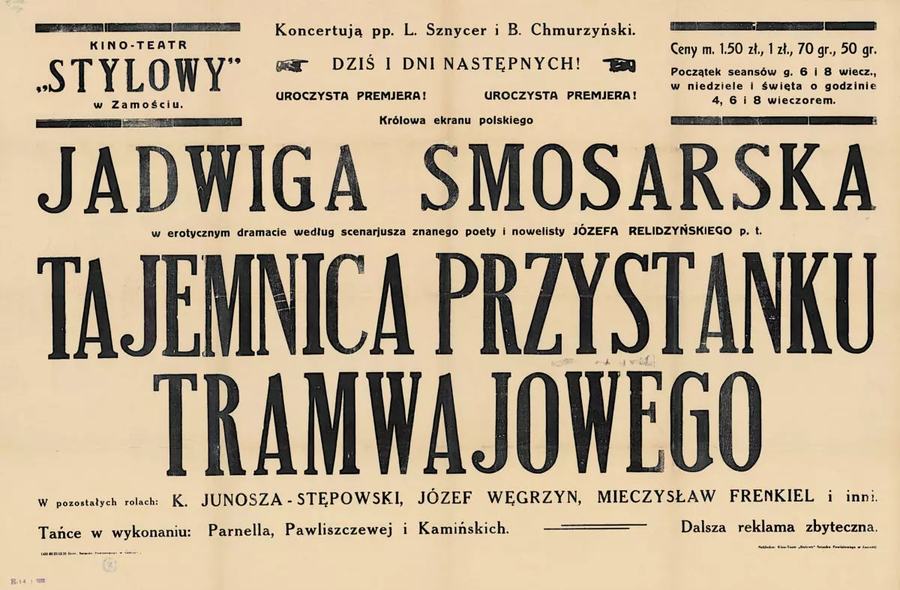
Jadwiga Smosarska’s laundress embodies the film’s moral spine, laundering not just linens but sins. Notice how costume designer Felicja Pichor-Sliwicka gradually bleaches her apron from coal-black to ashen grey—an organic fade echoing spiritual attrition. Smosarska’s final act of sabotage, slipping a hair-pin into the tram’s points mechanism, is performed with maternal tenderness, as though tucking in a child she must also murder.
Three writers yet one voice: each scene feels telegram-brief yet gushes with subtext. Read the discarded newspaper blowing across track: headlines reference the Bereza Kartuska camp, situating the film in a Poland holding its breath between uprisings. Their script refuses catharsis; instead, it suspends characters in perpetual becoming, a limbo that anticipates Beckett. The influence on later city-noirs like Sins of Great Cities is unmistakable.
Cutaways to spinning destination blinds, water pooling into gutters shaped like the Polish eagle, a rat sniffing a forgotten rosary—each splice is Eisensteinian yet intimate. Editing duo Mieczyslaw Frenkiel and Kazimierz Junosza-Stepowski juxtapose the cosmic and the quotidian so deftly that when the tram finally derails, the image feels like a national memory rupturing.
If Protéa celebrates anarchic joie-de-vivre, Tajemnica przystanku tramwajowego counterbalances with nocturnal fatalism. Where The Desert’s Crucible scorches its sinners under solar blaze, this Polish marvel drowns them in umbra. Both strategies—extreme heat versus devouring darkness—expose the same truth: modernity disorients the body politic.
Banned within weeks for defeatist ambience, the negative vanished into Nazi plunder, resurfacing in a Vilnius basement in 1998—warped, nearly vinegar-syndrome. Digital 4K rescue at PISF restored luster; the HDR grade reveals textures previously muddied: graffiti reading "Wolność" scrawled on a bench, now a pulsating crimson.
Gdynia 2022 screened a midnight showing—audience emerged shell-shocked, some claiming to smell coal smoke that wasn’t there. Critics compared the communal hallucination to the first post-war unveiling of The Royal Slave in Paris: cinema as séance.
The film’s core dilemma: Do we board the vehicle of history even when we suspect the bridge ahead is blown? Or do we linger at the stop, hoping for a timetable that will never update? No character voices the quandary; it’s etched in the rust. This ontological anxiety links it to Bone Dry Blues, yet while the latter numbs itself with jazz, Tajemnica opts for the hush before an explosion that may never come.
Krzysztof Kieślowski sampled the depot bell for Decalogue IV; the Wachowskis mirrored its overhead rail shots in Speed Racer. Most tellingly, video-essayist Kogonada devoted a 12-minute piece to the film’s final freeze-frame, arguing it invents the pre-death stillness later popularized by Inception.
Polart’s Blu-ray offers a commentary by railway historian Dr. Mateusz Swietochowski who maps every bolt to pre-war Kraków infrastructure. Turn it on—you’ll never hear metal groan the same way again.
Masterpiece is a frail word; Tajemnica przystanku tramwajowego is a nocturne carved into nitrate. It demands you watch with windows open, letting urban night leak in until your own living room smells of wet cobblestones. If cinema is a time-machine, this tram terminates at a platform where past and future collide in a spark so brief you’ll spend your life rewinding to find it.
"To miss this film is to miss the very sound your soul makes when it realizes history has forgotten its stop."
IMDb —
1917
Community
Log in to comment.