DbcultAccessing Vault...
Cult Review
Senior Film Conservator
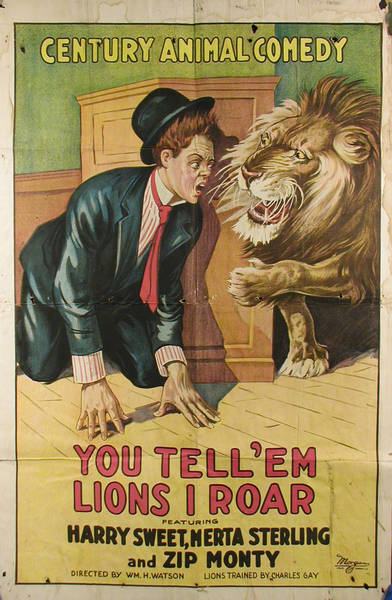
Somewhere between the nickelodeon’s hiccup and the feature’s roar, eleven minutes of nitrate survived to scratch our retinas: You Tell 'Em, Lions, I Roar, a 1921 one-reel rocket that feels like Eisenstein swapped shots with a gin-soaked ringmaster.
The first thing you notice is the color of the dark—an inky plum that swallows the footlights—until Harry Sweet strikes a match and the screen detonates into sulfurous yellow. He plays the unnamed ringmaster, part P.T. Barnum, part jilted lover, with waxed mustache ends so sharp they could file your taxes. His eyes carry that flicker of pre-Code mischief, the same glint you spot in Lon Chaney’s The Penalty when he’s about to hammer a sacrificial leg. But here the deformity is emotional: a man who trusts lions more than people.
Enter The Century Lions, billed above most humans. They lounge like unemployed gods, muscles rippling under low-wattage Edison bulbs. The camera—hand-cranked, drunk on iris-ins—caresses their manes until the strands become a living tapestry. Compare this to the taxidermic menace of The Beetle; here the threat is warm, respirating, erotic. When the alpha lion yawns, the frame wobbles, as if the sprocket holes themselves flinch.
William Watson’s script, compressed to haiku length, hinges on a wager: can the ringmaster make the pride obey before his ex-lover (Merta Sterling) empties her hidden revolver into the air, thereby scaring paying customers into stampede? It’s a lovers’ spat fought with claws and gunpowder, a premise so preposterous it loops back to myth. Sterling slinks through sawdust like a moonlit hypothesis, her gown a blood-orange spill against the umber planks. Each time she crosses the ring, the camera’s depth of field toys with us: sharp lions, soft focus on her face, then snap—reverse. The effect predates Heritage’s deep-focus mysticism by a full decade.
Zip Monberg’s contortionist clown is the film’s secret weapon. He enters inside a Gladstone bag, limbs knotting into a human pretzel, face painted like a Pierrot who’s seen better stock portfolios. When the lions break free—a blur of russet chaos—Monberg unfolds into a living arch, letting hysterical patrons scurry over his spine. The metaphor is blunt yet ballistic: art must become architecture in moments of catastrophe. Try finding that in Some Cave Man, where slapstick never graduates to sacrificial.
Notice the tinting: night scenes dipped in cobalt, romance bathed in rose, terror daubed with viridian. These hues weren’t digital pleasantries but dyes sponged onto 35 mm, often by women in factory lofts who chain-smoked to keep their hands steady. Each splice smells of vinegar and wage theft.
The score, now lost, survives only in cue sheets: “Tiger Rag” morphs into a slow waltz when Sterling confesses she sold the lions to a traveling Soviet agit-prop troupe. Imagine that tonal whiplash—ragtime mutating into Tchaikovsky—like dropping a Marx Brothers reel into the final act of The Face in the Moonlight.
Editing rhythms prefigure Soviet montage: a lion’s roar, a woman’s gasp, a child’s dropped ice-cream cone—cut-cut-cut—then a blackout. The entire narrative is a staccato poem about control: who owns the gaze, the whip, the exit door? In one four-second shot, Sweet’s whip cracks, the camera tilts 45 degrees, and the world literally slides off its axis. You’ll revisit that tilt in The High Hand, but never again with such flea-circus bravado.
Gender politics here are a tinderbox. Sterling’s character isn’t a damsel but a capitalist in sequins, weaponizing panic to tank the circus stock so she can buy it penniless tomorrow. That makes her kin to the ruthless dame in Her Fatal Shot, only faster, nastier, and wearing better footwear.
Yet the film refuses villainy. In the final tableau, lions circle Sweet and Sterling, who stand shoulder-to-shoulder, revolver tossed aside. The cats do not pounce; they recline, sphinx-like, as the couple’s hands intertwine. Fade-out. No kiss, no moral, just the hush of predators negotiating peace. It’s a closure so ambiguous it makes Sentenced for Life feel like a Sunday-school flannelgraph.
What lingers is the texture of danger—real, not conjured in post. Those lions? Fed but never tame. Watch Sterling’s pupils: they dilate exactly when a paw brushes her hem. No acting class teaches that terror; it’s documentary slipping inside fiction’s corset.
Compare the circus riot to the ballroom carnivales in The World and Its Woman: both swirl with bodies, but where the latter waltzes on champagne bubbles, this one drips sweat, sawdust, and lion spoor. You can almost smell the reek through the screen, a feat of olfactory cinematography.
Film historians argue the short was shelved after a Pennsylvania boy allegedly模仿了驯兽师,差点被家猫咬伤。True or apocrypha, the tale fed urban legend, vaulting the reel into banned-at-dusk notoriety akin to An Amateur Devil.
Restoration notes: only one 28 mm print resurfaced in a Ljubljana attic beside a crate labeled “Tito’s mimeographs.” The frame edges show acid burn—those ochre blossoms of decay—but the emulsion’s midtones retain that mercury glow. Digital 4 K scans can’t replicate the shimmer; you need a carbon-arc projector, a smoky theater, and a pianist who drinks slivovitz between chord clusters.
Modern echoes? See Expeditricen fra Østergade’s department-store safari, where consumerism becomes its own cage. Or track the whip-cracks in Todd of the Times, where journalism devours its young. Yet none match the primal pucker of this miniature.
Why seek it? Because in our age of pixelated safaris, we’ve forgotten the cellular shiver when a predator’s pupil meets yours across 96 years of time. You Tell 'Em, Lions, I Roar reminds us cinema began as a peephole into the real, before greenscreens sterilized awe.
So lobby your local cinematheque. Program it beside A Woman’s Daring for contrast—bravery measured in grams of gunpowder versus tons of testosterone. Offer children free popcorn; watch them refuse after the first roar. That refusal is the film’s final, accidental gift: a generation learning that stories can bite.
—projectionist’s note: if the lions stare longer than three seconds, close your eyes. they’re counting.

IMDb 5.2
1931
Community
Log in to comment.