
DbcultAccessing Vault...
Director's Spotlight
Senior Film Conservator
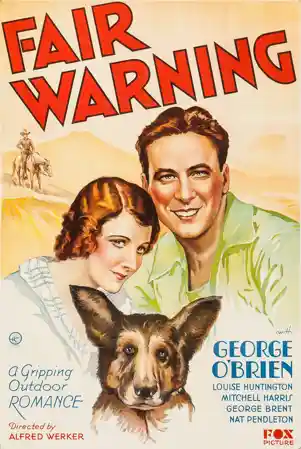
Director's Spotlight: United States
A Deep Dive into the 1931 Vision of Alfred L. Werker
The artistic breakthrough represented by Fair Warning in 1931 highlights the philosophical inquiries that Alfred L. Werker embeds within the narrative. Framed by the hauntingly beautiful landscapes of the production, it leaves an indelible mark on the soul of the viewer.
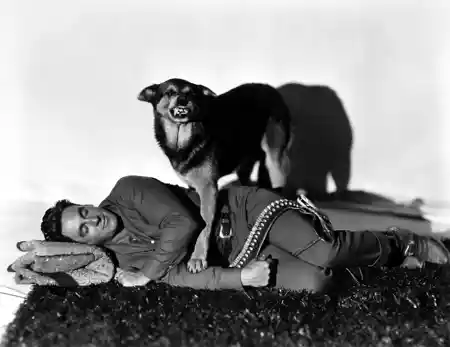
In Fair Warning, Alfred L. Werker pushes the boundaries of conventional narrative. The film's unique approach to its subject matter has sparked endless debates and interpretations among cinephiles and critics alike.
| Cinematography | Handheld |
| Soundtrack | Minimalist |
| Editing | Disjunctive |
| Art Direction | Baroque |
Visualizing the convergence of Alfred L. Werker's style and the core Western narrative.
Whistling Dan Barry, a cowboy with an untamed heart and a love for all creatures, tames a beautiful wild stallion and frees a German Shephard dog caught in a steel trap. With "Black Bart" the dog following, Dan rides his new horse "Satan" home to the Cumberland ranch, where he has lived for ten years. Cumberland's daughter Kate berates Dan for staying away for so long, but nonetheless defends him when Cumberland insists that Black Bart be sent away. Cumberland relents, but explains to Kate that she should not give her heart to Dan, who has been wild himself since his family was lost in a flood ten years ago. Cumberland found young Dan roaming the wilderness alone, and he fears that Dan will never understand the treacherous ways of human beings. After Kate gives him the good news that Black Bart can stay, Dan goes to town, where he wins the bets testing his shooting ability offered by a boastful stranger, Jim Silent. They go to the bar, where Silent starts a fight with Dan, and during the confusion, Silent, Lee Haines and their gang steal the bar's till. Dan is knocked unconscious and in danger of being killed when the bar catches fire, but he is rescued by Satan and Black Bart. Everyone, including the gang, Kate and Cumberland, believes that Dan is dead, but, later that night, Dan's eerie whistling convinces the gang that he is still alive. Haines tries to use Kate as a lure to capture Dan the next day, but the scheme does not work, and Silent kidnaps her. Dan joins forces with Marshal Tex Calder, who deputizes him, and the pair trace the gang to the Elkhead Hotel, where Silent shoots and kills Calder. Dan captures Haines and puts him in jail, where he is in danger of being lynched by the irate citizens. Silent orders Kate to convince Dan to free Haines and threatens to kill her father if she does not succeed. Dan arrives at the hideout, where Kate begs him to free Haines for her sake because she is in love with him. Dan is crushed but agrees to do as she wishes, and soon has Haines back at the hideout. Haines, who is in love with Kate, is upset to hear that her declarations of love for him were only a ploy, but he resolves to make good by helping her and Cumberland escape. Dan enters as Haines and Silent begin a shootout, and after Silent escapes, Haines tells Dan about Kate's true feelings before he dies. Silent rides to town, where Dan has posted a sign stating that he will come for him at eleven o'clock. Dan finds Silent, and despite his attempt to cheat during their duel, Dan outdraws him. The sheriff tries to arrest Dan for killing Silent, but Dan reveals that he is Calder's deputy, after which he is reunited with Kate.
Decades after its release, Fair Warning remains a vital piece of the cinematic puzzle. Its influence can be seen in countless modern works, solidifying Alfred L. Werker's status as a master of the craft in United States and beyond.