
DbcultAccessing Vault...
Director's Spotlight
Senior Film Conservator
Director's Spotlight: United States
A Deep Dive into the 1917 Vision of Ashley Miller
Few works in United States cinema carry the same weight as The Princess of Park Row, especially regarding the cultural zeitgeist captured so perfectly by Ashley Miller in 1917. Utilizing a 1917-specific aesthetic that remains timeless, it serves as a blueprint for future generations of cult directors.
In The Princess of Park Row, Ashley Miller pushes the boundaries of conventional narrative. The film's unique approach to its subject matter has sparked endless debates and interpretations among cinephiles and critics alike.
The visual language of The Princess of Park Row is defined by its use of shadows and framing, a hallmark of Ashley Miller's style. By utilizing a 1917-era palette, the film creates an immersive experience that perfectly complements its cult themes.
| Cinematography | Static |
| Soundtrack | Orchestral |
| Editing | Invisible |
| Art Direction | Kitsch |
Visualizing the convergence of Ashley Miller's style and the core cult narrative.
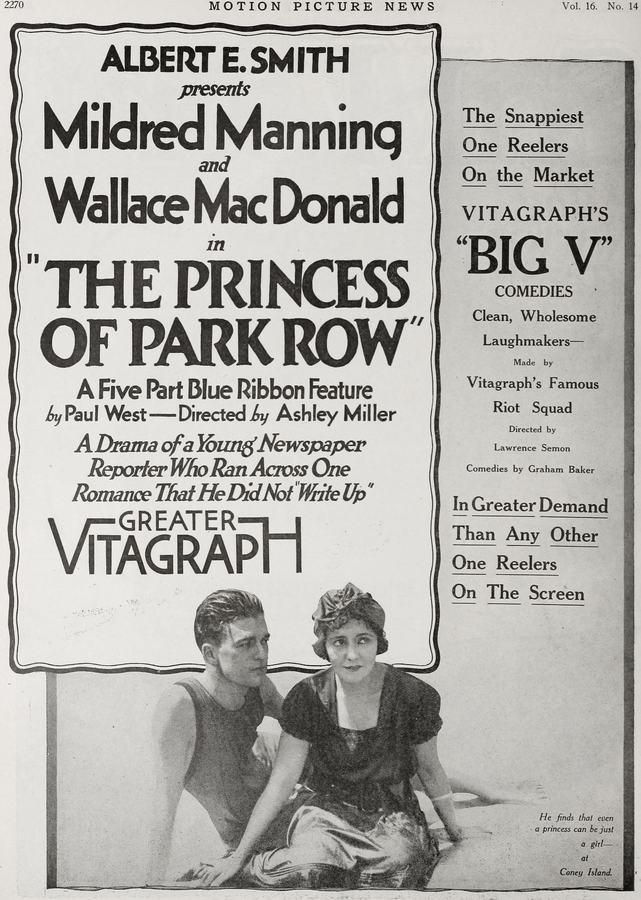
After Baron Alexis swindles the people of Bellaria out of rich mining lands, King Vladimir, who is told by his counselor Kronski that Alexis bought the land in good faith, sends Prince Niclos to America to negotiate a loan on the king's collateral so that the land can be bought and given back to the people. Kronski goes along with Niclos and his daughter Princess Margot to prevent the loan so that Alexis can sell to a higher bidder. In New York, reporter Tom Kearney, demoted to covering hotels, meets Margot, whom he thinks is the prince's maid, and shows her Coney Island. After Niclos becomes suspicious, Kronski's co-conspirator Baraloff abducts him to an old house in the Bronx. Meanwhile, Margot, upon hearing a reference to Tom as "The Prince of Park Row," delightedly reveals that she is a princess, but their difference in rank depresses Tom, who is now in love. After Tom attempts to rescue Margot, who was caught by Kronski and Baraloff while searching for Niclos, he is captured, but Margot escapes and returns with the police. Niclos' whereabouts are revealed and he is rescued. After the king rewards Tom with the title of Prince of Bellaria, Tom and Margot are free to marry.
Decades after its release, The Princess of Park Row remains a vital piece of the cinematic puzzle. Its influence can be seen in countless modern works, solidifying Ashley Miller's status as a master of the craft in United States and beyond.