
DbcultAccessing Vault...
Recommendations
Senior Film Conservator
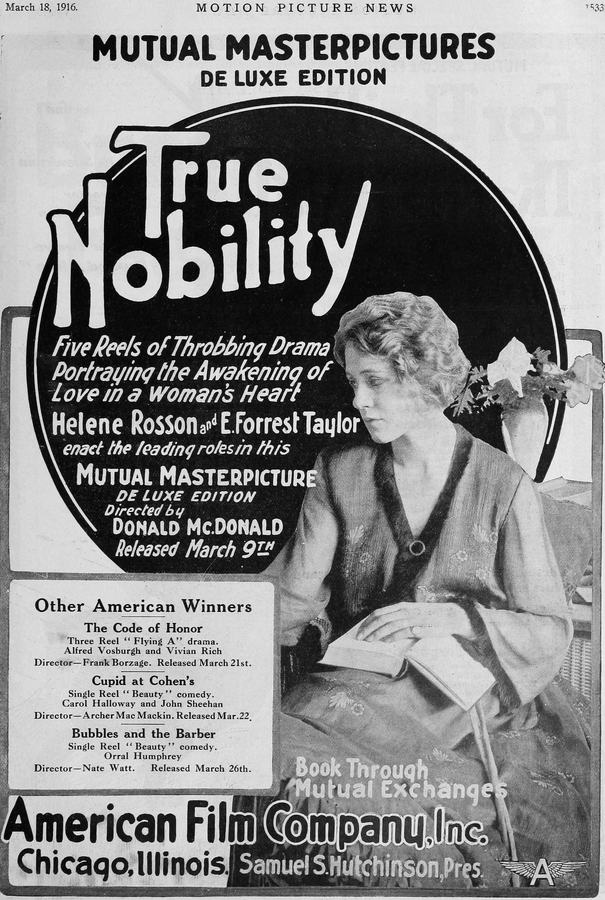
Witnessing the stylistic evolution of Donald MacDonald through True Nobility is profound, this cult landmark continues to dictate the rules of its category. If the cast impressed you, these next recommendations will too.
The synthesis of form and function in True Nobility to maintain its cult relevance across several decades.
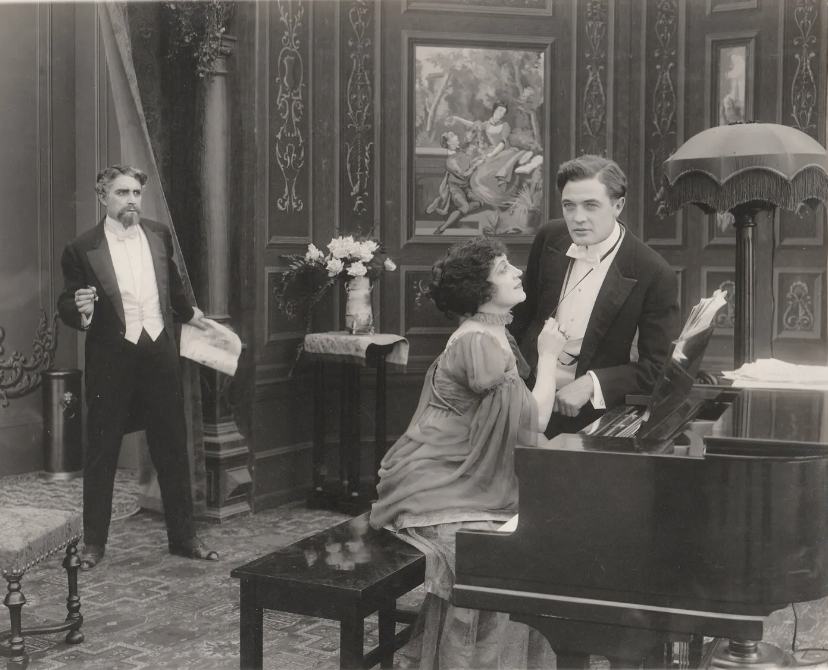
Phil Burton, a Harvard man of common parentage, returns to his western home the same loving and unassuming boy, for all his eastern experience, to gladden the hearts of his old-fashioned mother and Dad. Effie Marsh, Phil's childhood playmate, calls to tell them she is going to New York so that she may follow an art career. To better fit himself for the profession of mining engineer, Phil goes prospecting in the hills, where he finds a miner dying from smallpox, and regardless of personal danger, he cares for him. The miner assigns his claim to him, although Phil tries to find out if there are relatives, but before all his inquiries are answered, the miner dies leaving Phil a picture of himself and sister and the information that his dead sister is survived by a little daughter whose whereabouts he knew not. The claim proves valuable and Phil negotiates with a mining company for its development, the president of which is Count Nicasio, husband of Claudia Nicasio, a worshiper of social rank. Phil is invited to the Nicasio home and there meets Claudia's sister, Jean Bradford, who is expected to marry a title in the person of Lord Devlin, a profligate. Effie finds her dream of an art career empty and goes to work as a model. In this way she meets Devlin, who wins her affection, and after finding that she is the heir to Phil's mining claim and unwilling to assign her rights to him he casts her aside. Phil and Jean soon become attached to each other, which inflames Devlin. About this time, Phil's parents decide to surprise him by a visit. They arrive while Phil is at dinner with the Nicasios, and Devlin stopping in at Phil's apartment on his way to the dinner finds them and for the purpose of discrediting Phil with the Countess and her set, he suggests that the old people attend the dinner just as they are, assuring them of a welcome. Phil does welcome them, but they are treated contemptuously by the Countess and her guests and Phil takes them away indignantly. Jean, who has been disturbed by her sister's conduct and more than ever impressed with Phil's nobility, sends him a note the next morning, asking him to meet her in the garden, where they pledge their love. The Countess has a secret lover, and by accident mails a note intended for him to Devlin. This he uses as a lever to force his suit with Jean. Jean, engaged in charitable work, discovers Phil, comforting Effie, whom he saves from suicide and sends home, and misconstruing his action she listens to her sister's persuasion and consents to marry Lord Devlin. After an explanation, however, the lovers are reunited. Claudia confesses and begs Jean to save her from ruin, but Jean refuses. In desperation, Claudia goes to Devlin's apartment with a revolver, determined to get the incriminating letter. Jean follows her fearing trouble. In the meantime. Phil has learned from Effie that she is heir to the mine and of Devlin's attempt to gain control; he goes to call on Devlin in order to regain it and finds Jean alone with him, Claudia having hidden at Jean's approach. Phil gets possession of the two documents, gives Devlin a sound thrashing, and all ends happily for him and Jean.
Based on the unique stylistic flair of True Nobility, our vault has identified these titles as the most compelling follow-up experiences for fans of cult cinema:
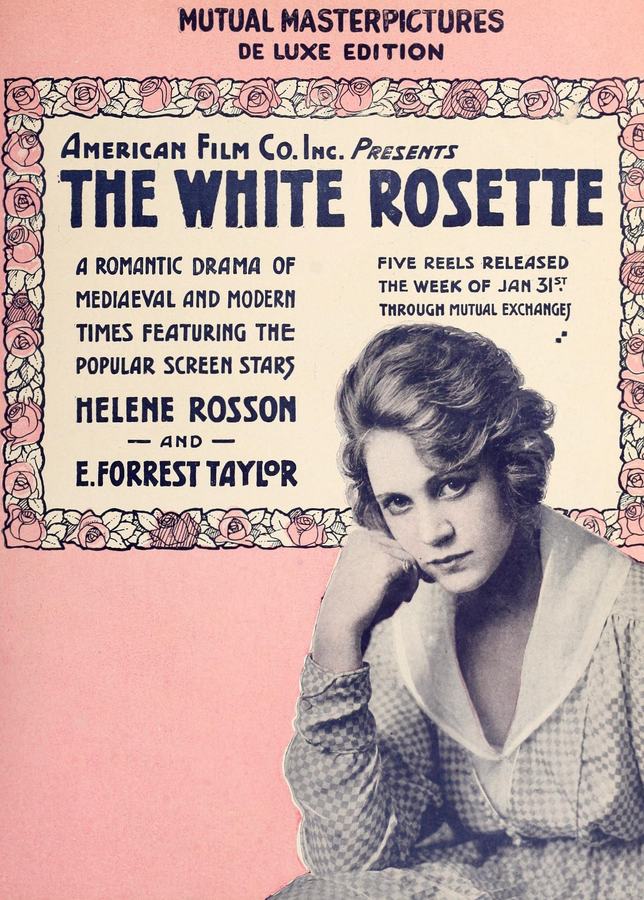
Dir: Donald MacDonald
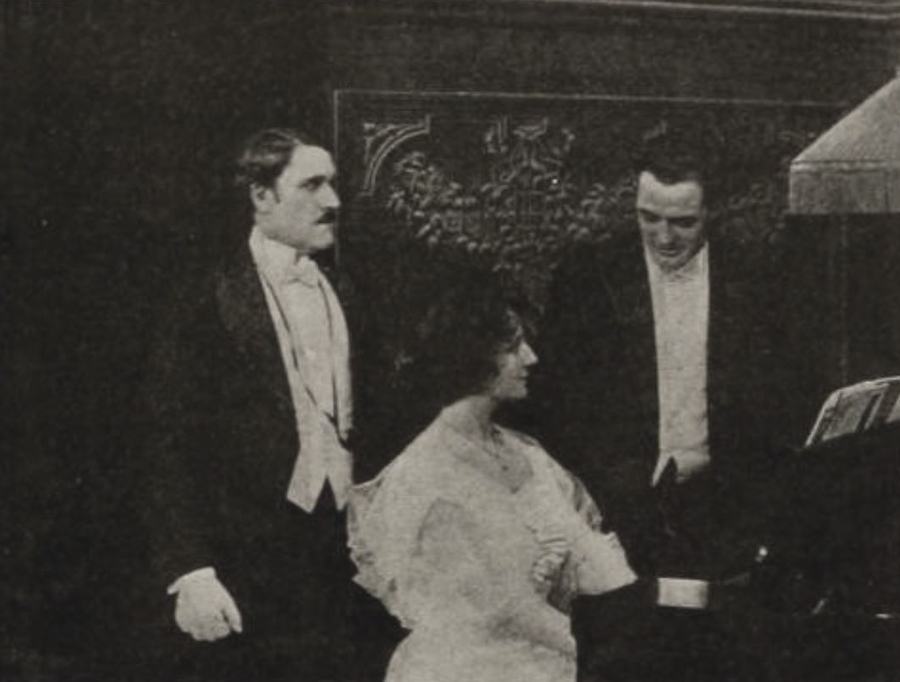
In the romantic days of the Eleventh Century the prologue of this picture shows us, Sir Errol, a victorious knight, returns to the castle of his liege lord, the Baron Edward, where he renews his vows with Lady Maud, his betrothed mistress. During Sir Errol's absence from the realm, the Baron has married Lady Elfrieda, daughter of an impecunious nobleman. Edward loves Elfrieda, but for her the marriage was solely one of expediency. She loses her heart to the handsome young knight. Learning that Errol and Maud are affianced, Elfrieda banishes her lady-in-waiting by sending Maud home to her father. Sir Longson, a retainer of the Baron's. The lovers meet secretly on the eve of Maud's departure, and she pins over Errol's heart a small, white rosette. He pledges to remain always her true and loyal knight. No sooner is Maud out of the way than the Baron's bride lays siege to Sir Errol. She plots with Lord Kerrigan and his followers to have the Baron murdered and Errol installed in the baronetcy. The conspiracy finds its way to Lady Maud's ears. On the eve of the night appointed for his death, she determines to warn Edward. Disguised as a maiden knight, she reaches the Baron's chamber, just too late. Maud is fatally wounded by the assassins. On recognizing his dead love. Sir Errol, renounces the Lady Elfrieda, and plucking the white rosette from his breast, swears on the hilt of his sword that he will atone for his dishonored life, be it now or a thousand years to come. The picture then introduces us to Pierpont Carewe, a railroad magnate, whose wife, Frieda, has married him solely for his wealth. Thomas Eric, a young civil engineer in Carewe's employ, returns to New York after a successful survey for a new road, and Carewe rewards him with a block of stock in the company. Frieda falls in love with Eric. The young engineer already is engaged to be married to Joan Long, daughter of Carewe's head engineer. Frieda schemes to get the Longs exiled to Bermuda, and then plots with Van Kerr, an unprincipled grafter, to place Eric in a position involving both his financial and his personal honor, the only solution of which shall be that he yield to the implorations of his inamorata, the wife of his chief. A few days later, Frieda traps the young man in her boudoir, declares her love, and begs him to run away with her. Finding his loyalty to his absent sweetheart still unshaken, she informs him that the stock which she recently borrowed of him, she tricked out of him, the better to have him in her control now. Eric, left to choose his course, is visited by a vision of his medieval forbear, Sir Errol. The life of that blasted flower of ancient chivalry passes before his inner eye in a series of vivid pictures until, over the dead body of the Lady Maud, in the character of Errol, he swears to atone for his faithlessness. Coming to himself, the young man recognizes in the present situation the opportunity for expiation which the restless soul of his ancestor has been seeking for nine hundred years. That night he attends the Carewe's fancy dress ball, costumed as the knight of old. Frieda is robed as the faithless Elfrieda. And Joan, mysteriously returned from the Southland, appears as Lady Maud. Eric is discovered by his temptress, renewing his vows to Joan. Frieda turns over the block of stock to Van Kerr, and Carewe, entering, demands an explanation. A quarrel ensues. Eric is just in time to save Carewe from being choked to death by his enemy. Frieda, check-mated, sobs out her bitter rebellion against Fate.
View DetailsAnalysis relative to True Nobility
| Film Title | Atmosphere | Complexity | Similarity |
|---|---|---|---|
| The White Rosette | Surreal | Linear | 90% Match |
This guide was algorithmically generated using the cinematic metadata of Donald MacDonald's archive. Last updated: 6/24/2026.
Back to True Nobility Details →