
DbcultAccessing Vault...
Director's Spotlight
Senior Film Conservator
Director's Spotlight: United States
A Deep Dive into the 1926 Vision of Clifford S. Elfelt
Peeling back the layers of Clifford S. Elfelt's Under Fire exposes the technical innovation that Clifford S. Elfelt introduced to the Western format. Driven by an uncompromising commitment to Western excellence, it stands as the definitive 1926 statement on Western identity.
In Under Fire, Clifford S. Elfelt pushes the boundaries of conventional narrative. The film's unique approach to its subject matter has sparked endless debates and interpretations among cinephiles and critics alike.
| Cinematography | Deep Focus |
| Soundtrack | Minimalist |
| Editing | Disjunctive |
| Art Direction | Baroque |
Visualizing the convergence of Clifford S. Elfelt's style and the core Western narrative.
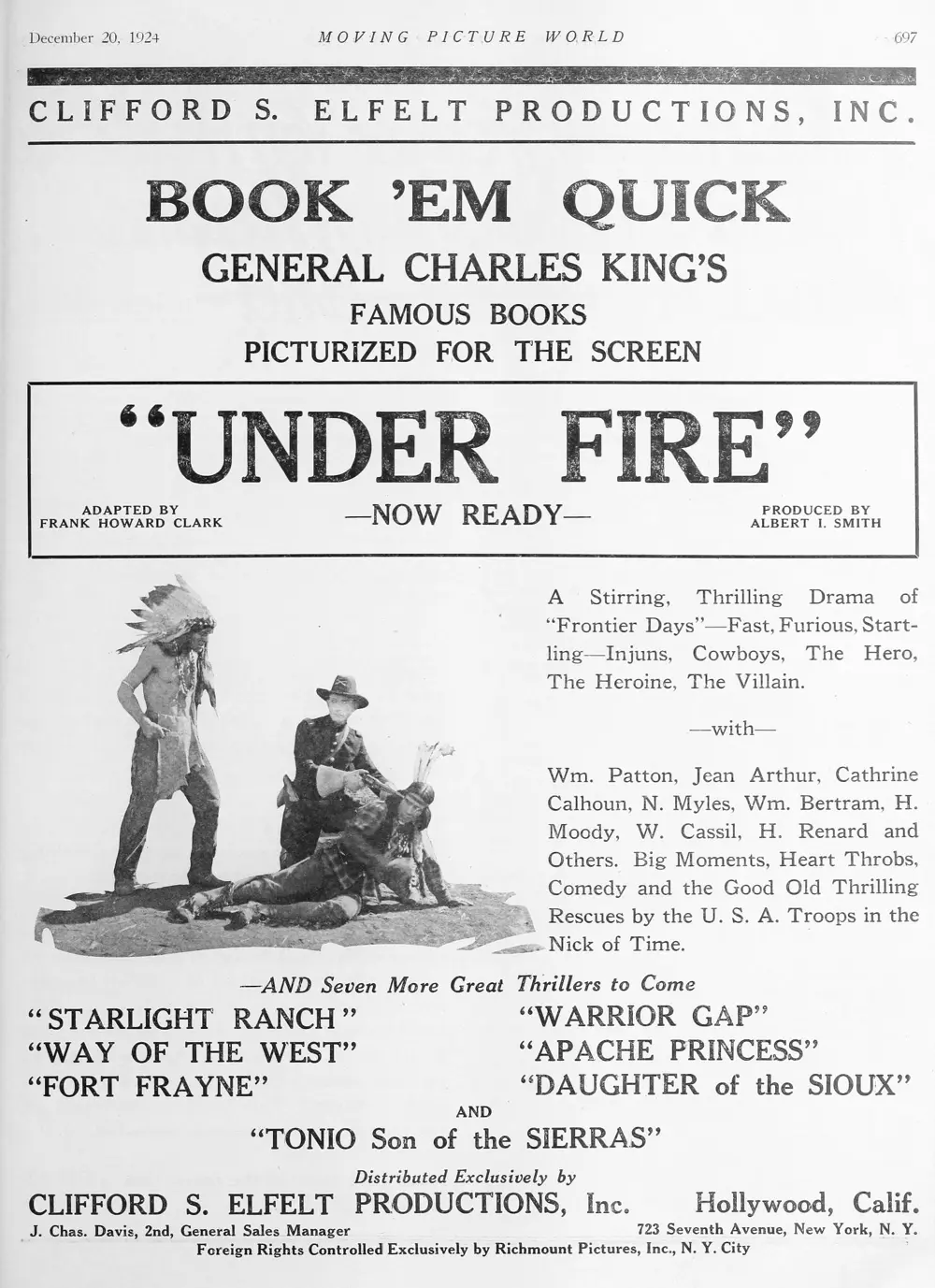
Lt. Tom Brennan is cashiered from the 7th Cavalry on two charges, both unjust: that of deserting his men in the face of a cruel Indian attack, and of entertaining a married woman in his quarters after hours. Tom wanders into the desert and is picked up half-dead by Yuba Bill, a prospector with whom he goes into partnership. The Indians go on the warpath, and Tom rides to the fort and warns the colonel. Tom's innocence is established by the confession of an enlisted man, and Tom is reinstated to the service with full honors, renewing his engagement with Margaret Cranston.
Decades after its release, Under Fire remains a vital piece of the cinematic puzzle. Its influence can be seen in countless modern works, solidifying Clifford S. Elfelt's status as a master of the craft in United States and beyond.