
DbcultAccessing Vault...
Director's Spotlight
Senior Film Conservator
Director's Spotlight: United States
A Deep Dive into the 1917 Vision of E. Mason Hopper
Witnessing the stylistic transformation of cult through The Prison Without Walls reveals the provocative questions that E. Mason Hopper poses to the United States audience. Exploring the nuances of the human condition with cult flair, it showcases the power of cult as a tool for social commentary.
In The Prison Without Walls, E. Mason Hopper pushes the boundaries of conventional narrative. The film's unique approach to its subject matter has sparked endless debates and interpretations among cinephiles and critics alike.
While deeply rooted in United States, The Prison Without Walls has achieved a global reach, influencing directors from various backgrounds. Its ability to translate cult tropes into a universal cinematic language is why it remains a cult staple decades after its 1917 release.
| Cinematography | Handheld |
| Soundtrack | Experimental |
| Editing | Elliptical |
| Art Direction | Expressionist |
Visualizing the convergence of E. Mason Hopper's style and the core cult narrative.
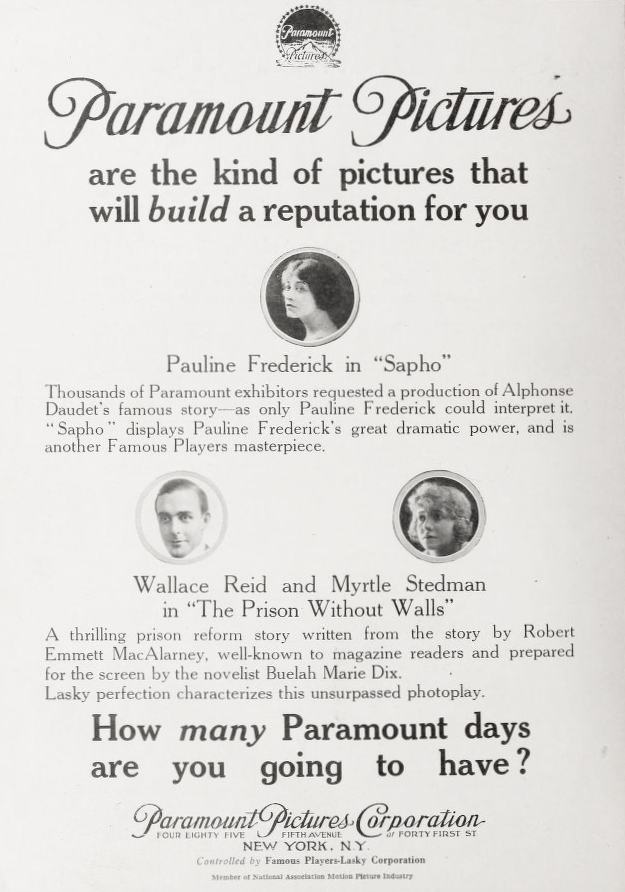
Helen Ainsworth, a young philanthropist, who is interested in a prison reform movement, is engaged to Norman Morris, administrator of the Ainsworth millions and the undiscovered "man higher up," grafting through his influence with prison wardens. He is also having an "affair" with Felice, Helen's maid, an ex-convict. Governor Havens sends for Huntington Babbs, prison expert, who enters the prison as a convict, is discovered by Helen and made her secretary upon his release. Morris is jealous of the good-looking secretary and he makes Felice "plant" a necklace which he has presented to Helen, in Babbs' room. Babbs discovers the plot, and Morris, overhearing his plan to visit a certain place in the rough part of the city, for Helen, plans to get him. He orders the gang to murder him. Helen accompanies Babbs (or Conroy, as he is known). Morris learns Helen has gone and reaches the place just as the men have nearly overpowered Conroy. Morris allows the men to escape, but Helen refuses his offer to take her home, preferring Conroy. Infuriated, Morris plans to have the Ainsworth safe burglarized the night of Helen's party. Conroy discovers the burglar and that he is Gilligan, whom he befriended in prison. Conroy sends a note to the Governor by Gilligan. Just as the burglar leaves, the guests of the house enter the library. Conroy is accused, but Helen allows no arrests. She orders Conroy to leave the house. Morris betrays the girl Felice by suggesting her arrest as an accomplice. Morris accompanies Helen to the Governor's office. The Governor requests an interview with Morris and accuses him of being the "man higher up." Morris asks for his witnesses and a door is opened, disclosing Gilligan and the gang, and Felice. Conroy is introduced as Huntington Babbs, prison expert. Morris is staggered. Helen overjoyed. Morris is arrested, but just as he is leaving Felice shoots him. Unconsciously, Helen goes into the arms of the man she loves.
Decades after its release, The Prison Without Walls remains a vital piece of the cinematic puzzle. Its influence can be seen in countless modern works, solidifying E. Mason Hopper's status as a master of the craft in United States and beyond.