
DbcultAccessing Vault...
Director's Spotlight
Senior Film Conservator
Director's Spotlight: United States
A Deep Dive into the 1918 Vision of Edward LeSaint
The thematic gravity of Nobody's Wife (1918) is rooted in the historical context that Edward LeSaint weaves into the cult fabric. Synthesizing the best elements of United States and international cinema, it highlights the importance of independent voices in United States.
In Nobody's Wife, Edward LeSaint pushes the boundaries of conventional narrative. The film's unique approach to its subject matter has sparked endless debates and interpretations among cinephiles and critics alike.
In this work, Edward LeSaint explores the intersection of cult and United States cultural identity. The meticulous attention to detail suggests a deep-seated commitment to pushing the boundaries of the medium, ensuring that Nobody's Wife remains a relevant topic of study for cult enthusiasts.
| Cinematography | Handheld |
| Soundtrack | Minimalist |
| Editing | Slow-Burn |
| Art Direction | Brutalist |
Visualizing the convergence of Edward LeSaint's style and the core cult narrative.
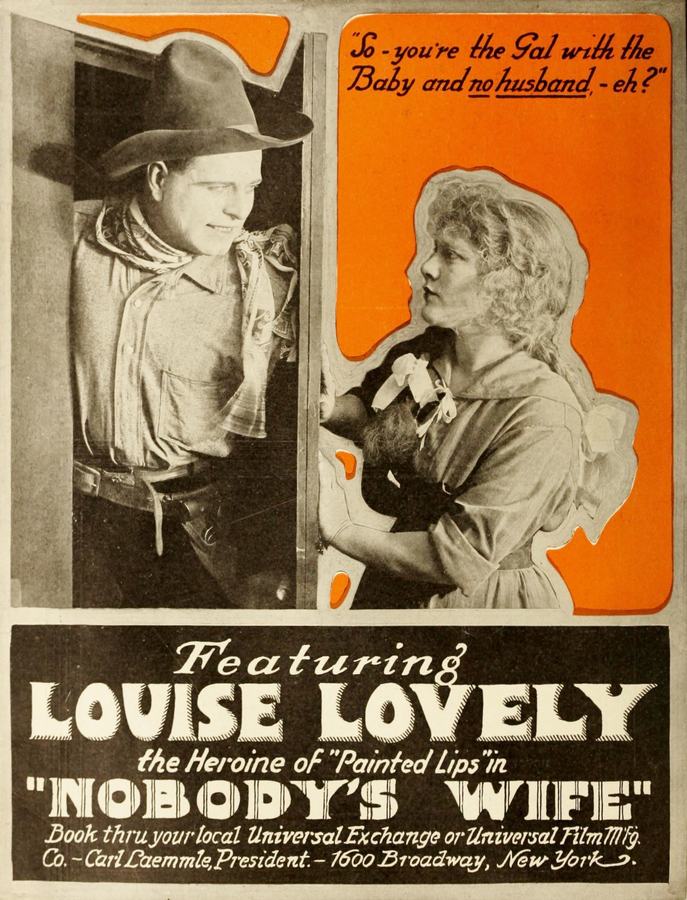
Jack Darling of the North West Mounted Police is ordered to track down and arrest murderer Alec Young, whose girl, Dancing Pete, performs in the Nugget dance hall. En route to Nugget, Jack meets Hope Ross, who is caring for her sister's baby. Although the two fall in love, the outlook for a happy romance appears hopeless, because he believes that she is married and she thinks that he is an outlaw. Jack visits Dancing Pete's cabin, where he finds a photograph that proves that the murderous Alec and Sheriff Carew of Nugget are the same person. Jack convinces Carew to join him in robbing the saloon's safe, but as the sheriff takes his share of the money, Jack exposes him to the angry townspeople. Carew tries to escape, but the Mountie overtakes him, following which Jack and Hope delightedly learn the truth about each other.
Decades after its release, Nobody's Wife remains a vital piece of the cinematic puzzle. Its influence can be seen in countless modern works, solidifying Edward LeSaint's status as a master of the craft in United States and beyond.