
DbcultAccessing Vault...
Director's Spotlight
Senior Film Conservator
Director's Spotlight: United States
A Deep Dive into the 1916 Vision of Edward Sloman
As we revisit the 1916 masterpiece A Woman's Daring, we are struck by the meticulous attention to detail that Edward Sloman applied to every frame. Anchored by a narrative that is both personal and universal, it bridges the gap between traditional cult and contemporary vision.
In A Woman's Daring, Edward Sloman pushes the boundaries of conventional narrative. The film's unique approach to its subject matter has sparked endless debates and interpretations among cinephiles and critics alike.
To fully appreciate A Woman's Daring, one must consider the cinematic climate of 1916. During this period, United States was undergoing significant artistic shifts, and Edward Sloman was at the forefront of this cult movement, often challenging established norms.
| Cinematography | Handheld |
| Soundtrack | Minimalist |
| Editing | Slow-Burn |
| Art Direction | Brutalist |
Visualizing the convergence of Edward Sloman's style and the core cult narrative.
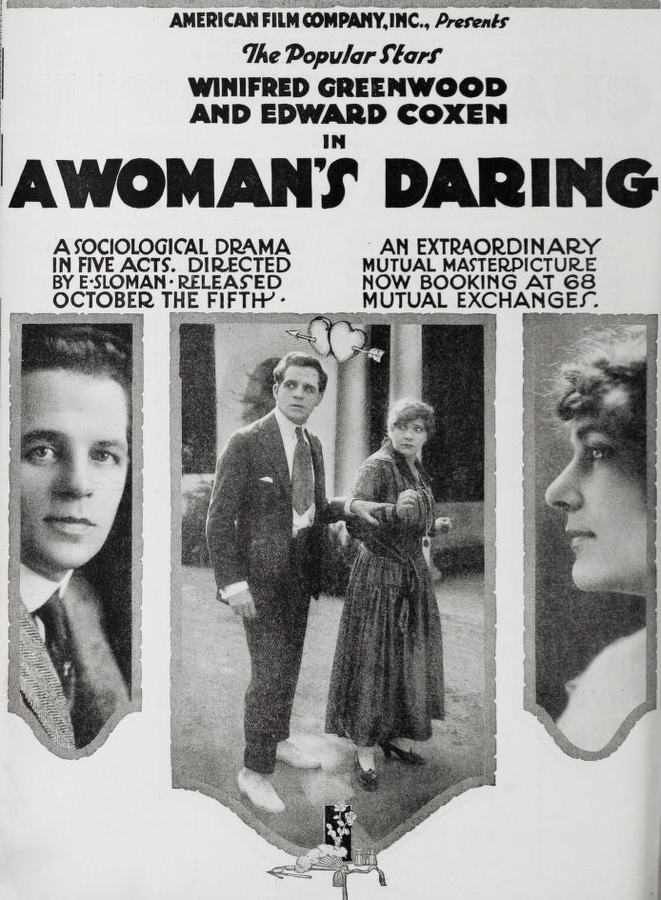
"The Woman" is brought up on a farm by a miserly uncle who denies her the company of other young people. It is no wonder then that she is introduced by a traveling mining stock broker. When the uncle learns her plight, he puts her out. A storm is raging. The girl seeks shelter in the same place as the man who has seduced her. He persuades her to go to a nearby town and marry him. She does, but shortly after the ceremony she discovers that he is already married, when his wife and the police come and take him. Deserted and alone, the girl finds out that her uncle has been killed in the storm, and has left her his money. She takes it and goes to a small city where she lives. Five years later her little son is quite a lad, and they are living happily. The woman is known as a widow. Two men fall in love with her, a prominent physician and a broker. The broker wins his suit. Later her husband engages a chauffeur for the woman. When the man arrives at the house she discovers that it is the man who betrayed her. He threatens to expose her unless she keeps him supplied with money. She dares not refuse. He treats their son cruelly. One day the broker sees the chauffeur hit the lad and discharges him on the spot. The chauffeur again threatens the woman, this time telling her that if he does not get his job back he will reveal the truth about her. The woman goes to her husband's office when he is not in, and meets the chauffeur there. He flourishes a gun and a struggle ensues. The man is shot and the woman runs away. The coroner finds a locket in the hand of the dead man that belongs to the woman. He keeps the incriminating bit of evidence for the trial. The woman hides herself, unknowing that her husband has been arrested for the murder. A vision of the penitentiary causes her to hasten to court where she tells of the man's attack upon her. This testimony clears the husband, and both are discharged. She determines to have her mind free of the shadow of her secret, and tells her husband the true story of her life when they return home. She is forgiven.
Decades after its release, A Woman's Daring remains a vital piece of the cinematic puzzle. Its influence can be seen in countless modern works, solidifying Edward Sloman's status as a master of the craft in United States and beyond.