
DbcultAccessing Vault...
Director's Spotlight
Senior Film Conservator
Director's Spotlight: United States
A Deep Dive into the 1918 Vision of Edward Sloman
In the storied career of Edward Sloman, Money Isn't Everything stands as a the atmospheric immersion that Edward Sloman achieves throughout Money Isn't Everything. Reflecting the political and social shifts of the 1918s, it reinforces the idea that cinema is a medium of infinite possibilities.
In Money Isn't Everything, Edward Sloman pushes the boundaries of conventional narrative. The film's unique approach to its subject matter has sparked endless debates and interpretations among cinephiles and critics alike.
To fully appreciate Money Isn't Everything, one must consider the cinematic climate of 1918. During this period, United States was undergoing significant artistic shifts, and Edward Sloman was at the forefront of this cult movement, often challenging established norms.
| Cinematography | Handheld |
| Soundtrack | Orchestral |
| Editing | Invisible |
| Art Direction | Kitsch |
Visualizing the convergence of Edward Sloman's style and the core cult narrative.
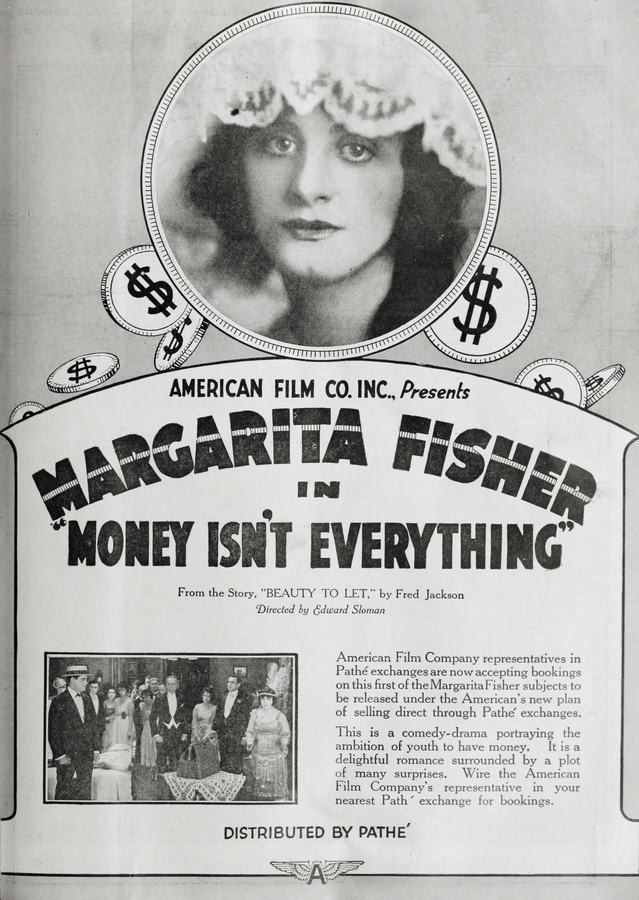
For advice on making money, down-on-her-luck Margery Smith visits Franklyn Smith, a lawyer who, although he appears prosperous, is equally hard-pressed for funds. Franklyn is struck by Margery's beauty and devises a plan whereby her services as a chaperoned partner at dances and teas may be purchased; however, because he believes her brainless, he forbids her to speak with the customers. The "Beauty to Let" corporation is a success, and soon two millionaires, Henry P. Rockwell and "Diamond Tim" Moody, ask to marry Margery. She has fallen in love with Franklyn and is distressed to learn that he has purchased bachelor's quarters from Tim. Diamond Tim forged the deed to the house, but when Margery sneaks into his room to retrieve Franklyn's money, her partner sees her and misconstrues her intentions. In the end, Margery and Franklyn outwit Tim, and Franklyn, realizing that his partner is bright as well as beautiful, proposes.
Decades after its release, Money Isn't Everything remains a vital piece of the cinematic puzzle. Its influence can be seen in countless modern works, solidifying Edward Sloman's status as a master of the craft in United States and beyond.