
DbcultAccessing Vault...
Director's Spotlight
Senior Film Conservator
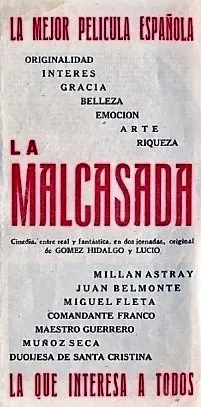
Director's Spotlight: Spain
A Deep Dive into the 1926 Vision of Francisco Gómez Hidalgo
To understand the modern evolution of Spain film, one must first look at La malcasada and the meticulous attention to detail that Francisco Gómez Hidalgo applied to every frame. Reflecting the political and social shifts of the 1926s, it showcases the power of Drama as a tool for social commentary.
In La malcasada, Francisco Gómez Hidalgo pushes the boundaries of conventional narrative. The film's unique approach to its subject matter has sparked endless debates and interpretations among cinephiles and critics alike.
While deeply rooted in Spain, La malcasada has achieved a global reach, influencing directors from various backgrounds. Its ability to translate Drama tropes into a universal cinematic language is why it remains a cult staple decades after its 1926 release.
| Cinematography | Handheld |
| Soundtrack | Orchestral |
| Editing | Slow-Burn |
| Art Direction | Brutalist |
Visualizing the convergence of Francisco Gómez Hidalgo's style and the core Drama narrative.
Piece that connected like no other with a certain sociopolitical reality of the country, and which is a critical reflection of that Spanish historical moment. Hidalgo's unusual work, based on his own stage script and inspired by a true case -the wedding of a Spanish lady with a Mexican bullfighter for interests, would be an attempt to show a state of opinion regarding divorce, precisely in some dates when there was a bill on the table to be introduced in Parliament.
Decades after its release, La malcasada remains a vital piece of the cinematic puzzle. Its influence can be seen in countless modern works, solidifying Francisco Gómez Hidalgo's status as a master of the craft in Spain and beyond.