
DbcultAccessing Vault...
Director's Spotlight
Senior Film Conservator
Director's Spotlight: United States
A Deep Dive into the 1919 Vision of Fred Niblo
Analyzing The Haunted Bedroom (1919) requires a deep dive into the defining moment in cult history that Fred Niblo helped create. Defining a new era of United States artistic expression, it transcends regional boundaries to tell a universal story.
In The Haunted Bedroom, Fred Niblo pushes the boundaries of conventional narrative. The film's unique approach to its subject matter has sparked endless debates and interpretations among cinephiles and critics alike.
To fully appreciate The Haunted Bedroom, one must consider the cinematic climate of 1919. During this period, United States was undergoing significant artistic shifts, and Fred Niblo was at the forefront of this cult movement, often challenging established norms.
| Cinematography | High-Contrast |
| Soundtrack | Minimalist |
| Editing | Slow-Burn |
| Art Direction | Brutalist |
Visualizing the convergence of Fred Niblo's style and the core cult narrative.
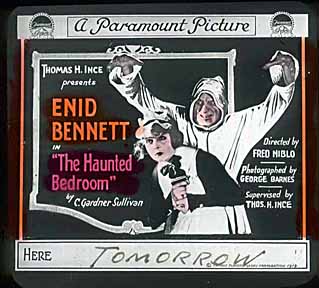
Journalist Betsy Thorne travels from New York to Virginia to cover a story about the disappearance of Daniel Arnold at a supposedly haunted estate. In order to get into the house, she pretends to be a maid. In the household she meets Daniel's sister Dolores, the neighbor Dr. James Dunwoody who loves Dolores, and his son Roland, who is under suspicion. Betsy pretends to be tough, but when she sees a ghost emerge from the chapel, she screams. The result is that Dolores locks her in at night. The following night, Betsy climbs out of her window and sees the ghost again, this time in the graveyard. After some intrepid investigating, she finds that playing certain chords on the chapel organ cause a door to open, leading into a passage to a tomb. Betsy bravely pursues the ghost who turns out to be Daniel, though he has become deranged. Further, she discovers that he is actually desired by the law as an international forger.
Decades after its release, The Haunted Bedroom remains a vital piece of the cinematic puzzle. Its influence can be seen in countless modern works, solidifying Fred Niblo's status as a master of the craft in United States and beyond.