
DbcultAccessing Vault...
Director's Spotlight
Senior Film Conservator
Director's Spotlight: United States
A Deep Dive into the 1917 Vision of George D. Baker
Few works in United States cinema carry the same weight as His Father's Son, especially regarding the technical innovation that George D. Baker introduced to the cult format. Subverting the expectations of the typical 1917 audience, it bridges the gap between traditional cult and contemporary vision.
In His Father's Son, George D. Baker pushes the boundaries of conventional narrative. The film's unique approach to its subject matter has sparked endless debates and interpretations among cinephiles and critics alike.
The visual language of His Father's Son is defined by its use of shadows and framing, a hallmark of George D. Baker's style. By utilizing a 1917-era palette, the film creates an immersive experience that perfectly complements its cult themes.
| Cinematography | Handheld |
| Soundtrack | Synth-Heavy |
| Editing | Disjunctive |
| Art Direction | Baroque |
Visualizing the convergence of George D. Baker's style and the core cult narrative.
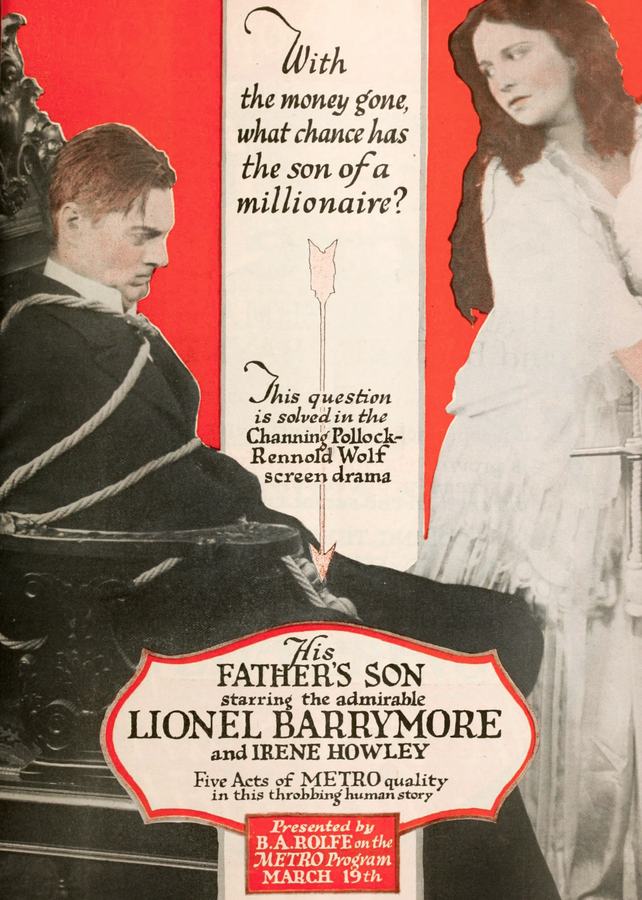
College youth J. Dabney Barron regularly fails in his examinations; in disgust, his father deprives him of money and tells him to go to work, betting him $6,000 that he cannot hold a $60-a-month position for that time period. J. Dabney agrees, and with his valet Perkins he goes to look for a job. In a park he meets heiress Betty Arden, whose car has broken down. Her guest, Lord Lawrence, is incapable of helping her, and Dabney hastens to her assistance. She hurries away as soon as her car is repaired. Installing himself and his valet in a room in a lodging house, Dabney reads the want ads. Answering an advertisement for a bookkeeper, he stands in a long line of applicants until he grows tired; his valet, who has taken his place, gets the job. Finally Dabney obtains work through his friend Jim Foley of a detective agency. John Arden, millionaire gem collector, has a priceless emerald called "The Lady of the Sea." He fears it may be stolen and as a matter of fact his guest Lord Lawrence, better known to the English police as "London Larry," is planning to steal the emerald. Foley tells Dabney that to guard the emerald he must pose as butler in the Arden home. No sooner does Dabney enter upon his new work than he discovers Betty Arden, his employer's daughter, to be the girl he helped in the park. In an attempt to retain his dignity in her eyes he tells her he and his sister inherited an enormous fortune from an uncle; that the uncle had a secretary a villainous chap named Slime who forced him to make a will disinheriting Dabney and his sister; that Slime and his accomplices made the old man drink nitroglycerin but unfortunately for them permitted him to fall down when he exploded burning up the will; that the villainous secretary had then overpowered Dabney and run away with the girl, whom Dabney had ever since been seeking, hence his presence in the Arden household as butler. Betty pretends to believe the story, although she has been aware of Dabney's identity all along. Dabney continues to attend to his duties as butler and to guard the jewel from "London Larry." Finally the month is up, and Dabney, in great glee at having won the bet from his father, dares to make known his love to Betty. She returns his affection, and they are discovered in a fond embrace by John Arden, who instantly discharges Dabney. That night he is about to take his departure when he surprises "London Larry" opening the safe in Arden's library. He overpowers the would-be jewel thief, and throws him into the safe. Arden, coming downstairs, liberates Lord Lawrence, who tells him Dabney is the real culprit, and together they overpower him and tie him to a chair. Dabney urges them to send for Foley, to identify him, and the detective, arriving, makes haste to free Dabney and arrest "London Larry." Dabney, cheered by Betty's promise to marry him, goes home to collect his $6,000, having proved himself his father's son.
Decades after its release, His Father's Son remains a vital piece of the cinematic puzzle. Its influence can be seen in countless modern works, solidifying George D. Baker's status as a master of the craft in United States and beyond.