
DbcultAccessing Vault...
Director's Spotlight
Senior Film Conservator
Director's Spotlight: United States
A Deep Dive into the 1917 Vision of George Siegmann
The artistic breakthrough represented by Should She Obey? in 1917 highlights the philosophical inquiries that George Siegmann embeds within the narrative. Framed by the hauntingly beautiful landscapes of the production, it leaves an indelible mark on the soul of the viewer.
In Should She Obey?, George Siegmann pushes the boundaries of conventional narrative. The film's unique approach to its subject matter has sparked endless debates and interpretations among cinephiles and critics alike.
| Cinematography | High-Contrast |
| Soundtrack | Diegetic |
| Editing | Elliptical |
| Art Direction | Expressionist |
Visualizing the convergence of George Siegmann's style and the core cult narrative.
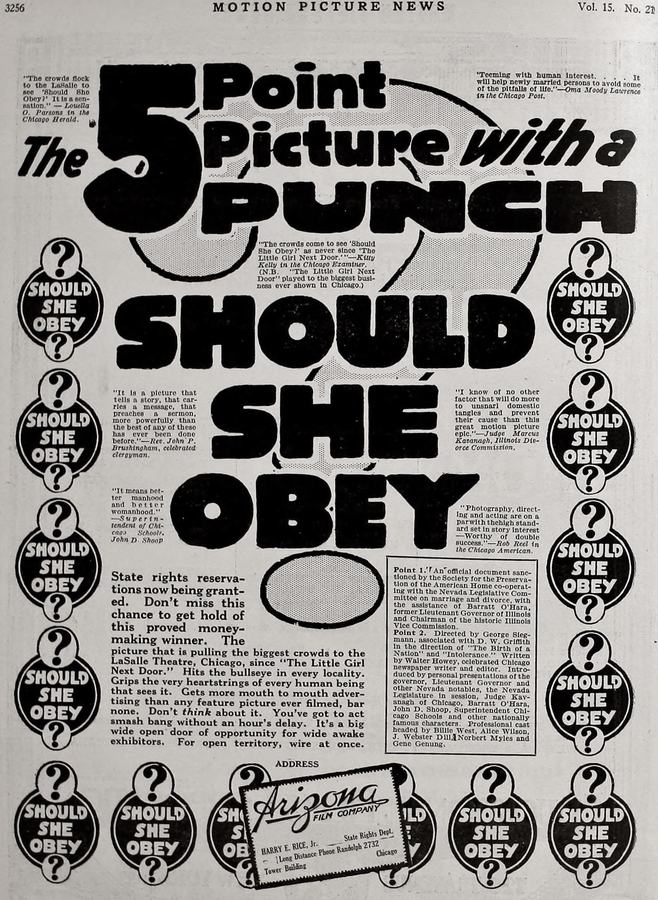
Inspired by his wife Lorna, shiftless William Gordon discovers a welding process worth millions and becomes president of a large corporation. Henry Blake, a friend of Gordon's from his indolent days, is forced to marry when his girl friend Mamie gives birth to a daughter, who is sent to live in a convent. Becoming infatuated with actress Marie Gibson, Gordon leaves Lorna and his son William, Jr. and promises to install Marie in society. After the dance hall that he is running is raided, Blake blackmails Gordon with the threat of exposing his illicit affair. With the extortion money, Blake deserts Mamie and opens up his own dance hall where he employs his daughter to entertain the idle rich. Meanwhile, both Mamie and Lorna have obtained divorces in Reno and are living together when they learn that Blake intends to force his daughter to marry a wealthy man. Together the women rescue the girl and justice is served when society refuses to sanction Gordon's remarriage to Marie and the pair are driven by ostracism to Europe.
Decades after its release, Should She Obey? remains a vital piece of the cinematic puzzle. Its influence can be seen in countless modern works, solidifying George Siegmann's status as a master of the craft in United States and beyond.