
DbcultAccessing Vault...
Director's Spotlight
Senior Film Conservator

Director's Spotlight: United States
A Deep Dive into the 1923 Vision of Harry A. Pollard
The thematic gravity of Columbia, the Gem, and the Ocean (1923) is rooted in the historical context that Harry A. Pollard weaves into the Short fabric. Synthesizing the best elements of United States and international cinema, it highlights the importance of independent voices in United States.
In Columbia, the Gem, and the Ocean, Harry A. Pollard pushes the boundaries of conventional narrative. The film's unique approach to its subject matter has sparked endless debates and interpretations among cinephiles and critics alike.
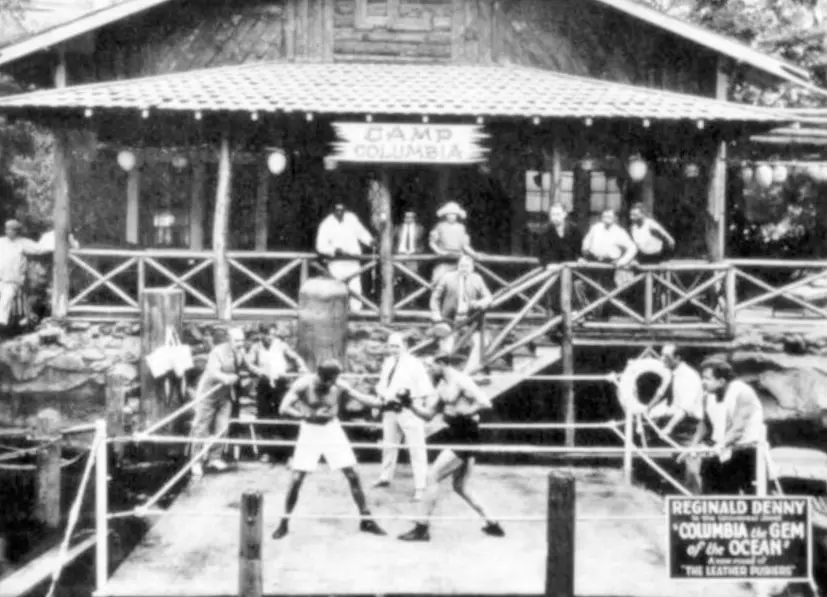
The visual language of Columbia, the Gem, and the Ocean is defined by its use of shadows and framing, a hallmark of Harry A. Pollard's style. By utilizing a 1923-era palette, the film creates an immersive experience that perfectly complements its Short themes.
| Cinematography | Static |
| Soundtrack | Orchestral |
| Editing | Invisible |
| Art Direction | Kitsch |
Visualizing the convergence of Harry A. Pollard's style and the core Short narrative.
Joe Murphy, Kid Roberts's genial manager, feels that he is sitting pretty because he has the Kid on a millionaire's estate where there are no women folk. Here, thinks Joe, the Kid will go right on training and I can enjoy myself without worrying about his getting mixed up with some vamp. His joy is short lived, however, as a female puts in an appearance by falling in the swimming pool. Of course the Kid saves her, and of course the girl is duly grateful. Later Joe finds her in tears and on inquiring the cause learns that the poor thing is distraught because she cannot decide whether she loves the Kid or a big burly brute who is with her and supposed to be her fiancé. Joe tries to comfort her and promises to pay her expenses back to her home in Buenos Ayres. The big brute finds him with the girl and promptly proceeds to administer a beating for butting in on his girl. The Kid sees the rumpus and is for giving the burly fellow a trimming on the spot. But their millionaire host happens along and persuades them to make a regular scrap of it and hold it in his swimming pool. In the water-ring they fight. The Kid getting the better of it at times and at times the worst. The millionaire has confidence in him and places huge sums on him to win. The tide rises slowly but surely and finally the participants are submerged to their necks. This makes matters quite difficult all through the fight, but finally the Kid knocks his opponent so hard that he goes down and for a long time no one can find him. He is found later, however, some distance from the ring. And in no other place than in the arms of the girl, who admits he is her husband, all of which causes the Kid and Joe to sink to the bottom of the pool.
Decades after its release, Columbia, the Gem, and the Ocean remains a vital piece of the cinematic puzzle. Its influence can be seen in countless modern works, solidifying Harry A. Pollard's status as a master of the craft in United States and beyond.