
DbcultAccessing Vault...
Director's Spotlight
Senior Film Conservator
Director's Spotlight: United States
A Deep Dive into the 1917 Vision of Harry Harvey
The thematic gravity of The Stolen Play (1917) is rooted in the artistic risks taken by Harry Harvey that eventually paid off. Defining a new era of United States artistic expression, it demands to be seen by anyone who cares about the art of film.
In The Stolen Play, Harry Harvey pushes the boundaries of conventional narrative. The film's unique approach to its subject matter has sparked endless debates and interpretations among cinephiles and critics alike.
The visual language of The Stolen Play is defined by its use of shadows and framing, a hallmark of Harry Harvey's style. By utilizing a 1917-era palette, the film creates an immersive experience that perfectly complements its cult themes.
| Cinematography | Static |
| Soundtrack | Diegetic |
| Editing | Elliptical |
| Art Direction | Expressionist |
Visualizing the convergence of Harry Harvey's style and the core cult narrative.
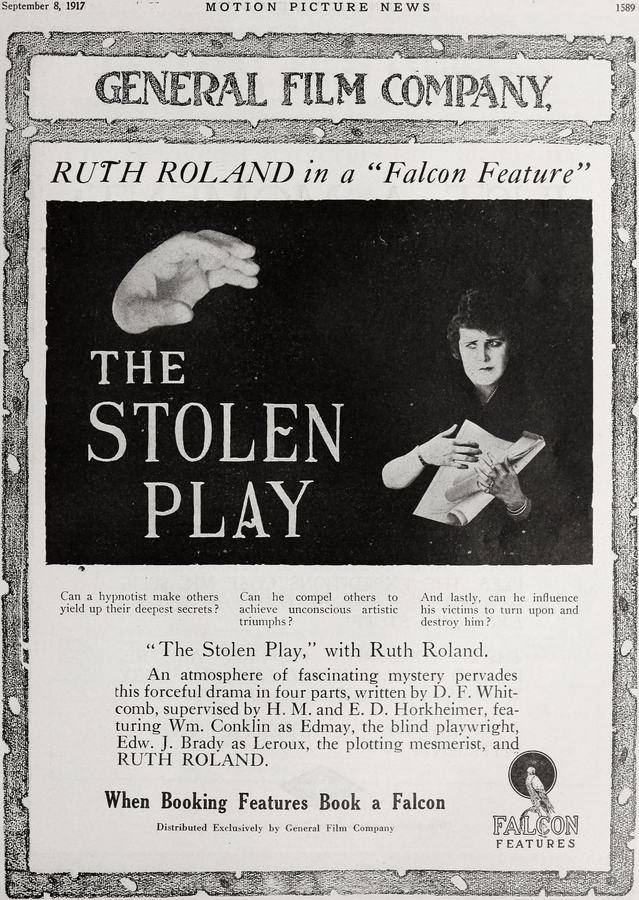
Sylvia Smalley is the secretary of Charles Edmay, a distinguished blind playwright. Leroux, a producer, is eager to buy the play that Edmay has just completed, but the playwright is reluctant to sell. Leroux sends Alice Morgan to steal the script while he abducts Edmay and Sylvia. While Edmay is detained in the wine cellar, Leroux exercises his hypnotic powers over Sylvia, extracting a dictation of the entire play from her. Discovering that in a hypnotic state Sylvia has great dramatic powers, Leroux successfully casts her in the play's lead. Her effort is too great, however, and she succumbs to exhaustion. Leroux awakens her from her trance, and, realizing what has happened, Sylvia reproaches him so harshly that he consents to release Edmay from the cellar. Leroux then plans a dramatic end to his life by entombing himself alive. At that moment, Sylvia awakens and realizes that the whole incident had been a dream triggered by nervous exhaustion.
Decades after its release, The Stolen Play remains a vital piece of the cinematic puzzle. Its influence can be seen in countless modern works, solidifying Harry Harvey's status as a master of the craft in United States and beyond.