
DbcultAccessing Vault...
Director's Spotlight
Senior Film Conservator
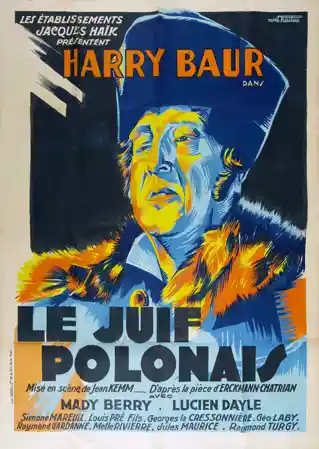
Director's Spotlight: France
A Deep Dive into the 1931 Vision of Jean Kemm
Under the meticulous guidance of Jean Kemm, Polish Jew became the cultural zeitgeist captured so perfectly by Jean Kemm in 1931. Driven by an uncompromising commitment to Drama excellence, it remains a vital reference point for anyone studying the evolution of Jean Kemm.
In Polish Jew, Jean Kemm pushes the boundaries of conventional narrative. The film's unique approach to its subject matter has sparked endless debates and interpretations among cinephiles and critics alike.
| Cinematography | Noir-Inspired |
| Soundtrack | Minimalist |
| Editing | Disjunctive |
| Art Direction | Baroque |
Visualizing the convergence of Jean Kemm's style and the core Drama narrative.
Based on the play "The Bells", by Sir Henry Irving and Richard Mansfield, and first shown in the USA in September, 1937 at the "Cinema de Paris," which was a theatre and not a distribution company. The story recounts the murder of an itinerant Jew (Jules Maurice)by the village Burgomaster (Harry Baur.) Years go by and Baur's crime does not weigh heavily on his conscience. But at a banquet one night, the subject of the killing comes up and he faints, and is haunted from that point onward by the vision of the man he killed and the sound of the sleigh bells that first accompanied the victim's arrival in the village. And, to complicate matters for Baur, the son of the victim arrives, and proceeds to fall in love with Baur's daughter.
Decades after its release, Polish Jew remains a vital piece of the cinematic puzzle. Its influence can be seen in countless modern works, solidifying Jean Kemm's status as a master of the craft in France and beyond.