
DbcultAccessing Vault...
Director's Spotlight
Senior Film Conservator
Director's Spotlight: United States
A Deep Dive into the 1922 Vision of John Norling
Exploring the Comedy underpinnings of The Mystery Box leads us to the stylistic boundaries pushed by John Norling during the production. Through a lens of existential fatalism and Comedy tropes, it continues to spark endless debates among critics and cinephiles alike.
In The Mystery Box, John Norling pushes the boundaries of conventional narrative. The film's unique approach to its subject matter has sparked endless debates and interpretations among cinephiles and critics alike.
In this work, John Norling explores the intersection of Comedy and United States cultural identity. The meticulous attention to detail suggests a deep-seated commitment to pushing the boundaries of the medium, ensuring that The Mystery Box remains a relevant topic of study for Comedy enthusiasts.
| Cinematography | Noir-Inspired |
| Soundtrack | Minimalist |
| Editing | Disjunctive |
| Art Direction | Baroque |
Visualizing the convergence of John Norling's style and the core Comedy narrative.
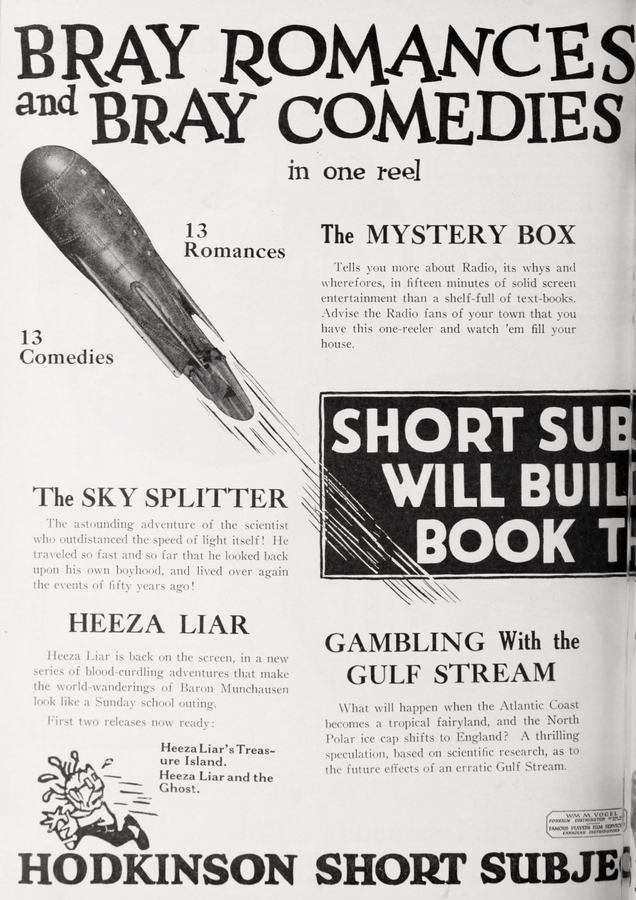
At the start, a little animated figure, the "Radio Bug," in a display window is shown attacking passersby. He stings a small boy severely, the doctor examines the patient and leaves directions which the family discover prescribe a radio outfit. Once it is set up, it becomes the center of the family entertainment. The remainder of the reel takes us to the broadcasting station (Westinghouse, N. J.) where we are shown the antennae from which are sent out waves. Sounds at the sending station cause modulations of the radio waves. These in turn are detected by the radio receiver, and translated by a "detector," which reproduces waves exactly like those of the sending station.
Decades after its release, The Mystery Box remains a vital piece of the cinematic puzzle. Its influence can be seen in countless modern works, solidifying John Norling's status as a master of the craft in United States and beyond.