
DbcultAccessing Vault...
Director's Spotlight
Senior Film Conservator
Director's Spotlight: United States
A Deep Dive into the 1925 Vision of Lambert Hillyer
Few works in United States cinema carry the same weight as I Want My Man, especially regarding the technical innovation that Lambert Hillyer introduced to the Romance format. Subverting the expectations of the typical 1925 audience, it bridges the gap between traditional Romance and contemporary vision.
In I Want My Man, Lambert Hillyer pushes the boundaries of conventional narrative. The film's unique approach to its subject matter has sparked endless debates and interpretations among cinephiles and critics alike.

While deeply rooted in United States, I Want My Man has achieved a global reach, influencing directors from various backgrounds. Its ability to translate Romance tropes into a universal cinematic language is why it remains a cult staple decades after its 1925 release.
| Cinematography | High-Contrast |
| Soundtrack | Minimalist |
| Editing | Slow-Burn |
| Art Direction | Brutalist |
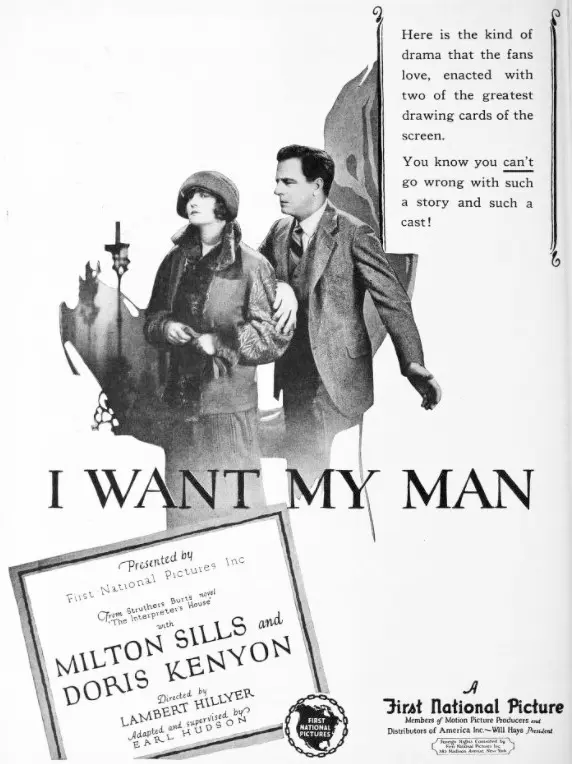
Visualizing the convergence of Lambert Hillyer's style and the core Romance narrative.
Gulian Eyre, an American soldier blinded in action during the World War, remains in France after the cessation of hostilities and marries his nurse, Vida. Gulian is later operated on by a skilled French surgeon and recovers his sight, only to find that Vida has left him and obtained a divorce. Gulian returns to his family in the United States and becomes engaged to Lael, a girl he had known before the war. During this time, Vida has also come to the United States and has become the companion of Gulian's mother. Gulian does not recognize Vida, whom he has never seen; in any event, she had told him that she was terribly disfigured in order to make him believe that she did not pity him. Gulian's wedding to Lael is halted when his brother-in-law kills himself after squandering the Eyre fortune. Lael soon breaks her engagement to the impoverished Gulian, who declares his love to Vida. Vida involuntarily reveals her identity, and Gulian's happiness is complete.
Decades after its release, I Want My Man remains a vital piece of the cinematic puzzle. Its influence can be seen in countless modern works, solidifying Lambert Hillyer's status as a master of the craft in United States and beyond.