
DbcultAccessing Vault...
Director's Spotlight
Senior Film Conservator
Director's Spotlight: United States
A Deep Dive into the 1920 Vision of Lawrence C. Windom
As a cultural artifact of the 1920s, The Truth provides the global recognition that Lawrence C. Windom garnered after the release of The Truth. Elevating the source material through Lawrence C. Windom's unique vision, it solidifies Lawrence C. Windom's reputation as a master of the craft.
In The Truth, Lawrence C. Windom pushes the boundaries of conventional narrative. The film's unique approach to its subject matter has sparked endless debates and interpretations among cinephiles and critics alike.
In this work, Lawrence C. Windom explores the intersection of Comedy and United States cultural identity. The meticulous attention to detail suggests a deep-seated commitment to pushing the boundaries of the medium, ensuring that The Truth remains a relevant topic of study for Comedy enthusiasts.
| Cinematography | Static |
| Soundtrack | Synth-Heavy |
| Editing | Disjunctive |
| Art Direction | Baroque |
Visualizing the convergence of Lawrence C. Windom's style and the core Comedy narrative.
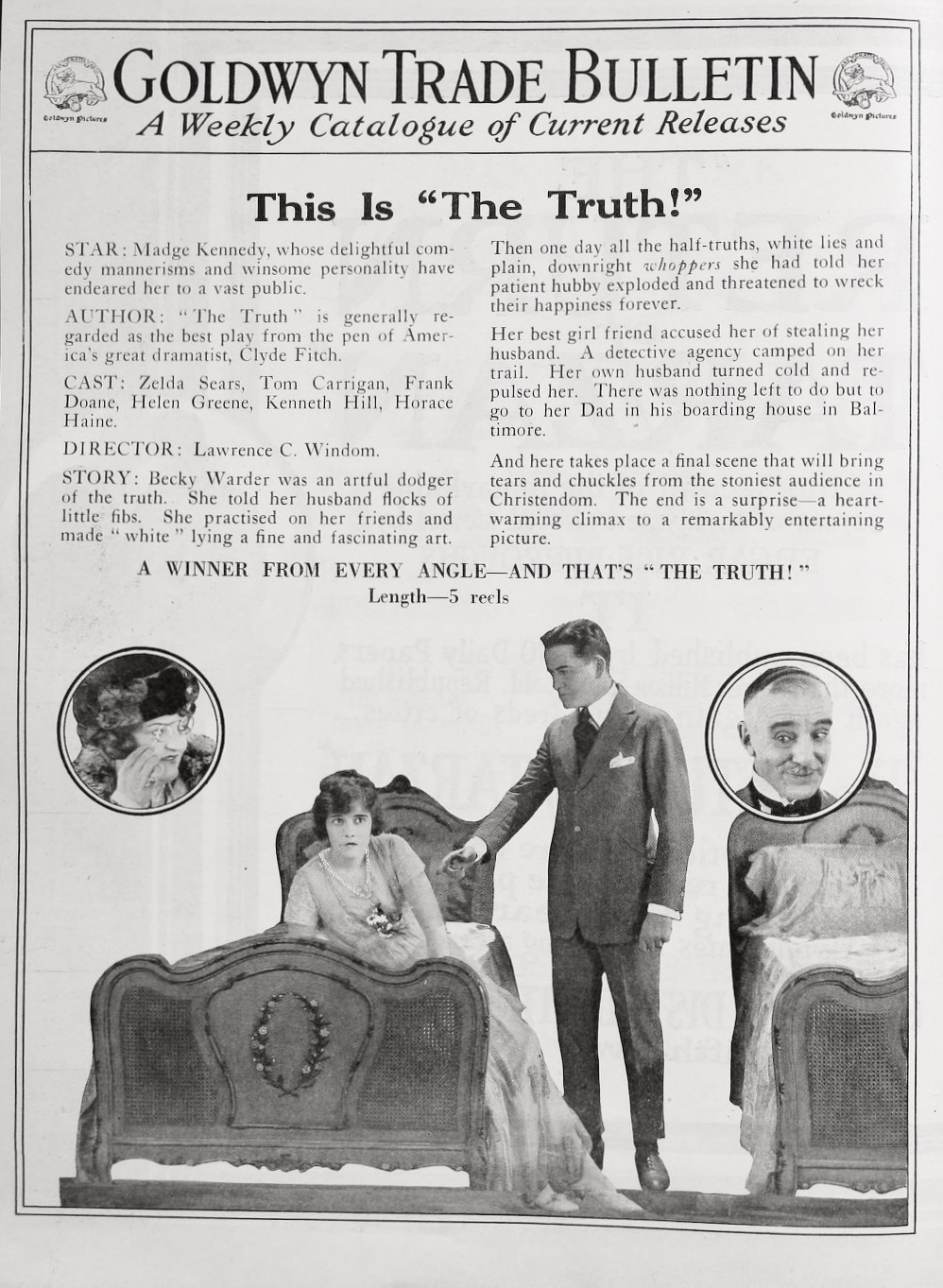
Becky Warder constantly indulges in the telling of little white lies. In an innocent effort to ease the troubled marriage of her quarreling friends Eve and Fred Lindon, Becky meets secretly with Fred, thereby constructing a web of deceit that leads Eve to suspect Becky of trifling with her husband's affections. Eve informs Becky's husband Tom of these meetings and Tom, suspicious, accuses his wife of infamy. After denying her participation in the matter, Becky goes to Baltimore to see her father Stephen Roland, who, like his daughter, is a schemer. Roland begins to construct an elaborate plan by which his daughter can win back her husband and so sends a false telegram to Tom notifying him that Becky is extremely ill. Rushing to Baltimore, Tom overhears Becky inform her father that she will not participate in any more lies, and, elated by his wife's reformation, Tom forgives her.
Decades after its release, The Truth remains a vital piece of the cinematic puzzle. Its influence can be seen in countless modern works, solidifying Lawrence C. Windom's status as a master of the craft in United States and beyond.