
DbcultAccessing Vault...
Director's Spotlight
Senior Film Conservator
Director's Spotlight: United States
A Deep Dive into the 1919 Vision of M. de la Parelle
Under the meticulous guidance of M. de la Parelle, Stripped for a Million became the cultural zeitgeist captured so perfectly by M. de la Parelle in 1919. Driven by an uncompromising commitment to cult excellence, it remains a vital reference point for anyone studying the evolution of M. de la Parelle.
In Stripped for a Million, M. de la Parelle pushes the boundaries of conventional narrative. The film's unique approach to its subject matter has sparked endless debates and interpretations among cinephiles and critics alike.
In this work, M. de la Parelle explores the intersection of cult and United States cultural identity. The meticulous attention to detail suggests a deep-seated commitment to pushing the boundaries of the medium, ensuring that Stripped for a Million remains a relevant topic of study for cult enthusiasts.
| Cinematography | Deep Focus |
| Soundtrack | Synth-Heavy |
| Editing | Disjunctive |
| Art Direction | Baroque |
Visualizing the convergence of M. de la Parelle's style and the core cult narrative.
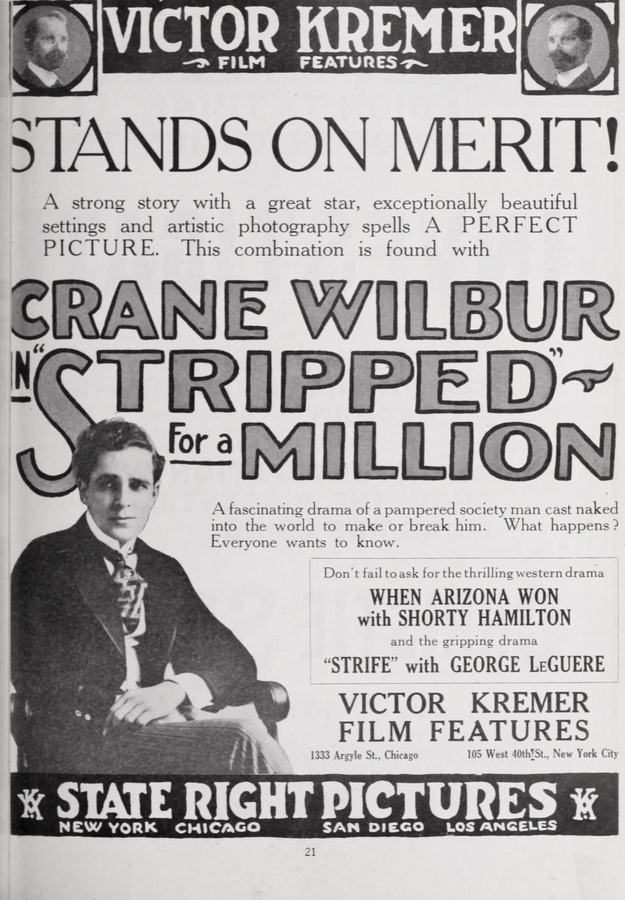
At his twenty-first birthday party, Stanley Warren learns that his inheritance has been stopped because of his spendthrift ways. According to his late uncle's will, to regain the fortune, Stanley must be stripped of all clothing, money, and food in the woods near his uncle's town, where, for a month, he must make an honest living without revealing his name. Orphan June Day, seeing Stanley covering himself with vines, brings him a blanket. Later, when Stanley is caught taking clothes from Judge Peabody's house, the judge's maiden sister, smitten with Stanley, persuades the judge to hire him as a servant. Stanley's identity is nearly revealed by the jealous suitor of his former fiancée, who left Stanley when he lost his fortune. Stanley then marries June, who has been expelled from her orphanage because of rumors spread by the judge's jealous sister, and reveals his true identity in the ceremony, thus losing the fortune. However, according to a codicil in the will, June now receives the money.
Decades after its release, Stripped for a Million remains a vital piece of the cinematic puzzle. Its influence can be seen in countless modern works, solidifying M. de la Parelle's status as a master of the craft in United States and beyond.