
DbcultAccessing Vault...
Director's Spotlight
Senior Film Conservator
Director's Spotlight: United States
A Deep Dive into the 1925 Vision of Mark Goldaine
In the grand tapestry of Comedy cinema, The Klynick serves as a bridge between the philosophical inquiries that Mark Goldaine embeds within the narrative. Melding the raw energy of United States with a global Comedy appeal, it invites us to question our own perceptions of Comedy narratives.
In The Klynick, Mark Goldaine pushes the boundaries of conventional narrative. The film's unique approach to its subject matter has sparked endless debates and interpretations among cinephiles and critics alike.
To fully appreciate The Klynick, one must consider the cinematic climate of 1925. During this period, United States was undergoing significant artistic shifts, and Mark Goldaine was at the forefront of this Comedy movement, often challenging established norms.
| Cinematography | Noir-Inspired |
| Soundtrack | Orchestral |
| Editing | Invisible |
| Art Direction | Kitsch |
Visualizing the convergence of Mark Goldaine's style and the core Comedy narrative.
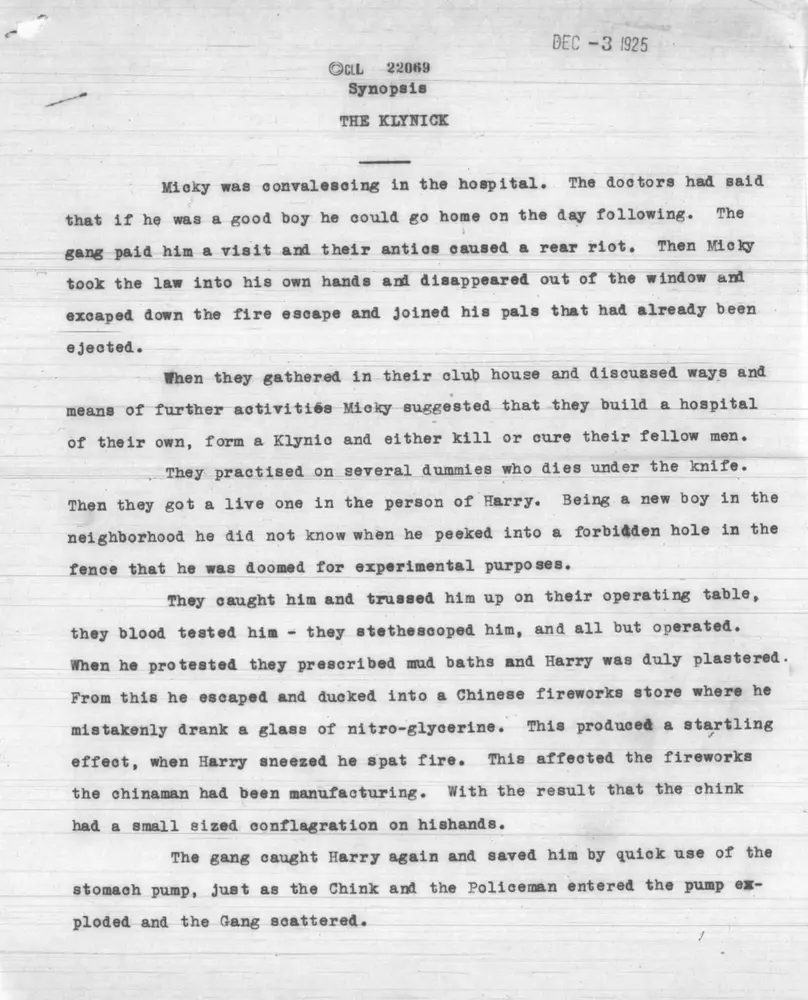
Mickey, convalescing in a hospital from a tummy ache brought on by an over-fondness for green apples, is visited by his pals who, after much roughhousing, enable him to escape. They get together and start a hospital of their own which they operate with indifferent success until a live victim turns up. They "go to work" on him until he escapes and gets into a fireworks manufacturing plant where he drinks a glass of nitroglycerin, immediately after which he is seized with a fit of sneezing which proves a combustible commodity as everything in sight goes up in a blaze. He goes back to the "hospital" and the "staff," using a stomach pump, succeeds in drawing off the explosive but it drops and scatters the gang.
Decades after its release, The Klynick remains a vital piece of the cinematic puzzle. Its influence can be seen in countless modern works, solidifying Mark Goldaine's status as a master of the craft in United States and beyond.