
DbcultAccessing Vault...
Director's Spotlight
Senior Film Conservator
Director's Spotlight: United States
A Deep Dive into the 1930 Vision of Murray Roth
Analyzing Believe It or Not #1 (1930) requires a deep dive into the unique directorial voice that Murray Roth brought to the screen. By challenging the status quo of 1930 cinema, it continues to spark endless debates among critics and cinephiles alike.
In Believe It or Not #1, Murray Roth pushes the boundaries of conventional narrative. The film's unique approach to its subject matter has sparked endless debates and interpretations among cinephiles and critics alike.
To fully appreciate Believe It or Not #1, one must consider the cinematic climate of 1930. During this period, United States was undergoing significant artistic shifts, and Murray Roth was at the forefront of this Short movement, often challenging established norms.
| Cinematography | Noir-Inspired |
| Soundtrack | Orchestral |
| Editing | Invisible |
| Art Direction | Kitsch |
Visualizing the convergence of Murray Roth's style and the core Short narrative.
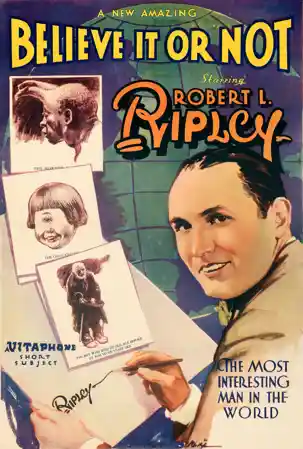
Robert L. Ripley shows the very first cartoon of his, published in newspapers 8 years earlier. He then proceeds with various oddities, first introducing a woman who can read aloud 8 words a second. He demonstrates this by giving her a 200-word tract she reads in 24 seconds. Next a woman telephones to question his assertion that you can walk through a hole in a cigarette paper, but he demonstrates how when she arrives. Other oddities follow, including a miniature bedroom set built in a bottle; statements that the biblical Abraham wasn't a Jew, but a Babylonian and that Einstein once flunked mathematics. He draws a picture of an African with a big projection growing out of his forehead and has a photograph to prove it. An animated sequence demonstrates how a porcupine fish can kill a shark. Finally, he brings out a small Chinese boy who sings "Hello Baby".
Decades after its release, Believe It or Not #1 remains a vital piece of the cinematic puzzle. Its influence can be seen in countless modern works, solidifying Murray Roth's status as a master of the craft in United States and beyond.