
DbcultAccessing Vault...
Director's Spotlight
Senior Film Conservator
Director's Spotlight: United States
A Deep Dive into the 1917 Vision of Paul Scardon
As we revisit the 1917 masterpiece Transgression, we are struck by the meticulous attention to detail that Paul Scardon applied to every frame. Anchored by a narrative that is both personal and universal, it bridges the gap between traditional cult and contemporary vision.
In Transgression, Paul Scardon pushes the boundaries of conventional narrative. The film's unique approach to its subject matter has sparked endless debates and interpretations among cinephiles and critics alike.
The visual language of Transgression is defined by its use of shadows and framing, a hallmark of Paul Scardon's style. By utilizing a 1917-era palette, the film creates an immersive experience that perfectly complements its cult themes.
| Cinematography | Static |
| Soundtrack | Diegetic |
| Editing | Rhythmic |
| Art Direction | Naturalist |
Visualizing the convergence of Paul Scardon's style and the core cult narrative.
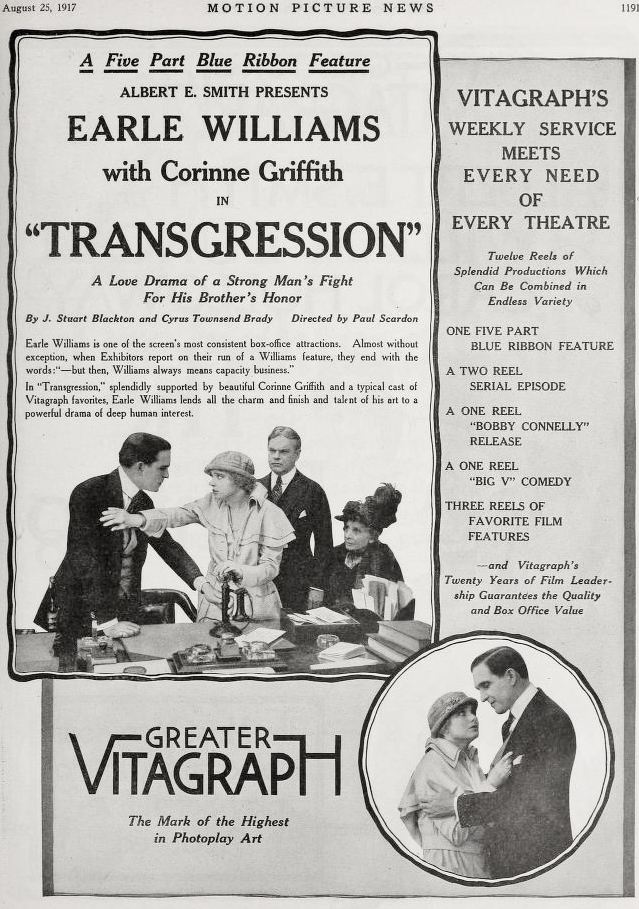
Hal Page, the weakling brother of Stephen Page, the town mayor, falls in love with Carline Shrefton, who throws over Burt Staley to entangle Hal in her self-serving schemes. Furious over her abrupt departure, Staley shows up at Carline's, and a jealous fight with Hal ensues in which Staley is shot and killed with Carline's gun. After Hal confesses to the deed, Stephen quietly sends him off to Spain. One year later, Stephen announces his engagement to Marion Hayward, the daughter of the district attorney, who is pressing charges against James Reed, a corrupt politician and Carline's new husband. To save Reed, Carline threatens Stephen with exposure, but he refuses to bend to her demands. Just days before Carline is to reveal her story about Staley, Hal appears and confesses to Hayward that Carline is the true killer. After verifying Hal's story, Hayward grills Carline, who finally admits her guilt. A matured Hal is restored to his family and Reed is sent away for his crimes.
Decades after its release, Transgression remains a vital piece of the cinematic puzzle. Its influence can be seen in countless modern works, solidifying Paul Scardon's status as a master of the craft in United States and beyond.